eBook - ePub
Narratives of Vulnerability in Mexico's War on Drugs
- English
- ePUB (mobile friendly)
- Available on iOS & Android
eBook - ePub
Narratives of Vulnerability in Mexico's War on Drugs
About this book
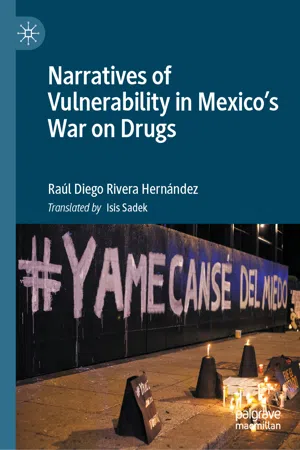
This book explores the current human rights crisis created by the War on Drugs in Mexico. It focuses on three vulnerable communities that have felt the impacts of this war firsthand: undocumented Central American migrants in transit to the United States, journalists who report on violence in highly dangerous regions, and the mourning relatives of victims of severe crimes, who take collective action by participating in human rights investigations and searching for their missing loved ones. Analyzing contemporary novels, journalistic chronicles, testimonial works, and documentaries, the book reveals the political potential of these communities' vulnerability and victimization portrayed in these fictional and non-fictional representations. Violence against migrants, journalists, and activists reveals an array of human rights violations affecting the right to safe transit across borders, freedom of expression, the right to information, and the right to truth and justice.
Information
Print ISBN
9783030511432
Subtopic
Giornalismo© The Author(s) 2020
R. Diego Rivera HernándezNarratives of Vulnerability in Mexico's War on Drugshttps://doi.org/10.1007/978-3-030-51144-9_11. Introduction. Vulnerability and Victimhood in Mexico’s War on Drugs: A Human Rights Crisis
Raúl Diego Rivera Hernández1
(1)
Department of Romance Languages and Literatures, Villanova University, Villanova, PA, USA
This book originates from a political urgency to understand the current human rights crisis that has been caused by the War on Drugs in Mexico. I study this crisis by focusing on three vulnerable populations that have felt the blunt impact of the War on Drugs: Central American migrants in transit to the United States of America (Chapter 2), journalists who report on violence in highly dangerous regions (Chapter 3), and the mourning relatives of victims of severe crimes, who take collective action by participating in human rights investigations and searching for their missing loved ones (Chapter 4). I discuss these communities by reading contemporary novels, journalistic chronicles, testimonial works, and documentaries. These analyses bring to light how all these fictional and nonfictional representations engage with vulnerable social groups affected by the violence wrought by the War on Drugs. They also capture the unique conditions of each of these communities, portraying their migratory status, professional activity, and the reasons why they decided to embrace as their own responsibilities that the state should and could not fulfill. Violence against migrants, journalists, and activists reveals an array of human rights violations affecting the right to safe transit across borders, freedom of expression and the right to information, and the right to truth and justice.
The three case studies in this book are part of a deeper and broader human rights crisis. In Mexico, this crisis is further aggravated by other forms of violence: internal displacement, the expansion of feminicidal violence, and a security policy that persecutes and criminalizes peasants, indigenous peoples, environmental and political activists. Within this framework of continuous violence against different vulnerable communities, I analyze forms of resistance by Central American migrants, journalists, and the relatives of the victims of extrajudicial executions and forced disappearances. I have selected these groups as a basis from which to discuss the War on Drugs as a “necropolitics” premised on different forms of control and administered by state and non-state actors. For example, territorial control ensures the development of a multimillion dollar economy centered on the business ensuing from clandestine migration. Or the control of information, which functions as a means of domination and shaping public opinion. Or social control by way of violent mechanisms of disciplining the population and in imposing multiple administrative steps to those who demand justice through official channels.
Scholars Alejandro Anaya Muñoz and Barbara Frey explain that the current human rights crisis in Mexico “is unfolding in the midst of a context of violence unparalleled in the country’s recent history” (2019, 2). Both argue that the main factors that contribute to this grave situation are the War on Drugs launched by former president Felipe Calderón Hinojosa (2006–2012) and the lack of accountability for human rights abuses (2019, 2–3). The lens of transitional justice offers a lucid perspective through which to comprehend this crisis. Transitional justice investigates the aftermath of war and mass atrocities by implementing judicial and nonjudicial measures to redress human rights violations. Since the early 1980s, “Latin America has been a pioneer in transitional justice mechanisms aimed at confronting the legacy of past military rule or internal armed conflict” (Skaar et al. 2016, 1). Although transitional justice studies have taken shape through the analysis of peace processes in post-conflict periods, as well as transitions from authoritarian regimes (typically military) to democratic projects, their framework provides useful tools for understanding the ongoing forms of violence and impunity in present-day Mexico (Angulo Nobara et al. 2018, 23–24). For example, the criteria established by transitional justice to characterize an individual as a victim of human rights abuses consider two features specific to the vulnerable groups studied in the book. The first one analyzes the severity of the crimes of forced disappearance, torture, and massacres (Angulo Nobara et al. 2018, 6) which have occurred in Mexico (Open Society 2016), especially along migratory paths (Inter-American Commission on Human Rights-IACHR 2013). The second principle highlights high-impact crimes—the murders of journalists, activists, and community leaders who defend human rights—that aim to either inhibit society or intimidate authorities with attacks on politicians and public servants (Angulo Nobara et al. 2018, 6).
Several reports have documented the failure of the Mexican state’s security policy, which was implemented during the Felipe Calderón administration, and which assigned the armed forces a central role in the fight against drug trafficking organizations (DTOs) and organized crime (Human Rights Watch 2011, 4; IACHR 2015, 11; Open Society 2016, 12). Instead of diminishing conflict, this security strategy had the opposite effect: “the government’s ‘war’ against criminal organizations added to the mix of armed violence carried out by the criminal organizations themselves” (Anaya Muñoz and Frey 2019, 2). As a direct or indirect result of this anti-drug campaign, 300,000 homicides have occurred in Mexico since 2006 (Lee et al. 2019). Mexico’s human rights crisis is further aggravated by the US-led War on Drugs to bolster its security through a broad hemispheric policy of securitization of borders (Vogt 2015). The failure of these two national and international security strategies are at the heart of the human rights crisis.
The cultural productions discussed in Narratives of Vulnerability in Mexico’s War on Drugs encompass a period that spans from the presidency of Felipe Calderón to the crisis of forced disappearances that emerged during President Enrique Peña Nieto’s administration (2012–2018). The War on Drugs was initiated in President Calderón’s native state of Michoacán where his administration launched Operativo Conjunto Michoacán (Joint Operation Michoacán) in 2006. This initiative gave permission to the country’s armed forces to unilaterally carry out missions related to public security and to combat DTOs. Journalist Marcela Turati explains that Calderón’s electoral campaign had never promised to launch a war against drug trafficking organizations (2011, 25). According to many political observers, the decision to involve the military in this security strategy was part of Calderón’s attempt to legitimize his administration in the eyes of voters and counter the shadow of fraud that lingered from the controversial 2006 presidential elections (Chabat 2010, 1; Morales Oyarvide 2011, 12; Vázquez Moyers and Espino Sánchez 2015, 494). However, in ¿Qué querían que hiciera? Inseguridad y delincuencia organizada en el gobierno de Felipe Calderón (2015; What did you want me to do? Insecurity and organized delinquency during the Felipe Calderón administration), sociologist Luis Astorga argues against this interpretation and notes that Calderón’s first military operation had the support of the influential Conferencia Nacional de Gobernadores (CONAGO; National Conference of Governors) (2015a, 23–24). The CONAGO’s support for Calderón’s initiative represents a generalized attitude of distrust among Mexican governors toward their own police forces. This stance illustrates how political elites, both at the state and municipal levels, hoped the military would take on the heavily armed groups that Mexico’s corrupt institutions had failed to counter.
However, instead of countering the violence that was gripping the country, the Joint Operations unwittingly contributed to a dramatic surge in human rights violations perpetrated by state and non-state actors. Calderón’s militarization transformed cities into battlefields, thereby increasing communities’ vulnerability and exposure to violence. In my readings of textual and audio-visual narratives drawn from a large volume of journalistic and cultural productions that respond to this state of things, I explore how they address the political potential of vulnerability. In other words, these works document victims’ capacity to adapt to these perilous scenarios and to define modes of resistance. Some of the aspects I focus on include the dangers that Central American migrants encounter in their irregular transit, as represented in literary works such as Alejandro Hernández’s Amarás a Dios sobre todas las cosas (You shall love god above all things, 2013), Antonio Ortuño’s La fila india (The indian file, 2013), and Emiliano Monge’s Las tierras a...
Table of contents
- Cover
- Front Matter
- 1. Introduction. Vulnerability and Victimhood in Mexico’s War on Drugs: A Human Rights Crisis
- 2. Vulnerabilities and Resistances in Transit: Narratives of Central American Colonial Transmigrants
- 3. “Nos están matando!”: Professional Reflexivity on Violence Against Mexican Journalists in Contemporary Chronicles
- 4. Dissident Mourners: Victims’ Political Participation in Human Rights Activism
- 5. Conclusion
- Back Matter
Trusted by 375,005 students
Access to over 1.5 million titles for a fair monthly price.
Study more efficiently using our study tools.
Frequently asked questions
Yes, you can cancel anytime from the Subscription tab in your account settings on the Perlego website. Your subscription will stay active until the end of your current billing period. Learn how to cancel your subscription
No, books cannot be downloaded as external files, such as PDFs, for use outside of Perlego. However, you can download books within the Perlego app for offline reading on mobile or tablet. Learn how to download books offline
Perlego offers two plans: Essential and Complete
- Essential is ideal for learners and professionals who enjoy exploring a wide range of subjects. Access the Essential Library with 800,000+ trusted titles and best-sellers across business, personal growth, and the humanities. Includes unlimited reading time and Standard Read Aloud voice.
- Complete: Perfect for advanced learners and researchers needing full, unrestricted access. Unlock 1.5M+ books across hundreds of subjects, including academic and specialized titles. The Complete Plan also includes advanced features like Premium Read Aloud and Research Assistant.
We are an online textbook subscription service, where you can get access to an entire online library for less than the price of a single book per month. With over 1.5 million books across 990+ topics, we’ve got you covered! Learn about our mission
Look out for the read-aloud symbol on your next book to see if you can listen to it. The read-aloud tool reads text aloud for you, highlighting the text as it is being read. You can pause it, speed it up and slow it down. Learn more about Read Aloud
Yes! You can use the Perlego app on both iOS and Android devices to read anytime, anywhere — even offline. Perfect for commutes or when you’re on the go.
Please note we cannot support devices running on iOS 13 and Android 7 or earlier. Learn more about using the app
Please note we cannot support devices running on iOS 13 and Android 7 or earlier. Learn more about using the app
Yes, you can access Narratives of Vulnerability in Mexico's War on Drugs by Raúl Diego Rivera Hernández, Isis Sadek in PDF and/or ePUB format. We have over 1.5 million books available in our catalogue for you to explore.