This book introduces blockchain technology applications in supply chains. Blockchain is a relatively new tool, nevertheless, there have been considerable advances over the last five years, and blockchain is now poised to revolutionize the conventional supply chains with the offering of accountability and quality to the wider complex supply networks.
Based on literature reviews and original research, this book serves as an essential introduction to blockchain and its applications in supply chain. The unique features of the book are empirical studies to demonstrate the application of blockchain technology in food, healthcare, manufacturing, transportation and retail sectors. Each chapter includes research framework and open research questions. Simple narration of concept and detailed insights from primary research information. Use case narrative will provoke the readers to demystify the myths in application of concepts in the supply chain . Overall, the book demystifies blockchain technology, reviews evolution and outlines its future applications by blending contents to meet the expectations of both academic and practice community.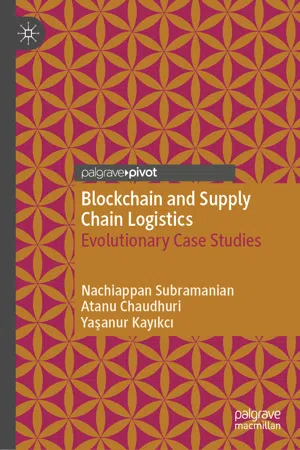
eBook - ePub
Blockchain and Supply Chain Logistics
Evolutionary Case Studies
- English
- ePUB (mobile friendly)
- Available on iOS & Android
eBook - ePub
Blockchain and Supply Chain Logistics
Evolutionary Case Studies
About this book
Information
© The Author(s) 2020
N. Subramanian et al.Blockchain and Supply Chain Logisticshttps://doi.org/10.1007/978-3-030-47531-4_11. Information System Evolution and Blockchain
Nachiappan Subramanian1 , Atanu Chaudhuri2 and Yaşanur Kayıkcı3
(1)
Brighton, UK
(2)
Durham, UK
(3)
Istanbul, Turkey
Yaşanur Kayıkcı
Abstract
Blockchain is the digital ledger used by the extended network to record activities along with the time stamp. The purpose of this chapter is to trace the information technology evolution and blockchain’s impact on supply chain. Overall, the chapter will enhance the understanding on potential research issues in supply chain, the status quo of blockchain applications and its limitations with the prescription of suitable theories and methods. Finally, the chapter concludes with open research questions. The major outcome of this chapter is to; (i) Understand the research opportunities in blockchain from supply chain perspective. (ii) Compare and contrast blockchain applications and limitations. (iii) List the major research questions in blockchain enabled digital supply chain.
Keywords
Information technologyEvolutionEnd-to-end supply chainBlockchain applicationsResearch directions1.1 Introduction
Information technology revolutionised logistics and supply chain and its contribution is substantial. Treiblmaier (2018) traced the information technology support in various stages starting from 1960. In late 60s and 70s progressive computation has been extensively used in logistics planning for randomized storage and to optimize inventory in managing warehouse and subsequently IT has been used to develop simplified route planning for trucks. In 1980 when personal computers emerged it has been used to support planning activities in logistics . Later in 1990, networking of computers and enterprise resource planning packages transformed linkages between companies and automated various process such as facilities to organize virtual meetings , tracking orders and order-deliver processing . As we all know in 2000 internet’s dominance substantially reconfigured supply chains on upstream and downstream members’ coordination activities. Typical activities are internet supported purchasing , computer aided relationship management and emergence of electronic market places . Later in 2010, IT becomes inseparable in logistics and supply chain ranging from product development , customer relationship management , computer aided manufacturing and radio frequency identification for tracking. Now in the digital era supply chain are gearing towards linking of enterprise resource planning across organizations in the tag of blockchains and embedding transparency in transactions of the end-to-end supply chain . From the above, we have seen the contribution of information technology to physical distribution , however, blockchain is completely reshaping the supply chain to encompass all the information and financial transactional activities.
According to Provenance (2015), blockchain enhances supply chain transparency by allowing every partner to access to information concerning the activities within the supply chain, such as providing customers with the ability to evaluate the products before making a decision. More specifically, blockchain is a distributed database that is based on cryptographic proof instead of trust, which allows two consenting parties to conduct a direct transaction between themselves instead of using an intermediary (Swan 2015; Pilkington 2015; Korpela et al. 2017). Thus, blockchain is a decentralized ledger recording all transaction information within a peer-to-peer (P2P) network to verify and authenticate (Arias and Shin 2013; Swan 2015). In blockchain, records and data are secure , traceable and auditable (Kouhizadeh and Sarkis 2018). The first Blockchain was conceptualized by Nakamoto, the founder of a digital currency Bitcoin (Nakamoto 2008). Blockchain alone does not utilize the advantages of the technology. Implementing emerging technologies with blockchain not only solves the visibility and traceability challenges in supply chain, but also facilitates connectivity and increases transparency . Blockchain technology can clearly be used in business to business (B2B) transactions , Internet of Things (IoT ) and machine-to-machine (M2M) integrations (Korpela et al. 2017). The world is getting more connected; therefore, organisations are placing billions of devices , sensors and actuators in their products and infrastructures. Therefore, IoT and blockchain technology integration is emerging, in the near future, blockchain systems will work solely with data automatically generated from physical IoT devices in the whole supply chain (Banker 2018; Rejeb et al. 2019). Moreover, combining blockchain’s distributed ledger framework with these applications and other emerging technologies such as smart mobile devices , artificial intelligence (AI) , augmented reality/virtual reality , edge cloud computing , RFID and 5G are especially important in autonomous decision making. Notably, blockchain, IoT, AI and 5G complement each other and could provide shared benefits in form of more reliable data , more secure transactions and auditable capabilities (Gartner 2019; Pavithran et al. 2020). This distributed ledger technology can have profound implications for supply chain sustainability (Kouhizadeh and Sarkis 2018). The fundamental of blockchain are explained in Chapter 2.
Overall, blockchain implications in supply chain is referred as an under-researched topic (Treiblmaier (2018). There is a possibility of applying blockchain technology in the logistics industry by allowing all participants to access information about what went into producing and ordering regarding a known product (Robinson 2016). At the same time, allowing every touchpoint in the supply chain to be tracked , recorded , which increases the supply chain information transparency (Brown 2016; Korpela et al. 2017).
1.2 Motivation
Recent studies are replete with finding and identifying improvements to the current challenges and limitations of blockchain (Swan 2015) as well as the security and privacy issues in blockchain (Aitzhan and Svetinovic 2016), but efforts related to the application of blockchain in different industries and its benefits and challenges are markedly insufficient and meagre. To overcome this a systematic literature review of block chain application has been carried out by...
Table of contents
- Cover
- Front Matter
- 1. Information System Evolution and Blockchain
- 2. Basics of Blockchain
- 3. Blockchain Applications in Food Supply Chain
- 4. Blockchain Applications in Health Care Supply Chain
- 5. Blockchain Applications and Future Opportunities in Transportation
- 6. Blockchain Applications in Retail Supply Chain
- 7. Blockchain Applications in Manufacturing Supply Chain
- 8. Blockchain Applications in Reverse Logistics
- Back Matter
Trusted by 375,005 students
Access to over 1.5 million titles for a fair monthly price.
Study more efficiently using our study tools.
Frequently asked questions
Yes, you can cancel anytime from the Subscription tab in your account settings on the Perlego website. Your subscription will stay active until the end of your current billing period. Learn how to cancel your subscription
No, books cannot be downloaded as external files, such as PDFs, for use outside of Perlego. However, you can download books within the Perlego app for offline reading on mobile or tablet. Learn how to download books offline
Perlego offers two plans: Essential and Complete
- Essential is ideal for learners and professionals who enjoy exploring a wide range of subjects. Access the Essential Library with 800,000+ trusted titles and best-sellers across business, personal growth, and the humanities. Includes unlimited reading time and Standard Read Aloud voice.
- Complete: Perfect for advanced learners and researchers needing full, unrestricted access. Unlock 1.5M+ books across hundreds of subjects, including academic and specialized titles. The Complete Plan also includes advanced features like Premium Read Aloud and Research Assistant.
We are an online textbook subscription service, where you can get access to an entire online library for less than the price of a single book per month. With over 1.5 million books across 990+ topics, we’ve got you covered! Learn about our mission
Look out for the read-aloud symbol on your next book to see if you can listen to it. The read-aloud tool reads text aloud for you, highlighting the text as it is being read. You can pause it, speed it up and slow it down. Learn more about Read Aloud
Yes! You can use the Perlego app on both iOS and Android devices to read anytime, anywhere — even offline. Perfect for commutes or when you’re on the go.
Please note we cannot support devices running on iOS 13 and Android 7 or earlier. Learn more about using the app
Please note we cannot support devices running on iOS 13 and Android 7 or earlier. Learn more about using the app
Yes, you can access Blockchain and Supply Chain Logistics by Nachiappan Subramanian,Atanu Chaudhuri,Yaşanur Kayıkcı in PDF and/or ePUB format, as well as other popular books in Business & E-Commerce. We have over 1.5 million books available in our catalogue for you to explore.