eBook - ePub
Electoral Pledges in Britain Since 1918
The Politics of Promises
- English
- ePUB (mobile friendly)
- Available on iOS & Android
eBook - ePub
Electoral Pledges in Britain Since 1918
The Politics of Promises
About this book
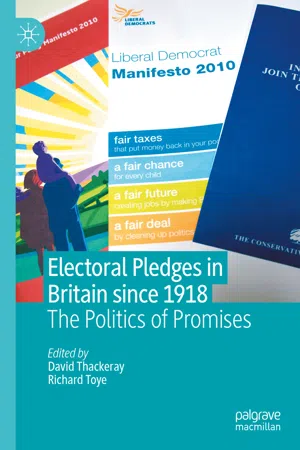
Nobody doubts that politicians ought to fulfil their promises – what people cannot agree about is what this means in practice. The purpose of this book is to explore this issue through a series of case studies. It shows how the British model of politics has changed since the early twentieth century when electioneering was based on the articulation of principles which, it was expected, might well be adapted once the party or politician that promoted them took office. Thereafter manifestos became increasingly central to electoral politics and to the practice of governing, and this has been especially the case since 1945. Parties were now expected to outline in detail what they would do in office and explain how the policies would be paid for. Brexit has complicated this process, with the 'will of the people' as supposedly expressed in the 2016 referendum result clashing with the conventional role of the election manifesto as offering a mandate for action.
Information
© The Author(s) 2020
D. Thackeray, R. Toye (eds.)Electoral Pledges in Britain Since 1918https://doi.org/10.1007/978-3-030-46663-3_2Election Promises and Anti-promises After the Great War
Luke Blaxill1
(1)
Hertford College, University of Oxford, Oxford, UK
Keywords
Text miningAnti-promiseGenderElection addressesPolitical partiesPromises made at election time are fascinating because they are the most explicitly contractual. Electors are asked to give votes to politicians in exchange for commitments (defined, vague, caveated, or otherwise) that are to be carried out in the coming elective term. The long-running debate on whether electoral mandates should be regarded as contractual—and whether and to what extent promises made during campaigns should be part of that contract—was arguably begun by Edmund Burke in his famous address to the electors of Bristol in 1774.1 In the course of the last two centuries, the expansion of the franchise from a tiny elite to universal suffrage has been accompanied by promises—and the implicit or explicit contract they create—becoming as ubiquitous an aspect of electoral culture as speeches, ballot papers, and canvassers.
While the growth of a culture of election promises has been noted by scholars, it has received little direct attention from historians.2 Most general accounts see the advent of modern political parties and keenly fought election campaigns as developments that made the explicit publication of menus of political promises—manifestoes—an inevitability. Accordingly, it was no surprise the first national manifesto (Joseph Chamberlain’s ‘Unauthorised Programme’) appeared in 1885: the first election fought after the political system had been democratically reforged by the 1883–85 reforms. Along similar lines, the political world ushered in by the twentieth century—dominated by a rapidly expanding state and the material tension between capital and labour—made it almost inconceivable by the mid-1920s that elections would not be dominated by promises of what rival parties would give and do if returned to office. This vague and generalised understanding of the origin and development of modern election promises seems particularly unsatisfactory when one considers that ‘pledge studies’ has been an established subfield in Political Science since the 1960s.3 This field—concerned with analysing how modern election commitments are judged by electors through objective ‘testability’ metrics of perceived fulfilment—does not consider when, or how, promises became part of the electoral landscape. Insofar as more general histories of late-nineteenth- and early-twentieth-century politics do discuss them, they do so overwhelmingly through the lens of national election campaigns and frontbench politicians. As a consequence, they overlook or entirely ignore the hundreds of constituency candidates up and down the country who almost certainly made—on behalf of themselves or their party in word or in print—most of the actual election promises.
In considering both the origin and development of the modern election promise in this key period of political change between 1885 and 1924, and the greater campaign in the 650–700 constituencies across the United Kingdom, it is easy to list numerous intriguing historical questions. For example, when did constituency candidates begin to make more political promises? Did the type of promises change, perhaps with a move away from softer commitments (indicating intent) to harder commitments (pledging action)? Were promises targeted at different groups of voters, particularly newly enfranchised groups such as agricultural labourers after 1885 or women after 1918? Was there a distinction between parties, perhaps with Labour candidates making more extensive promises, and Conservatives complaining that their opponents were making unrealistic and undeliverable pledges?
This study aims to shed light on some of these—and other—questions through a broad and macroscopic analysis of election promises from 1892, with a particular focus on the landmark ‘khaki’ election of 1918 held soon after armistice. Despite being the first election h...
Table of contents
- Cover
- Front Matter
- Introduction
- Election Promises and Anti-promises After the Great War
- The ‘Woman’s Point of View’: Women Parliamentary Candidates, 1918–1919
- ‘A Fighting Man to Fight for You’: The Armed Forces, Ex-Servicemen, and British Electoral Politics in the Aftermath of Two World Wars
- Broken Promises and the Remaking of Political Trust: Debating Reconstruction in Britain During the Second World War
- Fiscal Promises: Tax and Spending in British General Elections Since 1964
- The Introduction of Race and Immigration in British Post-Imperial Politics: The General Elections of 1964 and 1966
- The Electoral Promises of Winston Churchill
- ‘I Promise You This. I Won’t Make Empty Promises’. The Election Manifestos of Margaret Thatcher
- Custodians of the Manifesto: The Struggle over Labour’s Electoral Platforms, 1974–1983
- Thatcherism, the SDP and Vernacular Politics on the Isle of Sheppey, c. 1978–83
- The Promise of ‘Liberal Democracy’, c. 1981–2010
- ‘We made a pledge, we did not stick to it, and for that I am sorry’: The Liberal Democrats’ 2015 General Election Campaign and the Legacy of the Tuition Fees Debacle
- The Rhetorical Lives and Afterlives of Political Pledges in British Political Speech c. 2000–2013
- Back Matter
Trusted by 375,005 students
Access to over 1.5 million titles for a fair monthly price.
Study more efficiently using our study tools.
Frequently asked questions
Yes, you can cancel anytime from the Subscription tab in your account settings on the Perlego website. Your subscription will stay active until the end of your current billing period. Learn how to cancel your subscription
No, books cannot be downloaded as external files, such as PDFs, for use outside of Perlego. However, you can download books within the Perlego app for offline reading on mobile or tablet. Learn how to download books offline
Perlego offers two plans: Essential and Complete
- Essential is ideal for learners and professionals who enjoy exploring a wide range of subjects. Access the Essential Library with 800,000+ trusted titles and best-sellers across business, personal growth, and the humanities. Includes unlimited reading time and Standard Read Aloud voice.
- Complete: Perfect for advanced learners and researchers needing full, unrestricted access. Unlock 1.5M+ books across hundreds of subjects, including academic and specialized titles. The Complete Plan also includes advanced features like Premium Read Aloud and Research Assistant.
We are an online textbook subscription service, where you can get access to an entire online library for less than the price of a single book per month. With over 1.5 million books across 990+ topics, we’ve got you covered! Learn about our mission
Look out for the read-aloud symbol on your next book to see if you can listen to it. The read-aloud tool reads text aloud for you, highlighting the text as it is being read. You can pause it, speed it up and slow it down. Learn more about Read Aloud
Yes! You can use the Perlego app on both iOS and Android devices to read anytime, anywhere — even offline. Perfect for commutes or when you’re on the go.
Please note we cannot support devices running on iOS 13 and Android 7 or earlier. Learn more about using the app
Please note we cannot support devices running on iOS 13 and Android 7 or earlier. Learn more about using the app
Yes, you can access Electoral Pledges in Britain Since 1918 by David Thackeray, Richard Toye, David Thackeray,Richard Toye in PDF and/or ePUB format, as well as other popular books in History & British History. We have over 1.5 million books available in our catalogue for you to explore.