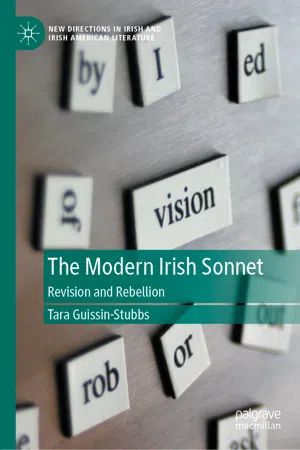
The Modern Irish Sonnet: Revision and Rebellion discusses how and why the sonnet appeals to Irish poets and has grown in popularity over the last century. Using a thematic approach, Tara Guissin-Stubbs argues for the significance of the Irish sonnet as a discrete entity within modern and contemporary poetry, and shows how the Irish sonnet has become a debating chamber for discussions concerning the relationship between Irish and British culture, poetry and gender, and revision and rebellion. The text reshapes the poetic and critical field, exploring canonical and non-canonical poems by male and female poets so as to challenge outmoded views of the thematic and formal limitations of the sonnet.
- English
- ePUB (mobile friendly)
- Available on iOS & Android
eBook - ePub
About this book
Information
© The Author(s) 2020
T. Guissin-StubbsThe Modern Irish SonnetNew Directions in Irish and Irish American Literaturehttps://doi.org/10.1007/978-3-030-53242-0_11. Introduction: The Modern Irish Sonnet
Tara Guissin-Stubbs1
(1)
Department for Continuing Education and Kellogg College, University of Oxford, Oxford, Oxfordshire, UK
I waver between poles of order and disorder, needing and loving both, trying to keep a precarious balance in a conflicted life. The sonnet may seem a tomb on which I try to carve words that sing of love and the desire to make it last. […] The sonnet confesses a limited faith in words written as epitaphs that may achieve, not immortality, but a resurrection of the love they express each time they are read.1
Mayo-born poet Richard Murphy’s extended commentary on the composition of his fifty-sonnet sequence The Price of Stone (1985) offers useful metaphors for the practice of sonnet-writing. Though Murphy’s stance tends to be more subjective, more autobiographically nuanced, than others’, his claims are analogous to theirs. For instance, in the introduction to their anthology The Making of a Sonnet (2008), Edward Hirsch and Eavan Boland describe the sonnet through a series of opposing factors: ‘[t]here is a sense of permanence and fragility, of spaciousness and constriction, about the sonnet form’.2 Some go so far as to claim that these apparently opposing ‘poles’ within the sonnet render it the form most representative of poetry in general. The poet and critic Jeff Hilson claims that he began to write sonnets out of his own ‘opposition’ to a form that has become, over time, ‘virtually a synecdoche for the poetic tradition itself, its most venerable and enduring object’. The hearing of ‘vulnerable’ behind ‘venerable’ is telling, as Hilson describes the desire of experimental poets to challenge the sonnet’s apparently ‘hegemonic’ dominance of poetic culture.3
Murphy’s claim that ‘[t]he sonnet may seem a tomb on which I try to carve words that sing of love and the desire to make it last’ sounds a note of fatalism that has echoed through the sonnet at least since P. B. Shelley’s ‘Ozymandias’. Shelley’s poem embeds a proclamation, carved on the ‘pedestal’ of a ‘shattered’ statue of a long-forgotten king, within a larger narrative concerning the arrogance of the artist who believes he might ‘last’: ‘“My name is Ozymandias, king of kings: / Look on my works, ye mighty, and despair!”’.4 Is Murphy’s almost-hopeful poet a fool? His evocation of ‘Ozymandias’ hints that this could be a possibility, both through ‘carving’ words upon a silent ‘tomb’ in a desperate bid to be heard, to make something ‘last’, and in the knowledge that by writing sonnets, he is stepping on hallowed ground. Murphy describes this position as ‘being no more than a poetic handyman, to adapt a structure perfected by consummate sonneteers’,5 so that throughout his commentary, ‘the sonnet’ appears to attain its own identity and power. In his essay ‘My Own Acquaintance’, meanwhile, Edward Hirsch claims of the sonnet that, ‘it worked on me before I worked on it’, noting: ‘[t]here was a kind of submission in it—a coping mechanism—that consoled me’.6 There is a tussle of wills between ‘the sonnet’ and the poet, to which the poet, eventually, acquiesces. But it is not the form alone that holds the power; it is the tradition, too. A. D. Cousins and Peter Howarth claim that ‘[t]oday the sonnet is probably the most widely read, taught, practised and written-about of lyrical forms’,7 but its most frequently-evoked models are white, western, and male—Petrarch, Shakespeare, Spenser, Wordsworth and Shelley to name a few. This state of play encapsulates the sonnet’s freedom and its restraints. Indeed, while Cousins and Howarth celebrate the form’s flexibility—claiming that it ‘has survived so long and across so many different cultures and audiences’ because ‘its internal checks and balances provide ready encouragement for anyone wanting to remake it in a manner more suitable to themselves’—they still acknowledge the ‘formal constraints’ of the sonnet, and its typical ‘association with sexual desire’.8 Though she has not given much attention to the sonnet form in particular, Lucy Collins has considered at length the position of contemporary women poets within the Irish tradition. In her book Contemporary Irish Women Poets, which focuses on ‘issues of tradition and innovation’ within the work of poets including Eavan Boland, Eiléan Ní Chuilleanáin, Medbh McGuckian, Catherine Walsh and Vona Groake, Collins notes: ‘[i]n light of the evolving role for women in Irish culture, their poetic mediation of the past is of considerable significance. It has also deepened our scrutiny of the relationship between the politics of writing and its forms’. This ‘poetic mediation’ involves an engagement with temporal and textual history. As Collins argues, ‘[a]ll these women acknowledge poetic precursors and their work engages with earlier poems—their own and the work of others—in ways that constitute acts of textual memory’.9 Collins’s arguments interlace with Amy Billone’s in her study of the nineteenth-century women’s sonnet in England. Arguing that ‘poets enter and exit the canon for reasons more complex than their gender alone’, Billone concedes nevertheless that poets such as Charlotte Smith, Elizabeth Barrett and Christina Rossetti ‘have suffered if not from the absence of recognition than from unfortunate acts of critical misrecognition’.10 Putting the pieces back together requires a creative engagement with the past, acknowledging that gender tells just one part of a complex narrative.
The present study focuses on what might be termed the modern Irish poetic tradition—moving from around 1900 to the present day, and book-ended by W. B. Yeats, Louis MacNeice and Patrick Kavanagh, and Paul Muldoon, Richard Murphy, and David Wheatley, as well as women poets Leontia Flynn, Paula Meehan, Vona Groarke and Mary O’Malley. In focusing on these writers’ use of the sonnet, in correspondence with past and present practitioners, it is fruitful to consider the ways in which sonnets perform ‘acts of textual memory’ in their formal and thematic responses to the sonnet tradition. This enables a consideration of the two ‘poles’ of sonnet criticism: the first, that it connotes ‘order’; and the second, that the challenge to this order propels the modern writer towards innovation.
Wherever we discover innovation within contemporary responses to the sonnet we almost always encounter simultaneously a reverence for the form. Debates about ‘sincerity’ have raged within the sonnet in English at least since the mid-seventeenth century, when it fell out of vogue thanks to its perceived performative qualities. Joseph Phelan demonstrates how advocates of the sonnet in the early 1800s tried to reshape it as an ‘organic’ form:
As a conventional and arbitrary form it runs counter to the prevailing belief in the necessity of an organic connection between form and content, leading to a series of attempts to ‘organicise’ the form and demonstrate its indissoluble connection with certain stages of mind and feeling. Again, as a form proverbial for its insincerity it seems to conflict with the very strong post-romantic emphasis on sincerity as a criterion of poetic value, and the result of this conflict is a sustained endeavour to position the sonnet as the most sincere and personal of poetic forms[.]11
For someone like Murphy, the sonnet needs to be understood (or refashioned) as ‘the most sincere and personal of poetic forms’, in order th...
Table of contents
- Cover
- Front Matter
- 1. Introduction: The Modern Irish Sonnet
- 2. Art and Artifice
- 3. Sonnet Sequences
- 4. Conversation
- 5. The Domestic
- 6. The Amatory Sonnet
- 7. Conclusion
- Back Matter
Trusted by 375,005 students
Access to over 1.5 million titles for a fair monthly price.
Study more efficiently using our study tools.
Frequently asked questions
Yes, you can cancel anytime from the Subscription tab in your account settings on the Perlego website. Your subscription will stay active until the end of your current billing period. Learn how to cancel your subscription
No, books cannot be downloaded as external files, such as PDFs, for use outside of Perlego. However, you can download books within the Perlego app for offline reading on mobile or tablet. Learn how to download books offline
Perlego offers two plans: Essential and Complete
- Essential is ideal for learners and professionals who enjoy exploring a wide range of subjects. Access the Essential Library with 800,000+ trusted titles and best-sellers across business, personal growth, and the humanities. Includes unlimited reading time and Standard Read Aloud voice.
- Complete: Perfect for advanced learners and researchers needing full, unrestricted access. Unlock 1.5M+ books across hundreds of subjects, including academic and specialized titles. The Complete Plan also includes advanced features like Premium Read Aloud and Research Assistant.
We are an online textbook subscription service, where you can get access to an entire online library for less than the price of a single book per month. With over 1.5 million books across 990+ topics, we’ve got you covered! Learn about our mission
Look out for the read-aloud symbol on your next book to see if you can listen to it. The read-aloud tool reads text aloud for you, highlighting the text as it is being read. You can pause it, speed it up and slow it down. Learn more about Read Aloud
Yes! You can use the Perlego app on both iOS and Android devices to read anytime, anywhere — even offline. Perfect for commutes or when you’re on the go.
Please note we cannot support devices running on iOS 13 and Android 7 or earlier. Learn more about using the app
Please note we cannot support devices running on iOS 13 and Android 7 or earlier. Learn more about using the app
Yes, you can access The Modern Irish Sonnet by Tara Guissin-Stubbs in PDF and/or ePUB format, as well as other popular books in Literature & European Literary Criticism. We have over 1.5 million books available in our catalogue for you to explore.