At the St. James's Theatre in London between 1891 and 1918, through a range of strategies including the support of new writers, and adaptation of fiction to the stage, Alexander sustained professional status through practices that continue to be reflected in the cultural industries today. A range of evidence is employed including production reviews, anecdotal accounts, financial records, and personal correspondence, to reveal how he operated as a business entrepreneur as well as an artistic innovator.
- English
- ePUB (mobile friendly)
- Available on iOS & Android
eBook - ePub
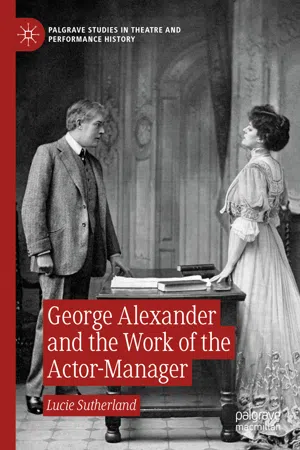
George Alexander and the Work of the Actor-Manager
About this book
In the first book-length study of the work and legacy of West End actor-manager George Alexander since the 1930s, George Alexander and the Work of the Actor Manager examines the key part this figure played in presenting new drama by authors including Oscar Wilde and Henry James. The book sheds new light on the figure of the actor-manager, assessing in detail the influence of Alexander within and beyond his time.
Information
Subtopic
Entertainment Industry© The Author(s) 2020
L. SutherlandGeorge Alexander and the Work of the Actor-ManagerPalgrave Studies in Theatre and Performance Historyhttps://doi.org/10.1007/978-3-030-40935-7_11. Introduction
Lucie Sutherland1
(1)
University of Nottingham, Nottingham, UK
Keywords
Actor-managerAnecdoteDavid GarrickTreasury BookW. Macqueen-PopeWest EndA St. James’s Theatre opened in 2012; the first newly constructed theatre in central London for more than thirty years, the building was funded entirely by private investment. With both a main house and a studio space, as well as a preference for new work or short-running revivals, the theatre aimed to set itself apart from the long-running and spectacular repertoire most often found within the West End. This St. James’s was overwritten in 2017 when the venue was acquired by the Really Useful Group and renamed The Other Palace, providing an arena for the entertainment corporation and its figurehead, Andrew Lloyd Webber, to trial new material. Although the space is situated beyond the arena marked out on Westminster City Council street signs as ‘Theatreland’, this is now one of many sites contributing to the West End, an urban environment associated with fashionable and commercially viable entertainment, which, although never precisely defined as a location , is commonly understood to be a district bounded by the Strand, Kingsway, Oxford Street and New Bond Street.1
Private investment and rapid assimilation as a West End venue echoes the trajectory of an earlier St. James’s Theatre that existed from 1835 until 1957 on King Street to the south of Piccadilly Circus. That new theatre was financed by tenor John Braham, who in 1835 secured a licence for a venue promising musical entertainment, but resistance to a permanent theatre space on King Street—barely within the West End arena described earlier, but on the border of the prestigious Mayfair—was pronounced. Petitions were sent to the Lord Chamberlain from local residents and, significantly, from managers at the nearby Haymarket, and the older London patent theatres of Drury Lane and Covent Garden. That resistance signalled that the St. James’s was a competitor and also a disruptive presence, bringing a cross-class pleasure-seeking audience into proximity with the residents of Mayfair. Unease was subsumed over time though, as the St. James’s was rapidly accommodated within a growing body of venues offering theatrical entertainment.
An equal proximity to both the West End and to Mayfair provided the potential for exclusivity to become a defining marker of the theatre, for example during the tenure of impresario John Mitchell, from 1842 until 1854, when it frequently housed French theatre or opera companies and leading performers from Paris, including Rachel and Regnier. However, the actor-manager who held the lease to the venue for the longest period of time also consolidated the exclusive St. James’s brand in the most extreme and explicit fashion. George Alexander leased the theatre from 1891 until his death in 1918; he produced a repertoire of new English drama aimed at sustaining and promoting management, work that was at home on the borders of Mayfair, abiding by the strictures of the censor. During this time fourteen new theatres were licensed by the Lord Chamberlain and built within the West End.2 As the number of competing venues rose, managers including Alexander had to revise their commercial practices and capitalise upon their specific appeal; their theatres effectively became brands encouraging audience, or customer, loyalty. George Alexander and the Work of the Actor-Manager will establish how he worked at the St. James’s to both survive within and to mould the West End theatre industry , influencing this prominent entertainment district beyond the end of his career and lifetime.
When that St. James’s Theatre was demolished in 1957, Laurence Olivier, who with Vivien Leigh campaigned to save the building, continued to link the venue to Alexander and his work; Olivier noted that in the theatre he was ‘struck by a feeling, most likely bred and inculcated by Sir George Alexander—the renowned actor-manager who brought fame to the St. James’s—that this was a theatre for gentle folk’.3 Even during the post-war development of Mayfair and the West End, the residual traces of a theatre maker who came to prominence at the end of the nineteenth century continued to haunt repertoire, with references by eminent actors and the influence of Alexander upon the work of prominent twentieth-century theatre makers like Nigel Playfair and May Whitty—who worked within the St. James’s company—extending his influence and continuing to shape mainstream theatre. This is one example of ‘ghosting’ as defined by Marvin Carlson, of ‘something coming back in the theatre, and so the relationships between theatre and cultural memory are deep and complex’.4 Alexander was one of the final generation of actor-managers—whose origins lay in the newly commercial early modern stage which premiered work by Shakespeare, Marlowe and their contemporaries—and ‘something coming back’ is an apt definition. As commercial production companies came to dominate West End theatre in the early decades of the twentieth century, there was no direct continuation of practice, but the frequent re-emergence of characteristics found within the actor-manager system. So, for example, prominent actors including Olivier and Kenneth Branagh have taken up residency in West End theatres for a significant period of time, presenting work in which they have starred, playing on an assumed ‘cultural memory’ of the actor-manager tradition on the part of West End audiences. Within the subsidised sector, the coordination of repertoire and funding by an artistic director is also comparable to some of the work undertaken by the actor-manager.
Defining the Actor-manager
The actor-manager figure developed from the practice, in the early modern period, of actors leasing or building sites for performance, a notable example being the Burbage brothers, both actors, and major shareholders in the Globe Theatre from 1599, with Richard Burbage as the prominent actor and manager at this venue where many Shakespeare plays premiered. The role was recuperated in the Restoration period, when under the patent system—in theatres licensed to stage spoken drama—it was common practice to combine a primary creative role at a venue with management of that venue. Thomas Killigrew and William Davenant, the two men given a royal patent to present public theatre performances after the Restoration of the monarchy in 1660, were dramatists, but actors took on a managerial role with increasing frequency throughout the eighteenth and nineteenth centuries. The tenure of David Garrick as actor and manager at the Theatre Royal Drury Lane from 1747 until 1776 was a key marker in his work to consolidate theatre as reputable environment and profession.5 The esteem afforded to this industry professional was endorsed through the establishment of the Garrick Club in 1831, a forum that worked to consolidate acting as a respected line of work, providing a space where ‘actors and men of refinement and education might meet on equal terms’.6 Acceptance into this Club was a marker of prestige, and Alexander was admitted on 2 January 1886, proposed by John Hare, and seconded by Henry Irving. The model demonstrated by Garrick, conjoining prominence as an actor not only with management, but with management of a single London venue over a long period of time, became the ideal for industry leaders. While reflected in regional and touring theatre, here the focus remains with a prominent actor-manager within the West End, as the hub for the English theatre industry since the origins of the actor-manager system.
Funding of managerial enterprises often occurred through discreet networks of fraternal investment and support, facilitated by institutions like the Garrick Club, which explains, to a significant extent, the difficulty experienced by women in entering management. While there are some notable examples of actress-managers in London theatre during the nineteenth and early twentieth centuries, including Eliza Vestris at the Olympic (1830), Marie Wilton at the Prince of Wales (1865), and Lena Ashwell at the Savoy (1906) and then the Kingsway (1907), actor-managers dominated in the West End sphere. Alexander is a representative of the last generation of this type of actor-manager, and a representative who first staged what is now the most frequently revived play of that era, The Importance of Being Earnest (1895). The first decade of the twentieth century saw the dissolution of the actor-manager system, but the term continued to be employed; for example, Olivier himself was often referred to as actor-manager during his time as director of Chichester Festival Theatre (1962–1965), and as first artistic directed for the National Theatre (1962–1973). However, while the phenomenon of a renowned figurehead at a venue survives, the actor-manager system did not progress beyond the first decades of the twentieth century. Looking at the tributes paid to the final generation of this older actor-manager type, it is apparent that altering production practices and an acute rise in the expense of leasing London venues prohibited their kind of work. So much so, that the obituary for Arthur Bourchier in 1927 actually began with reference to his exceptional position in London theatre by that time:
The death of Mr. Arthur Bourchier, which we record on another page, removes from the stage one of the last of the old school of actor-managers. He was proud to claim that he was the only London actor-manager having his own theatre (The Strand) and working without a syndicate or a financial partner.7
The Example of George Alexander
The following study of Alexander therefore aims to examine key p...
Table of contents
- Cover
- Front Matter
- 1. Introduction
- 2. George Alexander and the St. James’s ‘Brand’
- 3. The Actor-Manager System: Autonomy and Collaboration
- 4. The Actor-Manager System: The Role of the Playwright
- 5. Managing Risk: Cross-sector Adaptation
- 6. The Legacy of Alexander at the St. James’s Theatre
- Back Matter
Trusted by 375,005 students
Access to over 1.5 million titles for a fair monthly price.
Study more efficiently using our study tools.
Frequently asked questions
Yes, you can cancel anytime from the Subscription tab in your account settings on the Perlego website. Your subscription will stay active until the end of your current billing period. Learn how to cancel your subscription
No, books cannot be downloaded as external files, such as PDFs, for use outside of Perlego. However, you can download books within the Perlego app for offline reading on mobile or tablet. Learn how to download books offline
Perlego offers two plans: Essential and Complete
- Essential is ideal for learners and professionals who enjoy exploring a wide range of subjects. Access the Essential Library with 800,000+ trusted titles and best-sellers across business, personal growth, and the humanities. Includes unlimited reading time and Standard Read Aloud voice.
- Complete: Perfect for advanced learners and researchers needing full, unrestricted access. Unlock 1.5M+ books across hundreds of subjects, including academic and specialized titles. The Complete Plan also includes advanced features like Premium Read Aloud and Research Assistant.
We are an online textbook subscription service, where you can get access to an entire online library for less than the price of a single book per month. With over 1.5 million books across 990+ topics, we’ve got you covered! Learn about our mission
Look out for the read-aloud symbol on your next book to see if you can listen to it. The read-aloud tool reads text aloud for you, highlighting the text as it is being read. You can pause it, speed it up and slow it down. Learn more about Read Aloud
Yes! You can use the Perlego app on both iOS and Android devices to read anytime, anywhere — even offline. Perfect for commutes or when you’re on the go.
Please note we cannot support devices running on iOS 13 and Android 7 or earlier. Learn more about using the app
Please note we cannot support devices running on iOS 13 and Android 7 or earlier. Learn more about using the app
Yes, you can access George Alexander and the Work of the Actor-Manager by Lucie Sutherland in PDF and/or ePUB format, as well as other popular books in Media & Performing Arts & Entertainment Industry. We have over 1.5 million books available in our catalogue for you to explore.