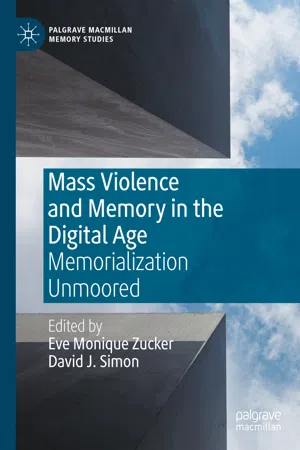
This volume explores the shifting tides of how political violence is memorialized in today's decentralized, digital era. The book enhances our understanding of how the digital turn is changing the ways that we remember, interpret, and memorialize the past. It also raises practical and ethical questions of how we should utilize these tools and study their impacts. Cases covered include memorialization efforts related to the genocides in Rwanda, Cambodia, Europe (the Holocaust), and Armenia; to non-genocidal violence in Haiti, and the Portuguese Colonial War on the African Continent; and of the September 11 attacks on the United States.
eBook - ePub
Mass Violence and Memory in the Digital Age
Memorialization Unmoored
- English
- ePUB (mobile friendly)
- Available on iOS & Android
eBook - ePub
Mass Violence and Memory in the Digital Age
Memorialization Unmoored
About this book
Information
© The Author(s) 2020
E. M. Zucker, D. J. Simon (eds.)Mass Violence and Memory in the Digital AgePalgrave Macmillan Memory Studieshttps://doi.org/10.1007/978-3-030-39395-3_7Teaching and Learning in Virtual Places of Exception: Gone GITMO and the Guantánamo Bay Museum of Art and History
Cathlin Goulding1
(1)
Hunter College, The City University of New York, New York, NY, USA
Cathlin Goulding
Keywords
Place of exceptionGuantánamoEmergency politicsDesign thinkingSecond lifeOnline museumsDigital simulationsIntroduction: The First Glimpse
In January 2002, the first photographs of the Guantánamo Bay detention camp were released for public viewing. Taken by US Navy photographer Shane T. McCoy and released by the Pentagon, the photos showed the newly constructed Camp X-Ray, a makeshift prison designed to hold suspected terrorists rounded up in some of the first military campaigns in Afghanistan. In them, the world saw Guantánamo’s new arrivals for the first time: orange uniform-clad prisoners, arms shackled, and blindfolded, kneeling in the gravel as U.S. soldiers hovered above their bent bodies. One photograph showed a prisoner being dragged toward a staunch line of waiting soldiers. Behind the prisoners, the camp was gridded by chain-linked fences, rocky pathways, and spiky coils of barbed wire. With the release of these images, Guantánamo was no longer simply a geographic locale or a noun in a White House press release. It became a symbol of the confusion and panic of our post-9/11 world, embodying both dismay for the treatment of the prisoners and relief at a seemingly quarantined threat. It was a place where our political leanings and anxieties played out contradictorily and without remittance.
These early photographs of Guantánamo were among the most prominent visual renderings of the extensions of state power in a post-9/11 world. But while these extensions played out trenchantly in the treatment of Guantánamo’s detainees, they also, often invisibly, exerted effects on the daily lives of the American public. Increased surveillance of those suspected of terrorist activities, close monitoring of telephone calls and emails, and the creation of new bureaucratic bodies to manage airport and border security were among the multitude of policies and practices created under the Bush administration and rationalized in the name of a seeming national emergency. For the most part, public debate was silenced in the name of acting swiftly for the sake of public safety. In the post-9/11 climate of widespread panic and fear, the argument that we needed to take immediate and aggressive action was one easily made. Secrecy and tightly controlled decision-making processes replaced open deliberation. Soon such measures which were once abnormal and temporary became “part of the taken-for-granted world of ‘how things are’… influencing how we perceive and talk about everyday life, including mundane as well as significant events” (Linke and Smith 2009, 64). In the 13 years since 9/11, as Mark Danner (2011) writes in The New York Review of Books, we have existed in a “subtly different country, and though we have grown accustomed to these changes and think little of them now, certain words still appear often enough in the news—Guantánamo, indefinite detention, torture—to remind us that ours remains a strange America” (para. 2). The normalization and broad acceptance of such mechanisms poses a real challenge and mandate to create forums that stimulate a public response, one that, like the release of Camp X-Ray’s photos, works as a kind of “shock” to public consciousness and provides a jolting reminder that we do in fact live in a “strange America.”
A number of individuals and organizations have provoked these jolts of consciousness through their engagements with heightened national security post-9/11, many of which have had a significant impact on public consciousness. Journalists, filmmakers, activists, and artists have created forums and works of art that subvert the argument that extralegal practices during times of heightened national security are necessary and lawful. Films like Taxi to the Dark Side (Blumenthal and Gibney 2007), WikiLeaks’ (2011) release of classified documents on Guantánamo’s detainees, and former National Security Administration (NSA) contractor Edward Snowden’s revelations about the NSA’s telephone and internet surveillance programs (Gellman 2013) are but a few examples of the potent efforts to defy the much-propagated image of post-9/11 security initiatives as safeguards that are limited in scope and “clean” (Van Veeren 2013). These mediums and media appear to effectively foment public outrage and awareness. However, it is unclear whether these forums, despite their availability, push the US public to wrestle with our vulnerability to the same extralegalities to which Guantánamo’s prisoners are bound. How do we, then, process and think through the notion that Guantánamo is not an instance of things that happen to other people but is one mechanism of a larger structure of state power that increasingly exerts its effects on us all?
Locating Guantánamo in Virtual Place
Located on a 45-square mile spread in Cuba, the site has operated as a US naval base since 1903, when Cuba and the United States entered into a perpetual lease agreement that permitted its sole jurisdiction and control over the area. The base was subsequently converted into a detention camp for Haitians and Cubans seeking asylum in the 1990s, which prepared the space for its present function as a repository for “unlawful combatants,” most held without charge or trial (Johns 2005; “Reporter reflects On Obama’s stalled effort to close Guantánamo” 2014). Soon after September 11, 2001, inmates—persons suspected of terrorist activity and arrested in military campaigns in Afghanistan—were brought to Guantánamo’s Camp X-Ray, the temporary outdoor prison space that soon gave way to a “state of the art” prison facility named Camp Delta.
At the time of this writing, GITMO holds 40 detainees, with approximately 780 persons detained over the course of its operations. Despite promises from the Obama administration, GITMO remained open. The complicated process of repatriation to their former home countries has slowed the transfer of “low-threat” prisoners. In January 2018, President Donald Trump signed an executive order to maintain the prison’s operations, later asking Congress in his State of the Union address “to continue to have all necessary power to detain terrorists” (Neuman 2018, para 3).
Guantánamo’s critics consider the prison as indicative of a “state of exception,” or a legal climate put into effect when the normal legal order is suspended, and new policies, practices, and structures are folded into the legal order by an executive body, often in the name of national security or emergency (Danner 2011; Hussain 2007). This broad outline of the state of exception originates with the German political philosopher and jurist Carl Schmitt (1922), who argued the survival of the state depends on its capacity to target and eliminate an “enemy” who poses a threat to the state’s territories. In cases of “extreme peril, [which constitute] a danger to the existence of the state” (Schmitt 1922, 6), the state’s sovereign power puts the existing legal order aside and institutes a state of exception. The theory of a state of exception was expansively reconsidered by the continental political philosopher Giorgio Agamben (1998, 1999, 2005). In Agamben’s formulation, an executive authority determines whose life is worth living and who will be abandoned by the polity, left to persist in a suspended state between life and death, inclusion and exclusion.
The state of exception is, however, more than a legal concept or analytic construct. It materializes in the concentration camp, in prisons, or in other kinds of buildings that exclude and hold persons during times when exceptional laws and practices become the norm. What happens when these places of exception become places for teaching and learning? When visitors enter and walk through these places, they take in the outlines and shape of the landscape, the architectures, and constraints of the built environment. They immerse in the palpable sensations of a prison camp, exposed to the stories and memories of those who were incarcerated while being in the actual site.
As Guantánamo stretches the limitations of intelligibility, so does the pedagogical challenge it poses in representing the “bare lives” (Agamben 1998) that inhabit its environs. Deborah Britzman (1998) describes a “difficult knowledge” in which the learner must “engage in the limit of thought—where thought stops, what it cannot bear to know, what it must shut out to think as it does” (156). In yet another line of thinking, Elizabeth Ellsworth’s (2005) body of work on outside-of-school pedagogy instructively posits structures of thinking and feeling that allow learning the unbearable. According to Ellsworth, “anomalous” places for learning—such as public art, memorial sites, and museums—“invite sensations of being somewhere in between thinking and feeling, of being in motion through the space and time of learning as a lived experience with an open, unforeseeable future” (Ellsworth 2005, 17).
In this chapter, I examine two virtual materializations of the prison at Guantánamo Bay, Cuba: Gone Gitmo and the Guantánamo Bay Museum of Art and History. In 2007, journalist and filmmaker Nonny de la Peña and the media artist Peggy Weil created Gone Gitmo, a virtual re-creation of Guantánamo in a platform called Second Life. In this blazingly colorful digital replica of Guantánamo, visitors could experience the prison “first-hand” on the web. A few years later, in 2012, the Guantánamo Bay Museum of Art and History, a web-based art museum premised on the imaginary closure of the prison, opened its digital doors. The website features the work of several artists who respond to the prison via mixed-media, photography, and art installations. It also provides articles and other educational materials, as well as detailing a speculative hi...
Table of contents
- Cover
- Front Matter
- Introduction: Mass Violence and Memory in the Digital Age—Memorialization Unmoored
- Memorialization in Rwanda: The Legal, Social, and Digital Constructions of the Memorial Narrative
- Breaking the Silence: Memorialization and Cultural Repair in the Aftermath of the Armenian Genocide
- Let Them Speak: An Effort to Reconnect Communities of Survivors in a Digital Archive
- (Re)Producing the Past Online: Oral History and Social Media–Based Discourse on Cambodian Performing Arts in the Aftermath of Genocide
- From the Material to the Digital: Reflections on Collecting and Exhibiting Grief at the 9/11 Memorial Museum
- Teaching and Learning in Virtual Places of Exception: Gone GITMO and the Guantánamo Bay Museum of Art and History
- The Slow Rise of Social Movement Organizations for Memorialization in Haiti: Lutte Contre Impunite, Devoire de Memoire-Haiti and Digitizing the Record on Atrocities
- “Rebuilding the Jigsaw of Memory”: The Discourse of Portuguese Colonial War Veterans’ Blogs
- Conclusion
- Back Matter
Trusted by 375,005 students
Access to over 1.5 million titles for a fair monthly price.
Study more efficiently using our study tools.
Frequently asked questions
Yes, you can cancel anytime from the Subscription tab in your account settings on the Perlego website. Your subscription will stay active until the end of your current billing period. Learn how to cancel your subscription
No, books cannot be downloaded as external files, such as PDFs, for use outside of Perlego. However, you can download books within the Perlego app for offline reading on mobile or tablet. Learn how to download books offline
Perlego offers two plans: Essential and Complete
- Essential is ideal for learners and professionals who enjoy exploring a wide range of subjects. Access the Essential Library with 800,000+ trusted titles and best-sellers across business, personal growth, and the humanities. Includes unlimited reading time and Standard Read Aloud voice.
- Complete: Perfect for advanced learners and researchers needing full, unrestricted access. Unlock 1.5M+ books across hundreds of subjects, including academic and specialized titles. The Complete Plan also includes advanced features like Premium Read Aloud and Research Assistant.
We are an online textbook subscription service, where you can get access to an entire online library for less than the price of a single book per month. With over 1.5 million books across 990+ topics, we’ve got you covered! Learn about our mission
Look out for the read-aloud symbol on your next book to see if you can listen to it. The read-aloud tool reads text aloud for you, highlighting the text as it is being read. You can pause it, speed it up and slow it down. Learn more about Read Aloud
Yes! You can use the Perlego app on both iOS and Android devices to read anytime, anywhere — even offline. Perfect for commutes or when you’re on the go.
Please note we cannot support devices running on iOS 13 and Android 7 or earlier. Learn more about using the app
Please note we cannot support devices running on iOS 13 and Android 7 or earlier. Learn more about using the app
Yes, you can access Mass Violence and Memory in the Digital Age by Eve Monique Zucker, David J. Simon, Eve Monique Zucker,David J. Simon in PDF and/or ePUB format, as well as other popular books in Social Sciences & Historiography. We have over 1.5 million books available in our catalogue for you to explore.