This long-awaited book is the first full-length study of the work of the extraordinary contemporary black British playwright, debbie tucker green. Covering the period from 2000 (Two Women) to 2017 (a profoundly affectionate, passionate devotion to someone (-noun)), it offers scholars and students the opportunity to engage in cutting-edge critical debate engendered by tucker green's innovative dramatic works for stage, television, and radio. This groundbreaking book includes contributions by a range of outstanding scholars, including black playwriting specialists, world-leading contemporary theatre scholars and some of the very best emerging researchers in the field. While always focused on the precision and detail of tucker green's work, this book simultaneously reframes broader debates around contemporary drama and its politics, poses new questions of theatre, and provokes scholarly thinking in ways that, however obliquely, contribute to the change for which the plays agitate.
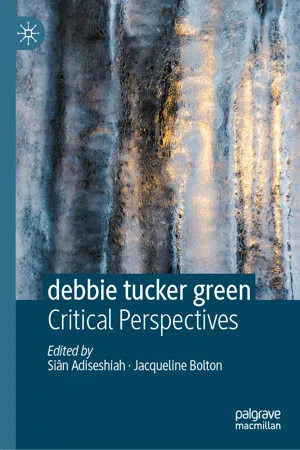
eBook - ePub
debbie tucker green
Critical Perspectives
- English
- ePUB (mobile friendly)
- Available on iOS & Android
eBook - ePub
debbie tucker green
Critical Perspectives
About this book
Information
Subtopic
Entertainment Industry© The Author(s) 2020
S. Adiseshiah, J. Bolton (eds.)debbie tucker greenhttps://doi.org/10.1007/978-3-030-34581-5_11. ‘change ain’t fuckin polite, scuse my language’: Situating debbie tucker green
Siân Adiseshiah1 and Jacqueline Bolton2
(1)
School of Social Sciences and Humanities, Loughborough University, Loughborough, UK
(2)
School of Fine and Performing Arts, University of Lincoln, Lincoln, UK
debbie tucker green’s theatre is rarely polite. Her aesthetically innovative, politically bracing work consistently stages emotionally emboldened scenes of social injustice, global inequalities and private trauma, mobilizing dramatic form in order to expose and attack the discriminatory operations of power that continue to structure the lived experience of specifically black, most often black female, subjectivities. Vociferous in its critique, eloquent in its resistance and compelling as a call to action, the language of tucker green’s plays is central to their political and affective project, the drama’s clarity and force of conviction released by a lyricism of expression as precise as it is penetrating. The quotation that titles our introduction comes from tucker green’s most recent play, ear for eye (2018). A coruscating puncturing of white privilege, ear for eye dramatizes with shattering boldness the lack of progress made with respect to racial equality since the horrors of slavery and racial segregation in nineteenth- and twentieth-century southern United States. ‘Change ain’t fuckin polite’ says Young Adult (tucker green 2018, p. 51)—though the language of tucker green’s theatre makes no excuses, or apologies, for this assertion.
tucker green’s mix of stylish poeticity, enlivening dramaturgy and pungent political subject matter has in recent years energized contemporary theatre scholarship. But until now, tucker green’s work has only been attended to in the short formats of book chapters and journal articles. Extended scrutiny of tucker green’s corpus is keenly awaited by students, scholars and spectators of contemporary theatre alike, a community who is attending and analysing her plays in ever-increasing numbers. Covering the period from 2000 (Two Women) to 2017 (a profoundly affectionate, passionate devotion to someone (-noun)), this first full-length treatment of tucker green’s work offers scholars and students the opportunity to appraise and engage in the spectrum of contemporary critical debate engendered by tucker green’s works for stage, television and radio. While always focused on the precision and detail of tucker green’s work, this collection—like its object of study—simultaneously seeks to reframe broader debates around contemporary drama and its politics, pose new questions of theatre and its making and provoke scholarly thinking in ways that, however obliquely, contribute to the change for which the plays agitate.
Since her professional debut, dirty butterfly, premiered at the Soho Theatre, London, in 2003, tucker green’s plays have been regularly staged by leading theatres for new writing in the UK, including Hampstead Theatre, the Royal Shakespeare Company, the Young Vic, the National Theatre and the Royal Court, where seven of her plays have premiered to date, four on the theatre’s main stage (stoning mary [2005], random [2010], hang [2015] and ear for eye). Unusually for a theatre culture in which playwright/artist-director/interpreter partnerships remain standard practice, tucker green is increasingly also the director of own plays: where earlier works were directed by emerging and established directors of new work such as Rufus Norris (dirty butterfly), Marianne Elliott (stoning mary) and Sacha Wares (generations [2005], trade [2004, 2005] and random), the premieres of truth and reconciliation (2011), nut (2013), hang, a profoundly affectionate passionate devotion to someone (-noun), and ear for eye were all directed by tucker green. In a UK theatre culture where the whiteness of stages, production teams and audiences remains pervasive, these facts offer more than just biographical detail. In writing and directing plays that centralize predominantly black women, tucker green’s theatre intervenes in discourses of race and gender not only at the level of representation but also within the sphere of production, through the labour of realizing these works within an industry where, to appropriate a phrase from Deirdre Osborne in this volume, the presence of black female creatives remains ‘unexpected’. The precise and deliberate specification of race and gender within tucker green’s dramatis personae both insists upon and carefully calibrates the presence of black and female characters in plays—and, by extension, rehearsal rooms—that speak to and about the experiences of those whose lives are marginalized, disempowered and traumatized. Through female characters that are often determinedly antagonistic—spiky, disaffected, truculent—tucker green’s plays redress a historic lack of commanding black female protagonists on UK stages while simultaneously rewriting and revising gendered and raced discourses of victimhood. In often intimate, though increasingly large-scale productions, theatre auditoria become the sites where majority-white audiences are brought into frequently uncomfortable, typically compelling, encounters with black rage—the affective power of which stands as an eloquent rebuke to twenty-first-century claims of a post-racial era, claims made in the context of the election of Barack Obama in the United States in 2008 (see James W. Caesar et al. 2009).
tucker green’s potent fusion of experimental aesthetics, piercing politics, and an affective economy of cruelty have galvanized intellectual engagement with her work and contemporary theatre more broadly—not least with regard to where to position her work within British theatrical lineages. As Lynette Goddard observed in 2005, efforts to place tucker green within ‘traditions of black British women playwrights’ are troubled because her work ‘is so very different from […] the plays that have come before’ (p. 380). tucker green’s work does not feature themes of ‘supportive sisterhood’, ‘spirituality’ or ‘feckless black men in the ghetto’, and moves away from the ‘insistence on providing “positive representations” of (black) women’ identified as characteristic of black women’s theatre in the 1980s and 1990s (Goddard 2005, p. 380). This breaking with tradition initially prompted Goddard to suggest that tucker green’s ‘complicated and layered plays’ feature characters that ‘happen to be black, or white, but could be from any culture’ (2005, p. 380), an observation offered as a reason for her widespread appeal but from which Goddard moves away in this volume.
The (white) critical establishment, after an initial period of questioning whether or not her lyrical dramas could properly be considered ‘plays’ (see Lucy Tyler’s chapter in this volume for an extended discussion of this), have connected tucker green’s innovations in form and language with such playwrights of (white) canonical status as Samuel Beckett, Caryl Churchill, Sarah Kane and Harold Pinter. While acknowledging the influence of these writers, Deirdre Osborne’s interventions into this critical narrative (2010, 2011, 2015), have urged the necessity of taking into account ‘the variegated experiential and aesthetic influences which fall outside traditions of British theatre criticism’ (2011, p. 201). tucker green herself cites as her main influences the works of black playwright and poet Ntozake Shange, Jamaican poet Louise Bennett and singer-songwriters Jill Scott and Lauryn Hill (Goddard 2013, p. 191). Osborne identifies this blend of African-diasporic and European intellectual inheritances as central to tucker green’s ‘genre-refusenik’ style (2011, p. x)—a style Osborne credits with effecting ‘substantial forays into dismantling the identity-politics or issues-based contingencies in which Black drama in Britain traditionally has been housed—to the point of claustrophobia’ (2010, p. 32). For Osborne, tucker green’s linguistic and formal inventiveness has presented a ‘blitz on the comfort zones of theatrical realism’ (2010, p. 32), advancing a bold aesthetic which itself performs a politically vital intervention into white-led cultural production in the UK.
While tucker green’s work is widely recognized in discussions of contemporary black theatre (see Goddard 2007, 2015; Brewer et al. 2014; Pearce 2017), a number of scholars have moved outside these parameters to advance analyses of individual plays that illuminate a series of other live debates in theatre and performance studies. Theatre scholars engaging with ethical philosophy, in particular, have produced some valuable critical work on tucker green’s oeuvre, for which the postmodern ethics of Emmanuel Levinas has provided a foundational framework. Over the last decade, a number of academics—including Marissia Fragkou, Lynette Goddard, Mireia Aragay, Enric Monforte, Martin Middeke, Martin Riedelsheimer and Korbinian Stöckl—have augmented Levinasian thought to offer readings that identify an ethical imperative towards ‘the other’ as central to the affective efficacy of tucker green’s plays. Fragkou, for example, has drawn upon work by Judith Butler on grief and precariousness and Hans-Thies Lehmann on the politics of perception to argue that, through complex acts of spectatorial witnessing, tucker green’s plays ‘mobilize a collective response-ibility vis-à-vis the value of human life’ (2010, p. 23). Mireia Aragay and Enric Monforte have extended Fragkou’s discussion of spectatorship, witnessing and ethical responsibility ...
Table of contents
- Cover
- Front Matter
- 1. ‘change ain’t fuckin polite, scuse my language’: Situating debbie tucker green
- Part I. Dramaturgies of Resistance
- Part II. Affective Encounters
- Back Matter
Trusted by 375,005 students
Access to over 1.5 million titles for a fair monthly price.
Study more efficiently using our study tools.
Frequently asked questions
Yes, you can cancel anytime from the Subscription tab in your account settings on the Perlego website. Your subscription will stay active until the end of your current billing period. Learn how to cancel your subscription
No, books cannot be downloaded as external files, such as PDFs, for use outside of Perlego. However, you can download books within the Perlego app for offline reading on mobile or tablet. Learn how to download books offline
Perlego offers two plans: Essential and Complete
- Essential is ideal for learners and professionals who enjoy exploring a wide range of subjects. Access the Essential Library with 800,000+ trusted titles and best-sellers across business, personal growth, and the humanities. Includes unlimited reading time and Standard Read Aloud voice.
- Complete: Perfect for advanced learners and researchers needing full, unrestricted access. Unlock 1.5M+ books across hundreds of subjects, including academic and specialized titles. The Complete Plan also includes advanced features like Premium Read Aloud and Research Assistant.
We are an online textbook subscription service, where you can get access to an entire online library for less than the price of a single book per month. With over 1.5 million books across 990+ topics, we’ve got you covered! Learn about our mission
Look out for the read-aloud symbol on your next book to see if you can listen to it. The read-aloud tool reads text aloud for you, highlighting the text as it is being read. You can pause it, speed it up and slow it down. Learn more about Read Aloud
Yes! You can use the Perlego app on both iOS and Android devices to read anytime, anywhere — even offline. Perfect for commutes or when you’re on the go.
Please note we cannot support devices running on iOS 13 and Android 7 or earlier. Learn more about using the app
Please note we cannot support devices running on iOS 13 and Android 7 or earlier. Learn more about using the app
Yes, you can access debbie tucker green by Siân Adiseshiah, Jacqueline Bolton, Siân Adiseshiah,Jacqueline Bolton in PDF and/or ePUB format, as well as other popular books in Media & Performing Arts & Entertainment Industry. We have over 1.5 million books available in our catalogue for you to explore.