- English
- ePUB (mobile friendly)
- Available on iOS & Android
eBook - ePub
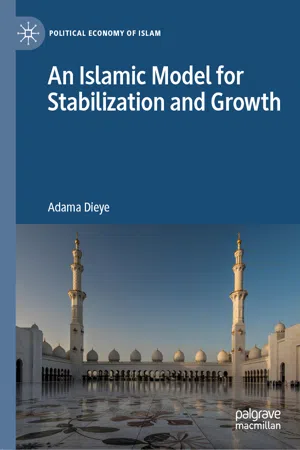
An Islamic Model for Stabilization and Growth
About this book
This book argues that the macroeconomic policy adjustment models recommended by the IMF and the World Bank for implementation in many Muslim countries, with substantial donor financial support, have not been effective. Economic indicators show low economic growth, persistent fiscal and external deficits and limited industrialization. Also, these countries are experiencing increases in unemployment, poverty and substantial growth in income and wealth ?inequalities. These facts ?underline an urgent need to produce an alternative to the failed conventional macroeconomic model in order to address the challenge of ?macroeconomic and social adjustment policies. The project posits and investigates the idea that the Islamic economic model prescribed in the Quran and applied by the Prophet (sawa) could be the ideal model for Muslim as well as non-Muslim ?countries.
Information
© The Author(s) 2020
A. DieyeAn Islamic Model for Stabilization and GrowthPolitical Economy of Islamhttps://doi.org/10.1007/978-3-030-48763-8_11. Introduction
Adama Dieye1
(1)
Central Bank of the West African Countries, Dakar, Senegal
Adama Dieye
Economic activities rise and fall in response to various external and internal shocks, including policy corrections. In severe shocks, the government implements a process of adjustment to stabilize and restore equilibrium to the economy. Since the 1970s, developing countries in particular, have implemented macroeconomic adjustment through financial reform programs, designed and supported by the International Monetary Fund (IMF), the World Bank, and other bilateral and multilateral institutions. The process of macroeconomic adjustment involves implementing macroeconomic policies aimed at managing aggregate demand and structural reform to establish an incentive for macroeconomic stability, poverty reduction and economic growth (Polak 1957; IMF 1987; Mody and Rebucci 2006; Mills and Nallari 1992; Khan and Montiel 1989; Khan et al. 1990; Mikkelsen 1998; Ghosh et al. 2005).
1.1 Significance of Macroeconomic Adjustment Policy Issues
In the mid-1990s, the search for an alternative model to orthodox economic stabilization models emerged, primarily due to the worsening financial, economic, and social conditions in program countries. The 2007/2008 global financial crisis further deepened the need for such reform, spurring debates to rethink macroeconomic policy and more recently, rebuild macroeconomic theory, even in developed countries1 (Blanchard et al. 2010; Stiglitz 2011). These debates have exposed the overall ineffectiveness of the IMF and World Bank policies in developing and emerging market economies.
Developing countries and, more recently, developed western nations had expressed their reservations about the credibility of the conventional stabilization and growth model. Concerns began to develop about the IMF policy prescriptions that had led to frequent financial crises, economic downturns, excessive fiscal deficits, financial imbalances, rising unemployment and poverty (Edwards 1989; Easterly 1999, 2002, 2003; Agenor 1999, 2002; Barro and Lee 2002; Krugman 2009; Niels and Brigitte 2009). While the IMF policy prescriptions introduce market policies through fiscal and monetary austerity, they seem to lead to financial crises and even debt deflation and depression (Wolfson 2002).
Many Muslim countries that implemented orthodox macroeconomic adjustment models did not achieve stabilization and growth as promised in these programs. They still suffer poor growth, declining or nonexistent infrastructure, critical unemployment, and unsustainable external debt (Chapra 1995, 2007, 2008; Ahmed 2002; Mirakhor and Krichene 2009; Askari et al. 2015). The Statistical Economic and Social Research and Training Centre (SESRIC) report published in 2017 pointed out that over the last five to ten years, despite their substantial, diverse resources such as agriculture, energy, mining, and human resources (making up 22.6% of the total world population in 2012), the share of OIC countries in total global production remains stable at 15%. Their contribution to total gross fixed capital formation stood at 8.9% globally, and 17.4% among developing countries. OIC countries also represent 45% of global sovereign wealth funds. In terms of labor productivity, the SESRIC report emphasized that an average worker in OIC countries produced 28.8% of the output produced by an average worker in developed countries. Askari et al. (2012, pp. 227–231) argued, “From a practical standpoint, Muslim countries lack the foundational elements of an efficient economic and financial system…” and “…have to tackle these glaring shortages in their economic systems.”
This book addresses pressing issues on macroeconomic adjustment policies. It posits and investigates the idea that the Islamic economic model prescribed in the Qur’an and applied by the Prophet (SAW) could be the ideal model for Muslim countries and non-Muslim countries. An alternative stability and growth model based on Islamic teachings may be more suitable for countries like Senegal where most of the population are Muslim. Researchers have contended that it is hard to find a contemporary economic system that converges with ideal Islamic principles, and that empirical investigations of the application of an ideal model are not possible. However, Ahmed (2002), unconvinced of this logic, urged researchers to conduct experimental work from an Islamic perspective. To demonstrate the idea, we have put forth Senegal as a case study in the application of an Islamic stabilization and growth model.
1.2 Senegal in Brief
Senegal, located on the West African coast, is a member of the West African Economic and Monetary Union (WAEMU).2 Country members of this Union have a common Central Bank (BCEAO), a common currency—the CFA Franc, pegged at the fixed rate of €1 = FCFA 655.957, and a community structure to supervise regional banking activities. Senegal is also a member of the Economic Community of West African States (ECOWAS).3
Since 1979, Senegal has faced recurrent episodes of instability. In response, the government has embarked on a long economic adjustment program to address deep-rooted fiscal and external imbalances and constraints, and to ensure the economy remains on a path of strong and sustainable growth. The government has completed several IMF macroeconomic adjustment programs,4 supported by the IMF, the World Bank and other multi and bilateral partners. Nevertheless, over the period, Senegal has endured volatile economic growth. Macroeconomic instability continues, reflecting persistent constraints—large fiscal and external shortfalls, lack of financial deepening, and limited shallow capital markets, low productivity, and vulnerabilities to exogenous economic and environmental shocks (droughts, disruptions in electricity supply, and adverse terms of trade) (IMF 2013). The country has also not solved its rising social problems, with poverty being the most pressing, and has become more dependent on foreign resources for support. Based on its economic history, Senegal may find it extremely difficult to exit IMF and World Bank programs.
Given the fact that successive IMF programs have failed to achieve the promised results, Senegal needs an alternative economic model to its existing conventional one to attain high and sustainable economic growth and improve social justice and human development. As a country, Senegal has rich resources that can be leveraged to address its economic and social challenges, including notable potential in solar energy, river irrigation, offshore oil and gas, and zircon mineral (IDB 2013). Also, as a member of the WAEMU and the ECOWAS, Senegal enjoys a potential regional market with an estimated 378 million consumers. It is therefore not beyond reach to assume that with Quran economic policy more in accord with the values of its population, Senegal should be able to achieve and sustain economic stability and growth.
1.3 An Islamic Model of Stabilization and Growth
Senegal’s predominantly Muslim population, exceeding 95% of its total population, bodes well for the implementation of an Islamic economic model in achieving sustainable economic growth. The main point of reference for Islamic economic principles, as with all other Islamic principles, is the Holy Qur’an.
The Holy Qur’an is the source of all Islamic paradigms as evidenced by the following verses:
“This is the Book about which there is no doubt, a guidance for those conscious of Allah” (2); “Who believe in the unseen, establish prayer, and spend out of what We have provided for them (3)”. (Qur’an, 2:2–3)
And [mention] the Day when We will resurrect among every nation a witness over them from themselves. And We will bring you, [O Muhammad], as a witness over your nation. And We have sent down to you the Book as clarification for all things and as guidance and mercy and good tidings for the Muslims. (Qur’an, 16:89)
The Qur’an prescribes the rules of behavior—“institutions”—for individuals and societies that cover all facets of life, including economics and finance. In particular, the Qur’an (7:96), stresses the necessary and sufficient condition for a prosperous economy are met through compliance with rules prescribed in it5 (Basmeih 2011):
S7 V96: “And if only the people of the cities had believed and feared Allah, We would have opened upon them blessings from the heaven and the earth; but they denied [the messe...
Table of contents
- Cover
- Front Matter
- 1. Introduction
- 2. Overview of Current Macroeconomic Policy Issues and Challenges in Mainstream Economics
- 3. Current Economic and Social Challenges and Islam
- 4. Islamic Institutional Policy Framework
- 5. Rules of Economic and Financial Operations
- 6. Sustainability of the Senegal Socioeconomic Model
- 7. Counterfactual Simulation of the Islamic Model for Senegal
- 8. Implementation of the Islamic Model for Senegal
- 9. Conclusion
- Back Matter
Trusted by 375,005 students
Access to over 1.5 million titles for a fair monthly price.
Study more efficiently using our study tools.
Frequently asked questions
Yes, you can cancel anytime from the Subscription tab in your account settings on the Perlego website. Your subscription will stay active until the end of your current billing period. Learn how to cancel your subscription
No, books cannot be downloaded as external files, such as PDFs, for use outside of Perlego. However, you can download books within the Perlego app for offline reading on mobile or tablet. Learn how to download books offline
Perlego offers two plans: Essential and Complete
- Essential is ideal for learners and professionals who enjoy exploring a wide range of subjects. Access the Essential Library with 800,000+ trusted titles and best-sellers across business, personal growth, and the humanities. Includes unlimited reading time and Standard Read Aloud voice.
- Complete: Perfect for advanced learners and researchers needing full, unrestricted access. Unlock 1.5M+ books across hundreds of subjects, including academic and specialized titles. The Complete Plan also includes advanced features like Premium Read Aloud and Research Assistant.
We are an online textbook subscription service, where you can get access to an entire online library for less than the price of a single book per month. With over 1.5 million books across 990+ topics, we’ve got you covered! Learn about our mission
Look out for the read-aloud symbol on your next book to see if you can listen to it. The read-aloud tool reads text aloud for you, highlighting the text as it is being read. You can pause it, speed it up and slow it down. Learn more about Read Aloud
Yes! You can use the Perlego app on both iOS and Android devices to read anytime, anywhere — even offline. Perfect for commutes or when you’re on the go.
Please note we cannot support devices running on iOS 13 and Android 7 or earlier. Learn more about using the app
Please note we cannot support devices running on iOS 13 and Android 7 or earlier. Learn more about using the app
Yes, you can access An Islamic Model for Stabilization and Growth by Adama Dieye in PDF and/or ePUB format, as well as other popular books in Politics & International Relations & African Politics. We have over 1.5 million books available in our catalogue for you to explore.