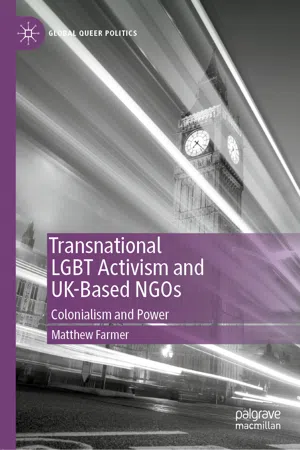
This book contributes an analysis of UK-based non-governmental organisations engaged in transnational lesbian, gay, bisexual, and trans (LGBT) activism, within a broader recognition of the complexities that British colonial legacies perpetuate in contemporary international relations. From this analysis, the book suggests that greater engagement with intersectional and decolonial approaches to transnational activism would allow for a more transformative solidarity that challenges the broader impacts of coloniality on LGBT people's lives globally. Case studies are used to explore UK actors' participation in the complexities of contemporary transnational LGBT activism, including activist responses to developments in Brunei between 2014 and 2019, and the use of LGBT aid conditionality by Western governments. Activist engagements with legacies of British colonialism are also explored, including a focus on 'sodomy laws' and the Commonwealth, as well as the challenges faced by LGBT people seeking asylum in the UK.
- English
- ePUB (mobile friendly)
- Available on iOS & Android
eBook - ePub
About this book
Information
© The Author(s) 2020
M. FarmerTransnational LGBT Activism and UK-Based NGOsGlobal Queer Politicshttps://doi.org/10.1007/978-3-030-45377-0_11. Introduction
Matthew Farmer1
(1)
Lancaster, Lancashire, UK
Matthew Farmer
Since 2011, the number of UK-based non-governmental organisations (NGOs) engaged in transnational lesbian, gay, bisexual and trans (LGBT) activism has notably increased, with new NGOs emerging and existing NGOs increasing their international work. Whilst NGOs engage in different activism strategies, all NGOs adopt a broadly similar ethos of seeking to improve global LGBT rights by working with local LGBT people and groups across the world. This increased international activity from UK non-governmental spaces concerned with global LGBT rights is reflected in broader trends of increased attention to LGBT discrimination worldwide. As greater legal protections for LGBT people are secured in some states, alongside improving social acceptance for LGBT lives, condemnation of worldwide LGBT discrimination and violence is increasing. Thus, the plight of LGBT communities under oppressive state mechanisms, for example in Uganda, Malawi, Brunei and Russia, has become more widely publicised, fuelling mainstream attention and catalysing greater NGO participation in transnational LGBT activism. This incitement to discourse of international LGBT rights has extended to discussions in international forums, including at the UN Human Rights Council, which appointed the first UN Independent Expert on Sexual Orientation and Gender Identity in 2016.
70 UN member states criminalise consenting same-sex sexual activity, in addition to a number of smaller jurisdictions, either using legislation that specifically targets LGBT people by prohibiting same-sex relations, or via other oppressive legal mechanisms (Mendos 2019). Although the number of states that criminalise their LGBT populations has gradually decreased over the past few decades, there has also been a recent trend towards introducing new legislation that either directly or indirectly harms LGBT communities. Some states have sought to introduce legislation that increases penalties for same-sex sexual relations, whilst others have introduced ‘propaganda’ laws to limit freedom of expression (Carroll 2016; Mendos 2019). There have also been recent trends to restrict civil society spaces and make it difficult for NGOs to function effectively, particularly when NGOs receive support from foreign donors (Amnesty International 2014; Dupuy et al. 2015; Kingsley 2014). This can present challenges for LGBT activists engaged in transnational activism who may rely on foreign financial support and for whom registering officially as an NGO can be difficult in many states.
That many LGBT people continue to suffer discrimination and violence worldwide highlights the need for continued research in this area to document discrimination and contribute to transnational strategies of improving the lives of LGBT people globally. The increased momentum and complexity of international LGBT rights strategies and discourses in the twenty-first century has led to a wealth of research that has examined the opportunities and challenges of international strategies as they have developed. This includes analyses of key developments, such as the Yogyakarta Principles, as well as engagements with general trends in global LGBT politics, such as the increased number of active international and local NGOs pursuing LGBT rights and equality globally (Altman and Symons 2016; Kollman and Waites 2009; Lennox and Waites 2013; Seckinelgin 2012; Tremblay et al. 2011; Weiss and Bosia 2013). There has also been an increase in scholarship on how queer sexualities in global politics can produce new theoretical understandings of the complexity of international relations (Langlois 2016; Picq and Thiel 2015; Rao 2018; Weber 2016). Some research has provided analyses of particular organisations that engage in transnational LGBT activism, particularly US-based and international organisations. For example, Long (2013) provides a critique of the funding sources of the Human Rights Campaign (HRC), whilst Thoreson (2014) provides a detailed examination of the International Gay and Lesbian Human Rights Commission, now known as OutRight. Others have critically engaged with broader themes of the problematic strategies and discourses deployed by mainly Western actors in their pursuit of LGBT equality worldwide. For example, Rao (2014b) explores and problematises contemporary representations of homophobia that produce simplistic conceptions of the ‘locations of homosexual freedom’ on the one hand and ‘locations of homophobia’ on the other (p. 174). Such representations rely on simplistic understandings of homophobia and the progress of LGBT equality, often with the implication that homophobic states are on a journey to catch up to the progress made by the West, undermining the nuances of effective transnational solidarity by relying on Western concepts of LGBT rights and modernity (Coly 2013; Ekine 2013; Gunkel 2013; Puar 2007; Rahman 2014; Rao 2014a, b).
Whilst there is a wealth of research that engages with the complexities of global LGBT politics, there remains scope for greater analysis of the ways in which NGOs operate and engage with global LGBT rights and equality. Little research has been produced that offers a detailed examination of the evolving nature and scope of the contemporary UK-based NGO space engaged in transnational LGBT activism. A notable exception to this is Waites’ analysis of what they identify as ‘the new London-based trans-national politics of LGBT human rights’, concerning the post-2011 growth of London-based NGOs engaged in supporting the human rights of LGBT people globally, particularly via a focus on the Commonwealth (Waites 2015). Waites’ (2015) analysis focuses on four key London-based organisations: Kaleidoscope Trust, Stonewall, Human Dignity Trust and the Peter Tatchell Foundation, followed by a more detailed examination of Kaleidoscope Trust and The Commonwealth Equality Network (Waites 2017). Whilst Waites provides a much-needed interrogation of the emergence and strategies of some key UK-based NGOs, there is scope for a more comprehensive analysis of the broader range of UK-based NGOs engaged in transnational LGBT activism.
This book contributes a new analysis of the key NGOs examined by Waites, whilst also considering the broader UK NGO space engaged in transnational LGBT activism, including organisations involved with LGBT asylum, such as UK Lesbian and Gay Immigration Group (UKLGIG), and diaspora-led organisations, such as Out & Proud African LGBTI (OPAL). Drawing on interview data and NGO publications, the book contributes an analysis of the evolution of NGO strategies and engagements in transnational LGBT activism, including efforts to influence UK governmental strategies on LGBT rights internationally, focusing on the period from 2011 to 2019. The book situates this analysis within a broader recognition of the complexities that British colonial legacies perpetuate in contemporary international relations, noting that greater engagement with a decolonial approach to understanding transnational LGBT activism would help UK-based NGOs to more successfully navigate and challenge the coloniality of power that persists in the international system (Mignolo 2007; Quijano 2000, 2007; Waites 2019). Adopting a decolonial approach would help contribute to a more effective transnational LGBT solidarity by highlighting the intersectionality of LGBT lives globally, going beyond a restrictive understanding of LGBT rights to challenge the ways in which coloniality restricts LGBT people’s lives in ways other than their being LGBT (Anguita 2012; Crenshaw 1989, 1993; Mohanty 2003).
The UK space is continually evolving, and as NGO strategies respond to critiques and revise their particular approaches to transnational activism, UK-based NGOs have the potential to contribute significantly to the development of transnational LGBT activist strategies, as well as influencing UK governmental strategies in the international sphere. Central to the long-term effectiveness of these strategies will be the ability of UK-based NGOs to fully engage in intersectional and decolonial approaches that understand and appreciate the complex challenges faced by LGBT people beyond s...
Table of contents
- Cover
- Front Matter
- 1. Introduction
- 2. Conceptual Tools for a Decolonising, Intersectional, Transnational LGBT Activism
- 3. Unpacking the Colonial Baggage of British Imperial Sexual Discourses
- 4. Contemporary Context of Sexual Orientation and Gender Identity in International Politics
- 5. Analysing the UK-Based NGO Landscape Engaged in Transnational LGBT Activism
- 6. UK Governmental Interventions and Transnational LGBT Activism
- 7. Navigating the Intersections of Colonial Legacies and LGBT Lives
- 8. Conclusion
- Back Matter
Trusted by 375,005 students
Access to over 1.5 million titles for a fair monthly price.
Study more efficiently using our study tools.
Frequently asked questions
Yes, you can cancel anytime from the Subscription tab in your account settings on the Perlego website. Your subscription will stay active until the end of your current billing period. Learn how to cancel your subscription
No, books cannot be downloaded as external files, such as PDFs, for use outside of Perlego. However, you can download books within the Perlego app for offline reading on mobile or tablet. Learn how to download books offline
Perlego offers two plans: Essential and Complete
- Essential is ideal for learners and professionals who enjoy exploring a wide range of subjects. Access the Essential Library with 800,000+ trusted titles and best-sellers across business, personal growth, and the humanities. Includes unlimited reading time and Standard Read Aloud voice.
- Complete: Perfect for advanced learners and researchers needing full, unrestricted access. Unlock 1.5M+ books across hundreds of subjects, including academic and specialized titles. The Complete Plan also includes advanced features like Premium Read Aloud and Research Assistant.
We are an online textbook subscription service, where you can get access to an entire online library for less than the price of a single book per month. With over 1.5 million books across 990+ topics, we’ve got you covered! Learn about our mission
Look out for the read-aloud symbol on your next book to see if you can listen to it. The read-aloud tool reads text aloud for you, highlighting the text as it is being read. You can pause it, speed it up and slow it down. Learn more about Read Aloud
Yes! You can use the Perlego app on both iOS and Android devices to read anytime, anywhere — even offline. Perfect for commutes or when you’re on the go.
Please note we cannot support devices running on iOS 13 and Android 7 or earlier. Learn more about using the app
Please note we cannot support devices running on iOS 13 and Android 7 or earlier. Learn more about using the app
Yes, you can access Transnational LGBT Activism and UK-Based NGOs by Matthew Farmer in PDF and/or ePUB format, as well as other popular books in Social Sciences & European Politics. We have over 1.5 million books available in our catalogue for you to explore.