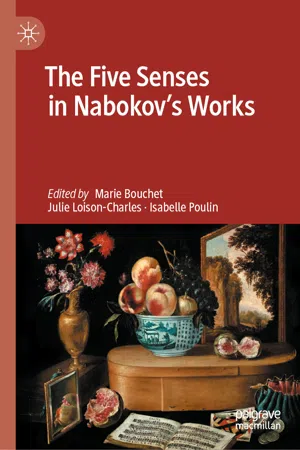
This collection of essays focuses on a subject largely neglected in Nabokovian criticism—the importance and significance of the five senses in Vladimir Nabokov's work, poetics, politics and aesthetics. This text analyzes the crucial role of the author's synesthesia and multilingualism in relation to the five senses, as well as the sensual and erotic dimensions of sensoriality in his works. Each chapter provides a highly focused and sometimes provocative approach to the unique role that sensory perceptions play in the shaping and narrating of Nabokov's memories and in his creative process.
eBook - ePub
The Five Senses in Nabokov's Works
- English
- ePUB (mobile friendly)
- Available on iOS & Android
eBook - ePub
The Five Senses in Nabokov's Works
About this book
Information
© The Author(s) 2020
M. Bouchet et al. (eds.)The Five Senses in Nabokov's Workshttps://doi.org/10.1007/978-3-030-45406-7_11. ‘Do the Senses Make Sense?’: An Introduction
Marie Bouchet1 , Julie Loison-Charles2 and Isabelle Poulin3
(1)
University of Toulouse, Toulouse, France
(2)
University of Lille, Lille, France
(3)
University Bordeaux Montaigne, Bordeaux, France
Marie Bouchet (Corresponding author)
Julie Loison-Charles
Isabelle Poulin
The pun on the various meanings of “sense” quoted in the title of this introduction is taken from the mock preface to Humbert’s confessions in Lolita. Its fictitious author John Ray Jr explains that it is because he won the “Poling Prize” for “a modest work (‘Do the Senses make Sense?’) wherein certain morbid states and perversions had been discussed” (Nabokov 1955, 7) that Humbert’s lawyer entrusted him with prefacing Humbert’s manuscript. In spite of, or because of, the suspicious name of that prize—a variant on the Pulitzer Prize which seems to rely only on polls—one can but ponder over this question, which is in fact the first interrogative sentence of the novel Lolita (and the first of the many enigmas in the following pages). The various significations one could assign to the question asked by John Ray powerfully resonate throughout Lolita, and throughout Nabokov’s works as a whole: are our senses rational? Do they make us behave in a rational way? Can we rely on our sensorial perceptions to understand the world around us? Do our senses actually produce signification (make/produce sense)? Can we rely on our senses for logical deductions? This collection of essays invites the reader to delve into the way Nabokov answered these questions in his texts, as if his own work was in fact the very “modest work” “wherein certain morbid states and perversions ha[ve] been discussed.”
This collection of essays offers the first large-scale reflection upon the importance and significance of the five senses in Nabokov’s work, poetics, and aesthetics.1 Many obvious elements from Nabokov’s life and works indicate the impact of senses on his creative process and on his aesthetic principles, all stemming from his way of experiencing the world around him. It is probably in his autobiographical writings that the key role of senses is the most blatant, as he repeatedly incorporates many sensorial elements within the flow of his memories, and even muses upon the sensorial education his mother was especially attentive to develop:
My mother did everything to encourage the general sensitiveness I had to visual stimulation. How many were the aquarelles she painted for me; what a revelation it was when she showed me the lilac tree that grows out of mixed blue and red! Sometimes, in our St. Petersburg house, from a secret compartment in the wall of her dressing room (and my birth room), she would produce a mass of jewelry for my bedtime amusement. I was very small then, and those flashing tiaras and chokers and rings seemed to me hardly inferior in mystery and enchantment to the illumination in the city during imperial fetes, when, in the padded stillness of a frosty night, giant monograms, crowns, and other armorial designs, made of colored electric bulbs-sapphire, emerald, ruby-glowed with a kind of charmed constraint above snow-lined cornices on housefronts along residential streets. (Nabokov 1966, 36)
In this excerpt, one can see Nabokov’s creative mind at work in his extraordinary capacity to relate elements to one another—the very core of metaphor-production. By linking the jewels his mother put on display for him in the warm interior of their Petersburg house with the outside holiday street decorations of a bygone time, the writer not only powerfully conjures up the past, but also subtly prepares for later episodes in his autobiography, namely, when his mother has to sell her jewels to feed her family during their exile.
Senses make particular sense in Nabokov’s world, but not only sight, as the above reflections may seem to indicate. In fact, the many studies of Nabokov’s references to visual arts and cinema can give the impression that sight is the all-dominating sense, and that Nabokov therefore followed the traditional hierarchy between senses inherited from Aristotle. This collection of essays strives to prove that things are a lot more complex in Nabokov’s case, since he was a man gifted with a spectacular visual , but also auditory, gustatory, olfactory, tactile, and kinetic memory. For example in the autobiographical short story “First Love”, which later became chapter 7 of Speak, Memory, Nabokov powerfully evokes Biarritz, the French sea resort on the Atlantic Ocean—a popular vacation spot for White Russians until 1917—and its Grande Plage, on which he “found himself digging, one day, side by side with a little French girl called Colette” (Nabokov 1966, 149), the author’s “first love.” Biarritz was the place where Nabokov had one of his first intense sensorial and emotional experiences, and offered many elements to stimulate his perceptive and imaginative self: from the “rising, rotating mass of foamy, green water” of the ocean to the unfamiliar sound of the Basque language, from the salty breeze on his lips to the “deep, mealy sand” in which he dug, from the “pistachio ice cream of a heavenly green” to the pine smell of the beach cabins, his sensorial memories saturate the text. This collection of essays therefore explores the key relation between the senses and memory.
Damien Mollaret uses Speak, Memory as a basis for studying how Nabokov’s sensorial development in his childhood was later used to evoke his past. In this chapter, the many references to Proust are considered within an intertextual network (Proust, Chateaubriand, Calvino) that questions the link between writing (the art of language) and sensations, and especially the link between multilingual writing and sensations. His comparisons with Romain Gary (and his desire to consume landscapes, or things from the past such as Russian pickles), or Fernando Pessoa (likening himself to “scrupulous scholars of feeling”) emphasize the carnal dimension of language, beyond its arbitrary arrangement of signs, because these very signs are fully incarnated for polyglots. He therefore shows how multilingual writing can be seen as a form of resistance against the automaticity of perceptions. Many a critic has been impressed by the vividness and precision of Nabokov’s memories from a sensorial point of view, but in fact, Nabokov likes to remind his readers that perceptive processes are complex. This is exemplified by Susan Elisabeth Sweeney’s chapter, which focuses, on the contrary, on the failures of visual memory. In her analyses of Laughter in the Dark, The Enchanter and Lolita, she studies the way Nabokov describes visual agnosia, “an unusual neurological disorder (…) which involves the failure to recognize objects as either familiar or coherent visual shapes.” The examples she recalls span the inabilities to recognize faces, colors, traces, pages, letters, or words: characters and readers are confronted with these visual aberrations, so as to raise the readers’ awareness of their own perceptive mechanisms. As for Yannicke Chupin’s chapter, it focuses on a rarely explored feature of Nabokov’s visual intermedial references, namely, his very personal use of photography in his texts. She investigates the striking intertwining of photography—captured visual memories—and death in Nabokov’s universe. Borrowing from Derrida’s “spectropoetics” in Specters of Marx and relying on Barthes’s reflections on photography in Camera Lucida, her chapter shows how photographic references disseminate their lethal function in the text that surrounds them, as if the specific act of vision that photography entails was synonymous with killing.
As recalled in Mollaret’s chapter, the central importance of sensory modalities in Nabokov’s work should also be related to his multilingualism, and his personal history. The writer came from an aristocratic family who frequently travelled, employed foreigners, and had access to an exceptional amount of foreign products when compared to their fellow Russian citizens; Nabokov’s senses were therefore constantly stimulated by new sounds, sights, smells, tastes, and textures in his childhood. His acute sensory perceptions were then probably further developed with the experiences of his émigré life as he moved around Europe and the United States. This explains the many instances of Nabokov elaborating upon the various taste/sound of foods depending on the language in which they are evoked, such as the “tartine au miel, so much better in French!” in Ada (Nabokov 1969, 81). With this aspect in mind, and from a study of food references in three of Nabokov’s self-translated texts (Ada, Lolita and Speak, Memory), Julie Loison-Charles questions what translating means, that is not only changing one’s linguistic system, but also changing one’s tongue. Nabokov indee...
Table of contents
- Cover
- Front Matter
- 1. ‘Do the Senses Make Sense?’: An Introduction
- Part I. The Role of the Senses in Nabokov’s Aesthetics and Metaphysics
- Part II. Crossing Sensations and Languages: Multilingualism, Memory and Intermediality
- Part III. Senses and the Body: From Pleasure to Displeasure
- Part IV. Synesthesia and Multisensoriality
- Back Matter
Trusted by 375,005 students
Access to over 1.5 million titles for a fair monthly price.
Study more efficiently using our study tools.
Frequently asked questions
Yes, you can cancel anytime from the Subscription tab in your account settings on the Perlego website. Your subscription will stay active until the end of your current billing period. Learn how to cancel your subscription
No, books cannot be downloaded as external files, such as PDFs, for use outside of Perlego. However, you can download books within the Perlego app for offline reading on mobile or tablet. Learn how to download books offline
Perlego offers two plans: Essential and Complete
- Essential is ideal for learners and professionals who enjoy exploring a wide range of subjects. Access the Essential Library with 800,000+ trusted titles and best-sellers across business, personal growth, and the humanities. Includes unlimited reading time and Standard Read Aloud voice.
- Complete: Perfect for advanced learners and researchers needing full, unrestricted access. Unlock 1.5M+ books across hundreds of subjects, including academic and specialized titles. The Complete Plan also includes advanced features like Premium Read Aloud and Research Assistant.
We are an online textbook subscription service, where you can get access to an entire online library for less than the price of a single book per month. With over 1.5 million books across 990+ topics, we’ve got you covered! Learn about our mission
Look out for the read-aloud symbol on your next book to see if you can listen to it. The read-aloud tool reads text aloud for you, highlighting the text as it is being read. You can pause it, speed it up and slow it down. Learn more about Read Aloud
Yes! You can use the Perlego app on both iOS and Android devices to read anytime, anywhere — even offline. Perfect for commutes or when you’re on the go.
Please note we cannot support devices running on iOS 13 and Android 7 or earlier. Learn more about using the app
Please note we cannot support devices running on iOS 13 and Android 7 or earlier. Learn more about using the app
Yes, you can access The Five Senses in Nabokov's Works by Marie Bouchet, Julie Loison-Charles, Isabelle Poulin, Marie Bouchet,Julie Loison-Charles,Isabelle Poulin in PDF and/or ePUB format, as well as other popular books in Literature & Literary Criticism. We have over 1.5 million books available in our catalogue for you to explore.