This book provides the first comprehensive overview of the global landscape of documentary film festivals, looking at its contemporary and future challenges. Contributors from across the globe reflect on how documentary has positioned itself within both internationally renowned and more alternative festivals, including IDFA (Netherlands), Cannes IFF (France), Sheffield Doc/Fest (UK), Dockanema (Mozambique), Ismailia (Egypt) and Zinebi (Basque Country, Spain), among others. With a special focus on industrial and curatorial developments, this second in a two-volume set looks at recent changes occurred in the festival circuit, such as the proliferation of markets and co-production forums, the inclusion of interactive and VR forms within their programs and the irruption of VOD platforms, and analyse how these affect the future of documentary aesthetics and its production/distribution contexts.
This volume is organized in two sections: the first reflects on how the documentary festival circuit has become a key industry node for contemporary documentary and identifies new curatorial trends at documentary and major film festivals. The second gives voice to professionals working for festivals and institutions who collaborate with them, who share inside knowledge and concerns, regarding the future challenges to be faced by documentary in the near future.
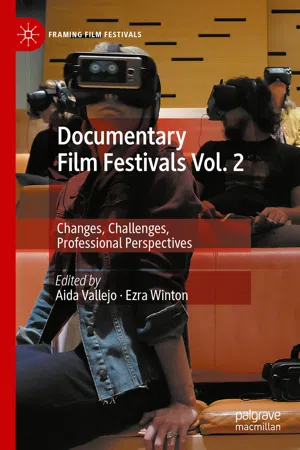
eBook - ePub
Documentary Film Festivals Vol. 2
Changes, Challenges, Professional Perspectives
- English
- ePUB (mobile friendly)
- Available on iOS & Android
eBook - ePub
Documentary Film Festivals Vol. 2
Changes, Challenges, Professional Perspectives
About this book
Information
Subtopic
Film & VideoPart IChanges and Challenges
© The Author(s) 2020
A. Vallejo, E. Winton (eds.)Documentary Film Festivals Vol. 2Framing Film Festivalshttps://doi.org/10.1007/978-3-030-17324-1_2Introduction to Part I, Vol. 2: Changes and Challenges for Documentary and Film Festivals
Aida Vallejo1
(1)
University of the Basque Country (UPV/EHU), Leioa, Spain
Recent changes in the festival realm have profoundly affected the aim and scope of both documentary film and documentary film festivals. A look at contemporary trends in the documentary festival ecosystem gives us some clues to better understand its functioning patterns, key agents and future challenges. Chapters in this section analyze these aspects, focusing on diverse agents, namely festivals as institutions, professionals and films.
The international documentary festival circuit has been subject to structural organizational changes since the 1990s. As noted by Marijke de Valck, these are characterized by “a shift from festival programmers in the 1970s, driven by cinephile passions and an ideology of political participation, to the festival director of the 1990s, who has become a professional cultural entrepreneur who manages the various constituencies of the festival network” (2007, 43). According to Skadi Loist, “larger-scale economic shifts, such as the spread of neoliberal market logic after the end of the Cold War and the rise of the global city paradigm have encouraged an eventization and further proliferation of the circuit” (2016, 60). For documentary festivals, this implies the spread of funding and organizational models based on private non-profit associations (Rhyne 2009), and the incorporation of industry activity (markets , funds, pitching fora, etc.) within the festival program (see De Valck 2007, 108–118; Wong 2011, 129–158; Vallejo 2014a). Other major changes include the digitization process and a global proliferation of events. This has brought us to the current state characterized by a “saturation of the circuit” and the articulation of global peripheries (Vallejo 2014b).
This section looks at recent changes in the festival ecosystem, identifying contemporary trends in the documentary realm. Focusing on the challenges faced by documentary (and generalist) film festivals, the following five chapters reflect on three main aspects: industrial concerns, technological issues and curatorial practices. These include studies on the role of film festivals as producers and distributors; the irruption of interactive forms within festival programs; and new documentary trends embraced by A-list film festivals.
Festival Proliferation, Hierarchies and Industry Sections
Documentary film festivals have proliferated globally throughout the 2000s. This can be considered as a natural response to the increasing number of productions made yearly as well as cheaper exhibition infrastructures, both facilitated by the availability of new digital equipment. In this frame, documentary festivals have developed strategies to position themselves in the global network of international events, both in relation to major fiction festivals and other parallel circuits such as thematic film festivals. A particular feature of documentary festivals is that they are not so much under pressure by premiere policies and accreditation rules imposed by the International Federation of Film Producers Associations (FIAPF)1, which certainly constrain programming practices and create an ever-increasing competitive environment. Conversely, several documentary festival programmes are made of the best films travelling the circuit, functioning mainly as exhibition platforms that fulfil the gap of commercial distribution, rather than creating a space for discovery of new works for international critics for whom world premieres are a pull factor. Moreover, thematically-driven events such as ethnographic film festivals (see Vallejo and Peirano 2017), human rights film festivals (see Tascón 2015) and other social-related thematic festivals (e.g. environmental or disabilities) add to the list of film festivals showing mainly documentary works, affording feature-length documentary a remarkable presence on the big screen.
In this context, retracing the global circulation of documentary films is becoming increasingly complex, as the circuits of circulation are multiple and rapidly expand in different directions. Film festival studies have noted the necessity to interrogate the extent to which film festivals function as a circuit (of films and people) and if so, of commercial distribution,2 considering the documentary as a parallel circuit. According to Loist “A host of smaller networks now exist to serve specific audiences or ‘minor genres’; these networks operate differently than the general narrative feature film norm and create their own niche markets and industries, building parallel circuits while also being interconnected with the general network” (Loist 2016, 52). Following Loist, the networked nature of the documentary festival circuit can be analysed focusing on two main agents: films and professionals.
Firstly, the documentary festival ecosystem can work as a distribution network for some films, securing revenues in the form of screening fees and/or further distribution deals for theatrical release or television broadcasting. Yet, for most documentaries festivals mostly act as an exhibition circuit, with films travelling from one place to another, gaining visibility and value through public exposure to key agents and media. Documentary films from specific geographical areas have found in documentary film festivals an exhibition platform that contributes to defining cinemas from certain regions, such as Northeastern Europe, as we see in this section’s contribution by Ilona Hongisto, Kaisu Hynnä-Granberg and Annu Suvanto. In their statistical analysis of the films’ circulation through European documentary festivals, they argue that festival exposure is key for the articulation of documentary aesthetics and themes associated to a specific geopolitical area.
Secondly, the circulation of professionals from festival to festival is key to understanding programming patterns at different events as well as the development of documentary productions through the years, thanks to networking practices and long-term professional relationships established within the festival circuit (see Vallejo 2015, 2017). As noted by María Paz...
Table of contents
- Cover
- Front Matter
- Introduction—Volume 2: Documentary Film Festivals: Changes, Challenges, Professional Perspectives
- Part I. Changes and Challenges
- Part II. Professional Perspectives
- Back Matter
Trusted by 375,005 students
Access to over 1.5 million titles for a fair monthly price.
Study more efficiently using our study tools.
Frequently asked questions
Yes, you can cancel anytime from the Subscription tab in your account settings on the Perlego website. Your subscription will stay active until the end of your current billing period. Learn how to cancel your subscription
No, books cannot be downloaded as external files, such as PDFs, for use outside of Perlego. However, you can download books within the Perlego app for offline reading on mobile or tablet. Learn how to download books offline
Perlego offers two plans: Essential and Complete
- Essential is ideal for learners and professionals who enjoy exploring a wide range of subjects. Access the Essential Library with 800,000+ trusted titles and best-sellers across business, personal growth, and the humanities. Includes unlimited reading time and Standard Read Aloud voice.
- Complete: Perfect for advanced learners and researchers needing full, unrestricted access. Unlock 1.5M+ books across hundreds of subjects, including academic and specialized titles. The Complete Plan also includes advanced features like Premium Read Aloud and Research Assistant.
We are an online textbook subscription service, where you can get access to an entire online library for less than the price of a single book per month. With over 1.5 million books across 990+ topics, we’ve got you covered! Learn about our mission
Look out for the read-aloud symbol on your next book to see if you can listen to it. The read-aloud tool reads text aloud for you, highlighting the text as it is being read. You can pause it, speed it up and slow it down. Learn more about Read Aloud
Yes! You can use the Perlego app on both iOS and Android devices to read anytime, anywhere — even offline. Perfect for commutes or when you’re on the go.
Please note we cannot support devices running on iOS 13 and Android 7 or earlier. Learn more about using the app
Please note we cannot support devices running on iOS 13 and Android 7 or earlier. Learn more about using the app
Yes, you can access Documentary Film Festivals Vol. 2 by Aida Vallejo, Ezra Winton, Aida Vallejo,Ezra Winton in PDF and/or ePUB format, as well as other popular books in Media & Performing Arts & Film & Video. We have over 1.5 million books available in our catalogue for you to explore.