eBook - ePub
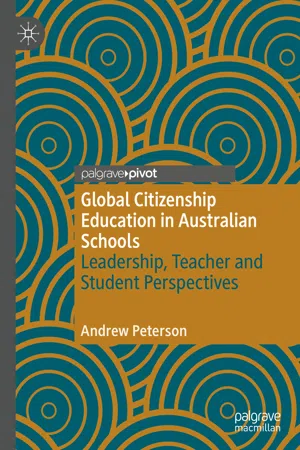
Global Citizenship Education in Australian Schools
Leadership, Teacher and Student Perspectives
- English
- ePUB (mobile friendly)
- Available on iOS & Android
eBook - ePub
Global Citizenship Education in Australian Schools
Leadership, Teacher and Student Perspectives
About this book
This book explores how Australian secondary schools prepare their students for global citizenship. Globalisation has irrevocably changed modern countries and societies, and the benefits and pressures this brings are being felt as never before. Drawing on empirical data from six Australian secondary schools, the author examines how school leaders and teachers understand global citizenship, how they translate this into their practice, and how students experience and make sense of global citizenship education. In doing so, the book portrays how school leaders, teachers and students grapple with key issues central to global citizenship education, including how they work to mediate some of the tensions involved. While the book concentrates on the Australian context, its findings and analysis have resonance for other countries in which global citizenship education operates as a core goal of education and schooling.
Information
Topic
EducationSubtopic
Comparative Education© The Author(s) 2020
A. PetersonGlobal Citizenship Education in Australian Schoolshttps://doi.org/10.1007/978-3-030-56603-6_11. Introduction
Andrew Peterson1
(1)
Jubilee Centre for Character and Virtues, University of Birmingham, Birmingham, UK
Abstract
This introduction establishes the focus of the book on global citizenship and education in Australian secondary schools. It does so by, first, providing a brief context of global citizenship education both globally and in Australia in order to situate the analysis offered in the chapters that follow, arguing that—as with other countries—global citizenship education stands as an important general goal of education and schooling, but that this does not necessarily translate into widespread and effective practice in schools. The chapter then proceeds to set out key details of the empirical study on which the book is based setting out the aims, research questions, methods, sample and participants of a project investigating approaches to global citizenship education in 6 Australian secondary schools. The chapter also lays out the structure of the book, situating the books aims in the context of a still limited body of research literature on how school leaders, teachers and students understand, implement and experience global citizenship education.
Keywords
Global citizenship educationAustraliaSchoolsInterviewsFocus groupsSimilar to its “parent” concept “global citizenship”, global citizenship education represents something of an enigma to the extent to which the term is now fairly ubiquitous within academic discourse yet defies clear, precise and—perhaps more importantly—consistent definition. Global citizenship education, for example, lacks clear disciplinary boundaries, and is permeated by themes such as peace education, human rights education, education for sustainable development, social justice education, education for cultural diversity and futures education. Not only do these terms fall within global citizenship education but some of them, such as peace education, human rights education and education for sustainable development, are identifiable and similarly contested fields in their own rights. In general terms, global citizenship education is posited as crucial for ensuring that students understand a wide range of global trends that impact upon themselves and upon others. These trends include technological developments, increased migration, food security/insecurity, the existence and prevalence of diseases (pandemic, or otherwise), transnational political organisations, multinational corporations, globalised financial systems and institutions, fair and free trade and international terrorism. Furthermore, central to most formulations of global citizenship education is the belief that students need to develop what has generally been termed a global consciousness , perceiving themselves as citizens of the world and learning the requisite capacities to participate actively in global(ised) communities. Furthermore, and as the discussion in Chap. 2 examines, global citizenship education can be conceptualised from a range of theoretical positions and as serving various ends.
Writing nearly a decade ago, Marshall (2011: 10) highlighted the lack of studies examining ‘how schools negotiate the tensions between … [the various] agendas’ that global citizenship education can serve. Despite the increase in empirical studies of global citizenship education over the last decade in a variety of contexts (for example, Israel—Yemini & Fulop, 2015; Yemini & Furstenburg, 2018; Goren & Yemini, 2016; South Korea—Kim, 2019; Pak & Lee, 2018; Lebanon—Ghosn-Chelala, 2020; New Zealand—Tallon, 2012; Milligan, Taylor, & Wood, 2011; USA—Rapoport, 2010; DiCicco, 2016; Canada—Schweisfurth, 2006; China—Woods & Kong, 2020; multiple contexts—Dill, 2013; Walsh & Casinader, 2019), there remains a need for more, and more detailed, empirical studies that illuminate how global citizenship education is understood, practiced and experienced by teachers and students.
The purpose of this present book is to give consideration and attention to forms of global citizenship education in Australia. More specifically, drawing on research collected from six Australian high schools, the book examines the perceptions and practices of school leaders, teachers and students to provide a much needed empirical understanding of how school teachers interpret policy and curricula intentions around global citizenship education and how students experience global citizenship education in practice. By focusing on Australia as a particular case, the analysis and arguments of the book will be of relevance and significance to those working in other contexts in which global citizenship is identifiable as an aim and outcome of education and schooling.
The remainder of this introduction consists of three main sections. The first provides a brief context of global citizenship education in Australia in order to situate the analysis offered in the chapters that follow. The second section provides details of the empirical study on which this book is based, setting out the aims, research questions, methods, sample and participants. The third section lays out the structure of the book. In the pages that follow I seek to portray and examine the ways that global citizenship education manifests in Australian schools at the lower secondary level. From the outset it should be acknowledged that the focus on global learning in Australia is not a completely contemporary phenomenon. Wierenga et al. (2008), for example, trace global citizenship education in Australia back to the 1970s and the educational programs of several development organisations, such as Oxfam and World Vision, and similar histories of global learning exist in other countries. However, in Australia, as elsewhere, the meaning of global citizenship and global citizenship education remains elusive, multifarious and contested. That this is so is not helped by the dearth of empirical studies that engage with the actual existing practices of schools. My hope is that this present book helps towards addressing this gap.
Global Citizenship Education in Australia: A Brief Context
Before offering some brief background comments by way of locating global citizenship education in the Australian context, it is worth saying something about the wider global policy agenda around global citizenship education. At the level of global policy, the increasing importance of global citizenship education is exemplified by a range of conferences, proposals and initiatives since the early 1990s that have recognised and promoted the need for young people around the world to learn about the nature of global issues and to do so through participatory pedagogies. While there is not space to recount all of the various initiatives in full here, key examples include the following: the United Nations Conference on Environment and Development held in Rio de Janeiro in 1992; the United Nations’ Agenda 21 action plan; the 1993 UNESCO report World Plan of Action for Education on Human Rights and Democracy (UNESCO, 1993); the United Nations’ Decade for Human Rights Education (1995–2004); the UNESCO Education for All conferences (Jomtein in 1990 and Dakar in 2000); and the Millennium Declaration; and, the United Nations’ Decade of Education for Sustainable Development (DESD) (2005–2014).
More recently the UN Secretary-General’s Global Education First Initiative placed the fostering of global citizenship as one of its three priorities:
It is not enough for education to produce individuals who can read, write and count. Education must be transformative and bring shared values to life. It must cultivate an active care for the world and for those with whom we share it. Education...
Table of contents
- Cover
- Front Matter
- 1. Introduction
- 2. Global Citizenship Education: Meanings and (Mis)Intentions
- 3. Understandings of, and Approaches to, Global Citizenship Education
- 4. Connections and Relationships Within Global Citizenship Education
- 5. Exploring Current Issues in Global Citizenship Education
- 6. Conclusion: Revisiting the Globally Oriented Citizen and Priorities for Empirical Research on Global Citizenship Education
- Back Matter
Trusted by 375,005 students
Access to over 1.5 million titles for a fair monthly price.
Study more efficiently using our study tools.
Frequently asked questions
Yes, you can cancel anytime from the Subscription tab in your account settings on the Perlego website. Your subscription will stay active until the end of your current billing period. Learn how to cancel your subscription
No, books cannot be downloaded as external files, such as PDFs, for use outside of Perlego. However, you can download books within the Perlego app for offline reading on mobile or tablet. Learn how to download books offline
Perlego offers two plans: Essential and Complete
- Essential is ideal for learners and professionals who enjoy exploring a wide range of subjects. Access the Essential Library with 800,000+ trusted titles and best-sellers across business, personal growth, and the humanities. Includes unlimited reading time and Standard Read Aloud voice.
- Complete: Perfect for advanced learners and researchers needing full, unrestricted access. Unlock 1.5M+ books across hundreds of subjects, including academic and specialized titles. The Complete Plan also includes advanced features like Premium Read Aloud and Research Assistant.
We are an online textbook subscription service, where you can get access to an entire online library for less than the price of a single book per month. With over 1.5 million books across 990+ topics, we’ve got you covered! Learn about our mission
Look out for the read-aloud symbol on your next book to see if you can listen to it. The read-aloud tool reads text aloud for you, highlighting the text as it is being read. You can pause it, speed it up and slow it down. Learn more about Read Aloud
Yes! You can use the Perlego app on both iOS and Android devices to read anytime, anywhere — even offline. Perfect for commutes or when you’re on the go.
Please note we cannot support devices running on iOS 13 and Android 7 or earlier. Learn more about using the app
Please note we cannot support devices running on iOS 13 and Android 7 or earlier. Learn more about using the app
Yes, you can access Global Citizenship Education in Australian Schools by Andrew Peterson in PDF and/or ePUB format, as well as other popular books in Education & Comparative Education. We have over 1.5 million books available in our catalogue for you to explore.