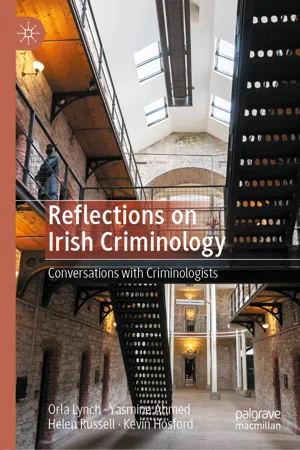
This book explores the development of the discipline of Criminology on the island of Ireland, through conversations with leading criminologists. Adding depth and breadth to the understandings of this growing discipline, leading scholars discuss their personal journey to Criminology, their research areas, their theoretical influences and the impact of the discipline of Criminology on how we think about criminal justice in Ireland and beyond. Research topics include desistence, victims' rights, parole, policing and research methods. The book explores what influences framed the work of key thinkers in the area and how Criminology intersects with policy and practice within and beyond the criminological and criminal justice fields. It provides an insight into how the discipline has emerged as a discrete subject through a discussion of Ireland's key historical moments. It argues that Ireland's unique historical, cultural, political, social and economic arrangements and research about Ireland have much to offer the international field of Criminology. This volume also reflects on future directions for Irish Criminology, as well as sounding warnings to ensure the healthy development of the field as a discipline in its own right and as an interdisciplinary undertaking.
eBook - ePub
Reflections on Irish Criminology
Conversations with Criminologists
- English
- ePUB (mobile friendly)
- Available on iOS & Android
eBook - ePub
Reflections on Irish Criminology
Conversations with Criminologists
About this book
Information
© The Author(s), under exclusive license to Springer Nature Switzerland AG 2020
O. Lynch et al.Reflections on Irish Criminologyhttps://doi.org/10.1007/978-3-030-60593-3_11. Criminology in Ireland, the Rise of a Discipline
Orla Lynch1 , Yasmine Ahmed2 , Helen Russell3 and Kevin Hosford4
(1)
Department of Sociology and Criminology, University College Cork, Cork, Ireland
(2)
Department of Sociology and Criminology, University College Cork, Cork, Ireland
(3)
Department of Sociology and Criminology, University College Cork, Cork, Ireland
(4)
Department of Sociology and Criminology, University College Cork, Cork, Ireland
Abstract
The rise and rise of criminology in Ireland cannot be understood by focusing only on the traditional disciplinary boundaries of the field. As Prof. Maruna points out in this volume, we are all academic magpies and criminology is our rendezvous discipline; it is this eclecticism that gives Irish criminology its uniqueness. Most importantly, and a belief that is shared by all the participants in this book, is that criminology in Ireland is what it is and where it is because of the people; the researchers, the teachers, the service users, the practitioners and the students. In this volume we trace the lineage of some of Ireland’s criminologists, magpies and purists alike, from their undergraduate studies to their appointment as Chairs and Professors, we document their influences and their partnerships, their innovations and their ideologies. Through understanding where the contributors are coming from we understand better how and why they are where they are.
Keywords
DisciplineCriminologyAbsenteeIrelandBoundariesThe uniqueness of Irish criminology is best summed up by reference to the opening statement in one of the founding texts of the discipline (Brewer et al. 1997b).
References to Ireland, even when it is to ordinary crime, are best to begin with political history. (p. 1).
In the nearly twenty five years since this recommendation was made, it has become a reality and captures what Maruna and McEvoy (2015) call the intellectual ambitiousness that defines Irish criminology. Criminology in Ireland has grown from what was once termed Ireland’s absentee discipline (Kearns, 2020) to a multi-disciplinary and interdisciplinary undertaking that re-imagines the work of international criminology from an Irish perspective.
Speaking at a conference in Mount Joy Prison in 2020, Prof. Ian O’Donnell described criminology in Ireland as buoyant, having long thrown off the label of Ireland’s absentee discipline (Kearns, 2020). Having come a long way since its roots in the early 1970s where attempts to stimulate research in the area were rejected by statutory organisations, Ireland’s criminal justice agencies are now active creators and consumers of research albeit some more ardent than others. Similarly, Hamilton, Healy et al. (2015) in their seminal volume on criminology in Ireland point out it is time to reconsider the Cinderella status of Irish criminology, that as a discipline we have come of age.
However, criminology if not in name, then certainly in intellectual spirit, has a long history on the island of Ireland. In 1993 Paul O’Mahony pointed out that there was no strong tradition of criminological or penological research in Ireland, namely because there was no university department of criminology at that time. However, despite this a diversity of individuals and disciplines contributed to and continue to contribute to what has become the discipline of criminology and this legacy uniquely defines the current scope and form of the field. To say there is an Irish criminology is perhaps inaccurate, but criminology in Ireland as a discipline is certainly unique. The field is very much informed by the history of the Island, defined by the violence and the politics of the Troubles, informed by our history of coercive confinement, and couched in an interdisciplinary tradition.
However, until recently, Irish criminology as a disciplinary speciality rarely featured in the international criminology literature despite a rich and vibrant criminology community developing on the island (O’Donnell 2005). For example, according to a review of the European Journal of Criminology (Smith 2013) between 2004 and 2012 there were no contributions by Irish authors.1 However, given where we started from, we are not that far behind the curve. The first issue of the European Journal of Criminology was published in 2004 and it is reasonable to suggest that Ireland’s criminological awakening only occurred the 1990’s so we are quite similar to our European neighbours (Smith 2013). But unlike our European neighbours, criminology in Ireland was not seen as a resource by the state and was not funded as such, and so its developmental trajectory is both slower and more critical.
Despite the total absence of state funding (O’Donnell 2005) or perhaps as a result of it, criminology in Ireland emerged thanks to the work of a few key individuals and a persistence that has led to the development of a vibrant and diverse academic criminology community on the island. The early work of Paul O’Mahony (1993), Ciaran McCullagh (1996), Ivana Bacik et al. (1998), Ian O’Donnell (1997), Caroline Fennell (1993), and John Brewer et al. (1997a) can reasonably be said to be the foundation stones for what was to come and more recently the work of Hamilton, Healy et al. (2015) cemented the discipline as a key part of Irish intellectual activity. In parallel to the research and theoretical outputs that propelled the field forward, a parallel growth in academic criminology programs and the emergence of criminology as a department or discipline in a number of Irish higher education institutions embedded criminology as a mainstay of Irish academia.
A key moment for criminology in the Republic of Ireland was the development of the Institute of Criminology in 2000. Situated in the Faculty of Law at University College Dublin (UCD) the Institute had an emphasis on research and doctoral training and remains the only such research centre in the south of the country. It is important to recognise however, that the trajectory of the development of criminology in Ireland was not uniform. In 2005 O’Donnell pointed out that criminology in Northern Ireland has long had a presence with the Institute of Criminology and Criminal Justice in existence since 1995 and a number of academic programmes being offered in both Queens University and the University of Ulster. However, Northern Ireland was still somewhat trailing criminology in Great Britain. Maruna and McEvoy (2015) point out that when Ken Pease was commissioned to review the criminological landscape of the region in 1992, he called it ‘quite bleak’ (p. 593), however, not as bleak as the Republic of Ireland. The impact of the Troubles was of course highly relevant for the emergence of criminology and the way in which criminal justice research developed in Northern Ireland, but this too was the case in the South— albeit somewhat less obvious, or at least less recognised. The fact that the 1988 Victimological survey of Northern Ireland stated the province had the lowest rate of victimisation of all European countries surveyed tells you something about the state of criminological research in the region. In the south, the impact of civil unrest on crime and punishment was largely overlooked. Brewer et al. (1997b) point out that in McCullough’s 1996 book on Crime in Ireland, one of the key foundational texts for Irish criminology, the North and the Troubles are hardly mentioned. In spite of both these issues, Maruna and McEvoy (2015) have jubilantly declared that things have now utterly changed (p. 593) for the better.
Since 2000, there has been a significant growth in criminology modules and programmes in both Northern Ireland and the republic. In 2015 Hamilton, Healy et al. pointed out that globally, criminology was booming and Ireland was slowly increasing its programme offerings. At the time, the authors counted over thirty programmes with criminological components, today that has increased to 18 programmes at level 8 QQI2 and above primarily focused on criminology (see appendix one) and 36 programmes with a criminology component at level 8 and above. In the Institutes of Technology (IRE) and Further Education Colleges (NI) there are approximately 20 programmes with a criminology component (level 7 or lower). These courses do not take into account the programmes (level 7 or lower, special purpose or CDP programmes) on offer by private, independent and not-for-profit colleges, nor do they account for adult or continuing education programmes on offer by Universities, nor Open University options. It is difficult to quantify the number of graduates, but based on average figures provided by the institutions themselves both North and South, there are between 900 and 1000 students who enrol each year on criminology and criminology related (level 8 and above) programmes (see appendix one for details).
While this progress represents a very positive development for the discipline of criminology, it does present the field with a dilemma; the need to balance the needs of an ever increasing student population with the limited research funding that is available and the limited opportunities that exist within academic to pursue research and teaching careers. In this volume O’Donnell (chapter two) points out that the burden of managing ever increasing numbers of programmes and students may well serve to stifle the opportunities for researchers to progress knowledge and critique of and in the field.
Situating Irish Criminology
More in step with our European colleagues (...
Table of contents
- Cover
- Front Matter
- 1. Criminology in Ireland, the Rise of a Discipline
- 2. In Conversation with Prof. Ian O’Donnell
- 3. A Conversation with Dr Deirdre Healy
- 4. In Conversation with Prof. Claire Hamilton
- 5. In Conversation with Dr Jennifer O’Mahoney
- 6. In Conversation with Dr Cheryl Lawther
- 7. In Conversation with Prof. Shane Kilcommins
- 8. In Conversation with Prof. Mary Rogan
- 9. In Conversation with Dr Diarmuid Griffin
- 10. In Conversation with Prof. Maggie O’Neill
- 11. In Conversation with Prof. Shadd Maruna
- Back Matter
Trusted by 375,005 students
Access to over 1.5 million titles for a fair monthly price.
Study more efficiently using our study tools.
Frequently asked questions
Yes, you can cancel anytime from the Subscription tab in your account settings on the Perlego website. Your subscription will stay active until the end of your current billing period. Learn how to cancel your subscription
No, books cannot be downloaded as external files, such as PDFs, for use outside of Perlego. However, you can download books within the Perlego app for offline reading on mobile or tablet. Learn how to download books offline
Perlego offers two plans: Essential and Complete
- Essential is ideal for learners and professionals who enjoy exploring a wide range of subjects. Access the Essential Library with 800,000+ trusted titles and best-sellers across business, personal growth, and the humanities. Includes unlimited reading time and Standard Read Aloud voice.
- Complete: Perfect for advanced learners and researchers needing full, unrestricted access. Unlock 1.5M+ books across hundreds of subjects, including academic and specialized titles. The Complete Plan also includes advanced features like Premium Read Aloud and Research Assistant.
We are an online textbook subscription service, where you can get access to an entire online library for less than the price of a single book per month. With over 1.5 million books across 990+ topics, we’ve got you covered! Learn about our mission
Look out for the read-aloud symbol on your next book to see if you can listen to it. The read-aloud tool reads text aloud for you, highlighting the text as it is being read. You can pause it, speed it up and slow it down. Learn more about Read Aloud
Yes! You can use the Perlego app on both iOS and Android devices to read anytime, anywhere — even offline. Perfect for commutes or when you’re on the go.
Please note we cannot support devices running on iOS 13 and Android 7 or earlier. Learn more about using the app
Please note we cannot support devices running on iOS 13 and Android 7 or earlier. Learn more about using the app
Yes, you can access Reflections on Irish Criminology by Orla Lynch,Yasmine Ahmed,Helen Russell,Kevin Hosford in PDF and/or ePUB format, as well as other popular books in Social Sciences & British History. We have over 1.5 million books available in our catalogue for you to explore.