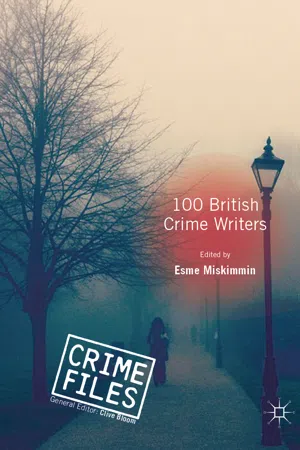
100 British Crime Writers explores a history of British crime writing between 1855 and 2015 through 100 writers, detailing their lives and significant writing and exploring their contributions to the genre. Divided into four sections: 'The Victorians, Edwardians, and World War One, 1855-1918'; 'The Golden Age and World War Two, 1919-1945'; 'Post-War and Cold War, 1946-1989'; and 'To the Millennium and Beyond, 1990-2015', each section offers an introduction to the significant features of these eras in crime fiction and discusses trends in publication, readership, and critical response. With entries spanning the earliest authors of crime fiction to a selection of innovative contemporary novelists, this book considers the development and progression of the genre in the light of historical and social events.
- English
- ePUB (mobile friendly)
- Available on iOS & Android
eBook - ePub
100 British Crime Writers
About this book
Information
Part IThe Victorians, Edwardians, and World War One, 1855–1918
Introduction
Popular perceptions of crime writing from this period, particularly in terms of the Victorians, tend to focus on the particular genre of detective fiction and the often-used and now mythologized narrations of super-ratiocination in foggy London streets. This is not really surprising, given that British detective fiction proper essentially begins with A Study in Scarlet (1887), in which we are introduced to Conan Doyle’s most famous of detectives, Sherlock Holmes. During the period covered in this first part there were a significant number of crime stories in the Holmes mould, but as the following entries from Caroline Clive to John Buchan show, there is in fact a diverse range of crime writing in this era, including some genres which we perhaps might think of as more modern in their inception, such as the spy thriller (represented in this part by E. Phillips Oppenheim, Erskine Childers and John Buchan) or tales of forensic investigation, such as Austen Freeman’s Thorndyke stories – arguably the very first in this field. We also find an early example of a work on the crime genre: Chesterton’s 1902 ‘A Defence of Detective Stories’, which foreshadows the continuing self-reflexive nature of the crime genre, and the need to make it the focus of critical discussion.
From the very earliest examples of crime writing explored here, we can see many of the issues and themes raised that preoccupy the genre and its critics over the next one hundred and sixty years, such as its explorations of justice and morality, gender, violence, the urban world and its overwhelming self-consciousness of genre and narrative. It should be remembered that, as with Haycraft’s discussions in Murder for Pleasure, the entries in this collection are about more than the writers’ works: they are about their lives and times as well. As will be demonstrated throughout this entire collection, these two factors are often linked, and we see the influence of the lives the writers lead on the fiction they write. Sometimes, it has to be said, it seems as though the lives of the writers make even more exciting reading than their stories: the biographical elements detailed below include bigamy, illegitimacy, some minor felonies and more than a few tragic endings, such as that of Caroline Clive, who is the subject of the first entry in this collection.
It is interesting to learn that contemporary responses to Clive’s first novel, Paul Ferroll (1855), expressed anxiety about the morality of this novel, with Clive being forced to rewrite an ending in which the guilty Ferroll dies. He dies, however, unrepentant of his crimes and due to illness rather than any force of human justice, a fact that serves to illustrate that the crime genre in its various forms has always raised challenging ethical questions and explored the ambiguity of justice as a concept. In fact, crime writing often becomes a discourse on the nature of crime and punishment from both a legal and spiritual perspective and, sometimes, the tensions arising between these two; a theme made explicit in the ‘Father Brown’ stories of G. K. Chesterton, discussed by Christopher Routledge in the entry below, where the dual roles of priest and detective raise some complex issues.
Caroline Clive is one of the four authors in this part that pre-date Doyle. As mentioned in the general introduction, Haycraft’s argument was that there could be no detective stories until there were detectives, and therefore his discussion of the British detective story begins with Arthur Conan Doyle. Holmes was not, technically, the first literary detective: accounts of Newgate crimes and the Bow Street Runners had been around some time, and writers such as Godwin and Andrew Forrester had produced crime and detective stories, but according to Haycraft, the advent of Sherlock Holmes marks ‘the creation of a really great detective character, the writing of full length detective stories concerned with detection and nothing else’. Haycraft does, however, preface this discussion of the Holmes stories with a chapter entitled ‘The In-Between Years’ (that is, in between Poe and Doyle), in which he discusses various authors who concern themselves with crimes in their narratives, but in which the detection of the crime ‘is the plum in the pudding, but it is by no means the entire pudding.’
The four pre-Doyle authors here, Caroline Clive, Wilkie Collins, Mrs Henry Wood and Mary Elizabeth Braddon, are all writers of the ‘sensation fiction’ popular at the time, in which lurid crimes are committed, usually within an apparently safe middle-class milieu. In his assessment of ‘The In-Between Years’, Haycraft discusses Collins, commenting on his lack of success in trying to write ‘polemic and reformist novels’, but also of his triumphs in imaginative plotting, humourous writing and quality of characterisation. However, Haycraft mentions none of the female writers listed below; indeed, Clive and Wood have been largely neglected in most critical responses to the literature of the period until recently. This has inevitably to do with gender; not least because, as Adrienne E. Gavin argues in her entry on Braddon, the subject matter of such novels was not considered suitable material for a woman as writer or reader. Gavin also points out the importance of Braddon’s writing in challenging traditional roles of women in crime fiction, long before the advent of specifically feminist crime writing such as Tart Noir, and moving women away from the sole function of victim into the roles of detectives and criminals.
There are actually quite a few female detectives and crime fighters in the selection below, although the numbers are in no way even, and there are sadly no female criminal masterminds to rank alongside E. W. Hornung’s Raffles or R. Austen Freeman’s Romney Pringle. On the side of the good, Collins gives us Anne Rodway and Marian Halcome, and in the Law and the Lady, the first pregnant investigator: Valeria Brinton/Woodvill. There are also several women who have made detection their career, such as George R. Sim’s Dorcas Dene and C. L. Pirkis’ Loveday Brooke, advertised as a ‘female Sherlock Holmes’, both examples of the ‘lady detective’ (or, as Haycraft would have it, of ‘feminine sleuths’). In her entry on Pirkis, Adrienne E. Gavin highlights some interesting differences between male-authored creations such as Dene and Pirkis’ Brooke, in as much that unlike Dorcas Dene, the female-authored Loveday Brooke is unmarried, independent and not portrayed in terms of her physical or feminine qualities. Later on in this period comes Baroness Orczy’s Lady Molly of the Yard, first appearing in 1910, and who, as Greg Rees points out, comes with her own proto-feminist female narrator.
A significant proportion of the works in the Victorian and Edwardian period, such as the Loveday Brooke stories, or Arthur Morrison’s Martin Hewitt narratives, were originally published in serial form or as individual short stories in journals and magazines, which has an inevitable influence on them in terms of content and style; short pieces of popular fiction must rely on recognisable tropes of character and place and the conventions of genre to convey things swiftly to their readers, so potentially a full development of many narrative elements is impossible. Serialised stories can also place more emphasis on moving the plot along, and the need for a ‘cliffhanger’ to encourage the reader to continue in the next volume can lead to some awkward plot ‘spikes’ when the story is collated into novel form. That is not to say that any of these stories are lacking in originality or stylistic dexterity, or are without interest to those concerned with an analysis of the genre: their appeal can lie, in part, in these publishing origins. As we move closer to the end of this era we see several examples of experimentation with form and style, such as Freeman’s collection of short stories The Singing Bone (1912), in which he describes the crime being committed before moving on to the process of deception. This is a device which Nick Freeman rightly describes as pioneering in its form, but which Haycraft, with some heat, described as ‘a rather dangerous departure’ from the norm, and even ‘perilous’ in its premise.
The appearance of much early crime fiction in serialised magazines and periodicals is also perhaps indicative of the genre both in relation to concepts of ‘literature’, and also of its readership; crime fiction is by and large ‘middlebrow’ writing. In her entry on Mrs Henry Wood, Anne-Marie Beller comments on her use of ‘provincial and predominantly middle-class’ settings, and Wood is not the only writer to locate her stories within these geographical and sociological spaces. The provinces are not utilised as much as London – the main home of crime writing in this period – but they are there, as are the suburbs of the capital; seemingly respectable middle-class worlds that are in fact as crime-filled and subversive as the rookeries of Holmes’ London. One of the key features of much British crime writing established during this period is that we cannot identify the criminal by his or her otherness, such as social class or physical appearance: crime exists in every area of society. This idea, perhaps best illustrated by Conan Doyle’s short story ‘The Man with the Twisted Lip’ (1891), must surely contribute to the vicarious frisson of the crime story: as I discuss in the general introduction, part of the appeal is that the escapism generated is paradoxically accompanied by the reader’s imagined participation, for which a recognisable milieu is essential. Although London features most frequently as a setting there are always counter-spaces: the provinces and the suburbs, but also the British colonies, such as in Collin’s The Moonstone with its Indian backstory, or the ‘Sanders of the River’ stories of Edgar Wallace (first appearing in 1911), set in the Belgian Congo and in which, as Stephen Knight observes, Sanders is ‘a sort of colonial Sherlock Holmes’. Europe likewise is an increasingly significant setting, especially in the late nineteenth and early twentieth centuries with society’s increasing concerns about German militarism.
These particular political and military circumstances contributed to the emergence of spy and adventure writing, and in this part Alexandra Phillips discusses Oppenheim’s The Mysterious Mr Sabin (1898) as arguably the first ever spy thriller. Haycraft refers to Oppenheim as a ‘border-liner’, whose ‘countless spy-and-intrigue novels […] occasionally approach detection’ and as such can do no more with him in a discussion of the pure detective story. Here, however, Phillips establishes his significance in terms of the crime writing genre as a response to social and political Zeitgeist and shows us that Oppenheim’s own experiences had a direct influence on his novels that ‘articulate anxieties about a possible German invasion’. Similarly, the personal, political and military experiences of Erskine Childers and John Buchan had an impact on the other spy stories discussed below, including Childers’ seminal The Riddle of the Sands (1903), and Buchan’s The Thirty-Nine Steps (1915). These gripping adventures also have a counterpart for younger readers in this era: the end of this period also sees the emer...
Table of contents
- Cover
- Front Matter
- Part I. The Victorians, Edwardians, and World War One, 1855–1918
- Part II. The Golden Age and World War Two 1919–1945
- Part III. Post-War and Cold War, 1946–1989
- Part IV. To the Millennium and Beyond, 1990–2015
- Back Matter
Trusted by 375,005 students
Access to over 1.5 million titles for a fair monthly price.
Study more efficiently using our study tools.
Frequently asked questions
Yes, you can cancel anytime from the Subscription tab in your account settings on the Perlego website. Your subscription will stay active until the end of your current billing period. Learn how to cancel your subscription
No, books cannot be downloaded as external files, such as PDFs, for use outside of Perlego. However, you can download books within the Perlego app for offline reading on mobile or tablet. Learn how to download books offline
We are an online textbook subscription service, where you can get access to an entire online library for less than the price of a single book per month. With over 1.5 million books across 990+ topics, we’ve got you covered! Learn about our mission
Look out for the read-aloud symbol on your next book to see if you can listen to it. The read-aloud tool reads text aloud for you, highlighting the text as it is being read. You can pause it, speed it up and slow it down. Learn more about Read Aloud
Yes! You can use the Perlego app on both iOS and Android devices to read anytime, anywhere — even offline. Perfect for commutes or when you’re on the go.
Please note we cannot support devices running on iOS 13 and Android 7 or earlier. Learn more about using the app
Please note we cannot support devices running on iOS 13 and Android 7 or earlier. Learn more about using the app
Yes, you can access 100 British Crime Writers by Esme Miskimmin in PDF and/or ePUB format, as well as other popular books in Literature & Literature General. We have over 1.5 million books available in our catalogue for you to explore.