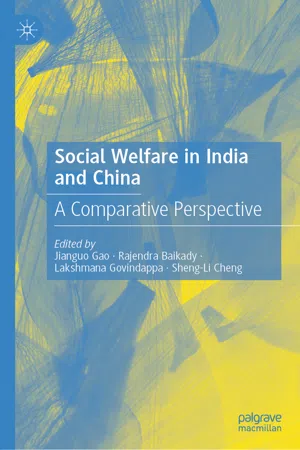
Focusing on social work and social service delivery, this book examines the social policies and programmes designed to address different societal issues and concerns across India and China. It focuses on gaining understanding of design and delivery of social welfare policies related to special interest groups, highlighting important contemporary challenges such as child labour, child abuse, exploitation of women, problems related to disabled people, mental health issue, illiteracy and unemployment. Offering a comparative perspective, the book considers the impact of political administration in both countries to critically assess key issues related to social welfare in two different political, economic, social, and cultural contexts.
eBook - ePub
Social Welfare in India and China
A Comparative Perspective
- English
- ePUB (mobile friendly)
- Available on iOS & Android
eBook - ePub
Social Welfare in India and China
A Comparative Perspective
About this book
Information
© The Author(s) 2020
J. Gao et al. (eds.)Social Welfare in India and Chinahttps://doi.org/10.1007/978-981-15-5648-7_11. Introduction: Globalization, Economic Reform and Social Welfare in India and China
Jianguo Gao1 , Sheng-Li Cheng1 , Rajendra Baikady2, 3 and Lakshmana Govindappa4
(1)
Shandong University, Jinan, China
(2)
Hebrew University of Jerusalem, Jerusalem, Israel
(3)
University of Johannesburg, Johannesburg, South Africa
(4)
Central University of Karnataka, Kalaburagi, India
Keywords
GlobalizationEconomic reformsSocial welfareIndia and ChinaGlobalization, neoliberalism and market-based economy had brought numerous changes in the welfare system of many countries across the world. Development in economic, lifestyle change and advancement of science, technology and communication resulted in innumerable changes in the social life of the people. These changes in social life have also led to changing social needs, social problems and their solutions. Irrespective of economic advancement, technological development and rise in the standard of living, in every society there are communities who are marginalized and disadvantaged. Social welfare provisions are the policies that target the wellbeing of society at a large. These policies and programmes include every class/group of people in the society i.e. children, women, the disabled, elderly and other marginalized and disadvantaged section of the society. These policies and programmes are primarily aimed at ensuring a basic standard of living for everyone. Social assistance is one of the most important and largely followed ways of social intervention to the adverse consequences resulting from the socioeconomic disadvantages (Bahle et al. 2010).
In both India and China, the government is the major service provider, but the approaches of service and the provisions of service are different in two different economies. Interestingly political administration of both India and China is different in nature and there is a considerable difference in social service delivery system between India and China. However as noted by the scholarly world the next big change to the contemporary world society will probably not be a matter of economics, or electronics, or military science; it will be a change in the everyday world of politics. The political administration of a nation is the basic concept that has an influence on each and every aspect of the development and welfare. In many countries provisions of social welfare, social security and social assistance are taken care of by the administrative divisions of the respective governments. In fact, in India, the democratic administrative system is directly responsible for the provisions of social welfare. In general, Social assistance is the programme of last resort. It is intended for persons who have exhausted all other means of financial support. India is a democratic republic where the constitution of the country guarantees each citizen of the country with rights and civil liberties. At present Indian society is facing many social problems such as child labour, child abuse, exploitation of women, problems related to disabled people, mental health issue, illiteracy, unemployment, etc. poverty is the substantial problem even in the present Indian society.
This book focuses on the social policies and programmes designed to address different societal issues and concerns across India and China. The primary focus is on gaining an understanding of the design and delivery of the social welfare policies and programmes related to special interest groups i.e. Women, Children, Elderly, poverty groups, etc. Chapters in this volume result from both theoretical, evidence -based and empirical to bring out policy analysis and outcome to enable academicians and practitioners for policy impact and advocacy work. China and India are two countries in the world that share the most characteristics in common. Both are the most populous countries in the world and both are located in Asia. Both are proud of their long civilization that goes back to some 5000 years, but both suffered invasions and colonial rules. Both India and China won their independence in the late 1940s and advocated the principles of peaceful co-existence, the moral ideas of Chinese and Indians are similar. India is the second-largest populated country in the world. Since its independence from Britishers in 1949, India is facing many issues related to the development. The uniqueness of the geography, political system, economic sectors and the other aspects are contributing as well as constraining the society’s development. China is the most populous country in the world with a single-party government in operation. The problems faced by present China are not very different from the rest of the word. Similar to India, the Chinese government is also following a planned growth strategy (five-year plans) since 1953. The purpose of this chapter is to critically examine the social welfare reforms of both India and China after 1978 and its effect on the welfare of the people. In this introductory chapter we provide; a general introduction followed by (i) an overview of reform, policies and social welfare in China; (ii) an overview of reform, policies and social welfare in India; (iii) the population in need for welfare—a comparison; and (iv) a critical understanding of the role of the state in social welfare. The chapter concludes with a summary of the volume and its scope.
India is a democratic republic and is divided into 27 states. Each of these states has its own government elected by the people living in it. In addition to these state governments the country has a federal government at the centre and over 200,000 (urban and rural) local governments which make the administrative structure a truly decentralized and people-centric. As a parliamentary democracy, the country has elected legislatures and an independent judiciary that hold both the legislative and executive arms of the state accountable. In order to ensure accountability and transference in its administration and development the nation followed the electoral process, the ultimate accountability mechanism in a democratic country, and it has performed well for over 70 years. A number of independent authorities and commissions are also set up to perform accountability functions in coordination with different parts of the government. The political functioning of the People’s Republic of China takes place in a framework of socialist republic run by a single party. Accordingly, the Communist Party of China is the administrative authority in the country with the largest population in the world. The country is governed under the constitution of 1982 as amended, the fifth constitution since the accession of the P.R China in 1949. The unicameral legislature is the National People’s Congress (NPC), consisting of deputies who are indirectly elected to terms of five years. The power to decide national economic strategy, elect or remove high officeholders, and change China’s constitution rests with the National People’s Congress (NPC). In our context, for the purpose of this volume “China” refers to the People’s Republic of China (mainland China); “Economic Reform” refers to the comprehensive reform in its economic system (or institution) since 1978; and an economic reform in India refers to the reforms after 1980. However, we also note here that contributions in this volume are addressed beyond the geographical and administrative boundaries of the People’s Republic of China.
The Reforms, Policies and Social Welfare in India
This part makes an attempt to familiarize the readers with the major reforms, policies and the programmes in India since 1980s. Here we discuss the government’s efforts to develop the economy and the society by introducing a number of programmes and policies for the advancement of economy and society. The discussion is concentrated on India’s opening up to the global market “Globalisation, Liberalization and the Privatization” and welfare activities. India restructured its economic plans after gaining independence from United Kingdome in 1947. A long-term colonialism and exploitation of resources by the Britishers left India a poor and developing country in the world. In addition, the Indian economy is predominantly based on Agriculture and rural-centric. The agricultural sector in the country contributes 13.9% of India’s gross domestic product (GDP) and employs just a little less than 54.6% of the country’s workforce (Wagh and Dongre 2016). In addition, agriculture is the principal means of livelihood for the 58% of rural households, Agriculture, along with fisheries and forestry, is one of the largest contributors to the Gross Domestic Product (Wagh and Dongre 2016). Being the most significant part of the Indian economy agricultural sector witnessed a considerable transformation in the past two decades. On the one hand, policies of globalization, liberalization and privatization have opened up new opportunities for the agricultural sector with modernization and advancement. On the other hand, these modernization lead to commercialization, diversification and technological and institutional innovations which generated a huge investment in the sector. Unfortunately, India’s agriculture is largely dependent on Monsoon and other factors like unfavourable geographical conditions, religious beliefs, social superstitions and Zamindari system. As a result of these issues, poverty is even today a major social issue in India. Today India’s economy is overpopulated. It has grown by more than three times in the last 60 years. At the time of independence in 1947, the population was 350 million. According to the 2011 census, India’s population stands at 1.21 billion. It is second only to China in the world and may even overtake China in future. Nearly one-third of the world’s poor live in India. The country today has beggars on the streets, the slums in towns and cities, children working in the fields or in the street side dhabas or employed in houses or in factories, etc.
Soon after independence, in 1951 the Indian government formulated five-year plans for accelerating the focused development. As a result, the first five-year plan came into force during 1951–1956 and the twelfth five-year plan was ended in 2017. These five-year plans helped the Indian economy to tackle many challenges that were bothering the development of the country. At the beginning of the first plan, more than 70% of the population were engaged in agriculture and related activities. Even if this has come down, still around 60% of the population was still dependent on agriculture at the beginning of the twenty-first century i.e. the y...
Table of contents
- Cover
- Front Matter
- 1. Introduction: Globalization, Economic Reform and Social Welfare in India and China
- Part I. Society and Welfare in India and China—A Comparison
- Part II. Child Welfare in India and China
- Part III. Elderly Care in India and China—Emerging Concerns
- Part IV. Poverty in Numbers—Where India and China Stands
- Part V. Social Problems in India and China—A Comparison
- Back Matter
Trusted by 375,005 students
Access to over 1.5 million titles for a fair monthly price.
Study more efficiently using our study tools.
Frequently asked questions
Yes, you can cancel anytime from the Subscription tab in your account settings on the Perlego website. Your subscription will stay active until the end of your current billing period. Learn how to cancel your subscription
No, books cannot be downloaded as external files, such as PDFs, for use outside of Perlego. However, you can download books within the Perlego app for offline reading on mobile or tablet. Learn how to download books offline
Perlego offers two plans: Essential and Complete
- Essential is ideal for learners and professionals who enjoy exploring a wide range of subjects. Access the Essential Library with 800,000+ trusted titles and best-sellers across business, personal growth, and the humanities. Includes unlimited reading time and Standard Read Aloud voice.
- Complete: Perfect for advanced learners and researchers needing full, unrestricted access. Unlock 1.5M+ books across hundreds of subjects, including academic and specialized titles. The Complete Plan also includes advanced features like Premium Read Aloud and Research Assistant.
We are an online textbook subscription service, where you can get access to an entire online library for less than the price of a single book per month. With over 1.5 million books across 990+ topics, we’ve got you covered! Learn about our mission
Look out for the read-aloud symbol on your next book to see if you can listen to it. The read-aloud tool reads text aloud for you, highlighting the text as it is being read. You can pause it, speed it up and slow it down. Learn more about Read Aloud
Yes! You can use the Perlego app on both iOS and Android devices to read anytime, anywhere — even offline. Perfect for commutes or when you’re on the go.
Please note we cannot support devices running on iOS 13 and Android 7 or earlier. Learn more about using the app
Please note we cannot support devices running on iOS 13 and Android 7 or earlier. Learn more about using the app
Yes, you can access Social Welfare in India and China by Jianguo Gao, Rajendra Baikady, Lakshmana Govindappa, Sheng-Li Cheng, Jianguo Gao,Rajendra Baikady,Lakshmana Govindappa,Sheng-Li Cheng in PDF and/or ePUB format, as well as other popular books in Politics & International Relations & Comparative Politics. We have over 1.5 million books available in our catalogue for you to explore.