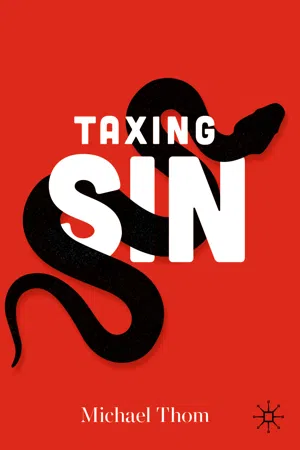
Conventional wisdom dictates that those goods which are said to cause harm or impose costs on society deserve a special tax. For centuries, governments have levied these "sin taxes" on alcohol and tobacco, but the list of taxable sins has now grown to include soda and marijuana, with calls to impose further taxes on plastic bags, meat, and even robots and carbon. Contrary to what experts and policymakers tell us, many of these alleged sins impose very little, if any, cost on society, and the harms that do exist can be minimized without resorting to tax. What follows in this book is a discussion of four case studies—on tobacco, marijuana, alcohol and soda—which make the case against the conventional wisdom in taxing these "sins", before concluding that when it comes to taxing sin, it is time for governments to forgive—and forget.
eBook - ePub
Taxing Sin
About this book
Information
© The Author(s) 2021
M. ThomTaxing Sinhttps://doi.org/10.1007/978-3-030-49176-5_11. Tax Your Sins, Experts Say
Michael Thom1
(1)
Sol Price School of Public Policy, University of Southern California, Los Angeles, CA, USA
Keywords
Sin taxesExternalityCognitive biasesPaternalismOur moral reformers, so often given to intemperate words and contemptuous measures, have been instrumental to a large extent in accustoming the American mind to habits of over-statement and unmitigated rebuke, which are unfortunately now becoming a national disease. The New York Times, 1854
Each is the proper guardian of his own health, whether bodily, or mental and spiritual. Mankind are greater gainers by suffering each other to live as seems good to themselves, than by compelling each to live as seems good to the rest. John Stuart Mill, 1859
The word “sin” comes from terms in early Jewish and Christian texts that refer to an individual who committed an error, went astray, or missed the mark. The notion raises profound questions that theologians have wrestled with for thousands of years. How does an individual know whether a choice is sinful or not, especially if scripture offers no indication? Who makes those judgments? What must a sinner do to reconcile with others and God? Should sinners flounder in imperfection or strive for perfection?
While church and state may be increasingly separate, parallel themes dominate public policymaking. Which choices and behaviors in society are acceptable and unacceptable? Who makes those distinctions? On what basis? What restitution is due from those who make the wrong choice? Should governments aim to help individuals muddle through a world of imperfect choices, or should governments push society toward utopia?
If there is a meaningful difference between sacred and secular approaches to those who have committed an error, gone astray, or missed the mark according to their respective standards, it is the path to redemption.
In most religious traditions, atonement comes through repentance and divine mercy. Governments, by contrast, often incarcerate their transgressors to ensure they “pay their debt to society.” And although most denominations have abandoned efforts to monetize forgiveness, governments charge some of their sinners for redemption every day.
Taxing Sin is about a particular kind of secular redemption—paying a tax—for a particular kind of secular sin—the choice to buy something the government says you should avoid. Sin taxes have been applied to alcoholic beverages and tobacco products for some time. By the twenty-first century, they spread to soda and marijuana alongside calls to expand the list of tax-worthy items to include plastic bags and meat. Some went further and demanded a tax on robots and carbon.
Against that momentum, Taxing Sin argues that classifying certain goods as deserving of a selective tax is a folly—a foolish, ineffective policy for governments to control our choices. To understand why that’s the case, it is important to understand the reasons why so many put their faith in the redemptive power of government—and taxation.
***
Governments have charged sin taxes for hundreds of years.1 By the sixteenth and seventeenth centuries, taxes on alcohol, tobacco, and other goods appeared throughout the Americas, Europe , and the Middle East. In 1574, Holland imposed an alcohol tax to fund a revolt against Spain. King James VI of England ordered a tobacco tax in 1604 because he believed smoking was a “foolish vanity.” The Ottoman Empire levied taxes on tobacco and coffee—yes, coffee—in the eighteenth century to finance stipends for the ulema, a group of Islamic scholars. Federal alcohol and tobacco taxes in the United States helped bankroll the Revolutionary War, the War of 1812, and the Civil War.
Those early taxes targeted different choices at the behest of varying motives but had two common traits. First, the tax applied to a small number of goods.2 And second, it was often temporary. Some taxes ended after military conflict subsided, some ended when regimes changed, and some ended after collection proved difficult.
Neither is true anymore. Sin taxes appear on a growing list of items and are a permanent fixture of government budgets around the world. That shift resulted from an evolution in the relationship between citizens and their government.
The drive for sin taxes now is paternalism, a belief that governments should interfere with an individual’s choices for their own good, for the good of society, or both. Those who support paternalism—let’s call them paternalists—include experts, policymakers, journalists, special interest groups, philanthropic organizations, and much of the public. Paternalists believe that governments should enact policies to discourage individuals from making choices that experts say are harmful—choices that commit an error, go astray, or miss the mark for assorted secular reasons. The choice can be drinking a soda or an alcoholic beverage. It could be smoking a cigarette or marijuana. Or it might be eating meat, using a plastic bag, or employing robots to eliminate a job.
Paternalists embrace taxation as a way to redeem harmful choices. They view sin taxes as a win-win proposition. The thinking goes something like this: by using a tax to raise the price of harmful goods, individuals buy less of those goods. Their well-being will thus increase, and society overall will benefit. Individuals who purchase the goods anyway pay taxes that fund government programs that benefit society, thus atoning for the harm their choice has created.
In other words, forgiveness is just a tax away.
Paternalism is a thought-provoking viewpoint, one that is simultaneously principled and patronizing. It stems from what economist Thomas Sowell called the “unconstrained vision” of human nature.3 At their core, paternalists believe most individual choices are flawed, irrational, and perhaps selfish. They believe that those imperfect choices are the root of society’s problems. The solution, paternalists say, is to transfer decision-making authority from individuals to experts and government officials, who they trust to use public policy to make better choices for everyone. Only then, according to paternalists, will society embark on an unconstrained path toward utopia.
The paternalism behind today’s sin taxes originated in the progressive movement that swept through the United States and Europe beginning in the late nineteenth century, carried by activists, social reformers, and clergy. Social science professors provided the movement’s intellectual leadership. Most had studied at German universities, where the prevailing ethos was a leftist political philosophy that prescribed government control as a tonic for the ills of individualism and laissez-faire economics.4
Most progressives were avowed paternalists, scorning the idea that individuals should be permitted to make their own choices as a freedom that held back society. John C. Calhoun, a former Democratic vice president, argued before the United States Senate as early as 1848 that the belief that all individuals were “born free and equal” was “the most false and dangerous of all political errors.”5 In his 1901 book Social Control, prominent sociologist Edward Ross complained that society was “too often the prey of individuals.”6 And Herbert Croly, cofounder of The New Republic, a progressive magazine, later wrote that any individual suspicious of government interference in their choices was guilty of “licensed selfishness.”7
Progressives firmly believed that society’s needs took precedence over individual liberty. For some, that deference sprang from a conviction that individuals were merely an appendage of society, a limb inseverable from—and subservient to—the whole body. Charles Cooley, a progressive fo...
Table of contents
- Cover
- Front Matter
- 1. Tax Your Sins, Experts Say
- 2. Taxing Soda
- 3. Taxing Alcohol
- 4. Taxing Tobacco
- 5. Taxing Marijuana
- 6. Taxing Twenty-First Century Sins
- 7. Conclusion: Don’t Tax Sin, Forgive It
- Back Matter
Trusted by 375,005 students
Access to over 1.5 million titles for a fair monthly price.
Study more efficiently using our study tools.
Frequently asked questions
Yes, you can cancel anytime from the Subscription tab in your account settings on the Perlego website. Your subscription will stay active until the end of your current billing period. Learn how to cancel your subscription
No, books cannot be downloaded as external files, such as PDFs, for use outside of Perlego. However, you can download books within the Perlego app for offline reading on mobile or tablet. Learn how to download books offline
Perlego offers two plans: Essential and Complete
- Essential is ideal for learners and professionals who enjoy exploring a wide range of subjects. Access the Essential Library with 800,000+ trusted titles and best-sellers across business, personal growth, and the humanities. Includes unlimited reading time and Standard Read Aloud voice.
- Complete: Perfect for advanced learners and researchers needing full, unrestricted access. Unlock 1.5M+ books across hundreds of subjects, including academic and specialized titles. The Complete Plan also includes advanced features like Premium Read Aloud and Research Assistant.
We are an online textbook subscription service, where you can get access to an entire online library for less than the price of a single book per month. With over 1.5 million books across 990+ topics, we’ve got you covered! Learn about our mission
Look out for the read-aloud symbol on your next book to see if you can listen to it. The read-aloud tool reads text aloud for you, highlighting the text as it is being read. You can pause it, speed it up and slow it down. Learn more about Read Aloud
Yes! You can use the Perlego app on both iOS and Android devices to read anytime, anywhere — even offline. Perfect for commutes or when you’re on the go.
Please note we cannot support devices running on iOS 13 and Android 7 or earlier. Learn more about using the app
Please note we cannot support devices running on iOS 13 and Android 7 or earlier. Learn more about using the app
Yes, you can access Taxing Sin by Michael Thom in PDF and/or ePUB format, as well as other popular books in Politics & International Relations & Economic Theory. We have over 1.5 million books available in our catalogue for you to explore.