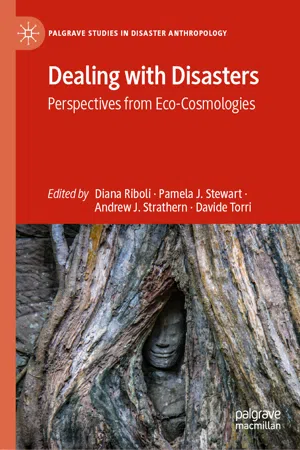
Providing a fresh look at some of the pressing issues of our world today, this collection focuses on experiential and ritualized coping practices in response to a multitude of environmental challenges—cyclones, volcanic eruptions, tsunamis, earthquakes, warfare and displacements of peoples and environmental resource exploitation. Eco-cosmological practices conducted by skilled healing practitioners utilize knowledge embedded in the cosmological grounding of place and experiences of place and the landscapes in which such experience is encapsulated. A range of geographic case studies are presented in this volume, exploring Asia, Europe, the Pacific, and South America. With special reference throughout to ritual as a mode of seeking the stabilization, renewal, and continuity of life processes, this volume will be of particular interest to readers working in shamanic and healing practices, environmental concerns surrounding sustainability and conservation, ethnomedical systems, and religious and ritual studies.
eBook - ePub
Dealing with Disasters
Perspectives from Eco-Cosmologies
- English
- ePUB (mobile friendly)
- Available on iOS & Android
eBook - ePub
Dealing with Disasters
Perspectives from Eco-Cosmologies
About this book
Information
© The Author(s) 2021
D. Riboli et al. (eds.)Dealing with DisastersPalgrave Studies in Disaster Anthropologyhttps://doi.org/10.1007/978-3-030-56104-8_11. Introduction
Diana Riboli1 and Davide Torri2
(1)
Department of Social Anthropology, Panteion University, Athens, Greece
(2)
Department SARAS (Storia Antropologia Religioni Arte e Spettacolo), Sapienza University of Rome, Rome, Italy
The writing and editing of this volume took place during in uncertain times. By the end of 2019, the virus named Covid-19 spread to all continents, regardless of national borders and political regimes. Behind the more or less scientific or fictitious fanciful theories about the possible causes of the pandemic, one fundamental question lies: Was the newborn (?) virus and/or its spread caused by or linked to anthropogenic factors? The same question recurs in most of the scientific analyses and debates on the alarming increase of natural disasters worldwide.
The more and more frequent appearance of epidemics and pathogenic agents seems to be connected to environmental changes such as deforestation, pollution, human overpopulation, exploitation of natural resources and climate change (Singer 2009, 201). Despite the fact that it seems possible that Covid-19 may have evolved from an older animal-infecting coronavirus and transmitted to a human host via a spillover process, the more or less direct connections between health and environmental crises are multiple and complex. According to the World Health Organization (WHO) around eighty percent of the world’s population experiences some level of water scarcity, while just one in four healthcare facilities worldwide lacks basic water services.1 Considering the fact that, up to now, the most effective prevention is to practice basic hygiene, the lack of (safe) water—one of the most evident consequences of climate change—put at risk about six billions people worldwide with 1.1 billion of people totally lacking access to water.
A recent study conducted at the Harvard University T.H. Chan School of Public Health demonstrated the relationship between air pollution and coronavirus in the United States. According to the results of this study, even an increase of just one microgram of fine particulate matter known as PM2.5 per cubic meter corresponds to a 8% increase in Covid-19 deaths (Wu and Nethery 2020). The study reveals that poor, minority communities run a much higher risk of developing serious conditions and complications from Covid-19 in part due to air pollution caused by white Americans’ consumption practices.
The pandemic represents a major threat for indigenous communities the world over, urging the Department of Economic and Social Affairs of the United Nations to ask Member States and the international community to include “the specific needs and priorities of indigenous people in addressing the global outbreak of Covid-19.”2
After centuries of colonial domination, the more recent neocolonial intrusion equipped with increasingly powerful technological means continues to devastate and radically transform most of the ancestral territories to which indigenous culture and eco-cosmologies are linked. The process of industrial extraction and exploitation of natural resources already deprived many indigenous communities and vulnerable minorities of fundamental human rights for secure livelihood and preserved ecosystems. The consequences of climate change are amplified by the destruction of many ecosystems: violent floods and landslides cancel in minutes human settlements and cultivated fields in deforested areas. Wildfires are becoming extremely frequent worldwide, from Siberia to the Amazonian forest, as droughts cause the forest fuels—the organic matter that burns and spread wildfires—to be much drier than in the past.
The earth is not only “angry” (Oliver-Smith and Hoffman 1999) but also deeply wounded. Risks of potential disasters on a local and global level arise from each wound.
It seems strange to think that merely a couple of decades ago, the dimension of risk was recognized as a prerogative of the so-called risk societies (Beck 1992 [1989]) or capitalistic societies living in “high modernity” (Giddens 1991). Nowadays, risks and anxieties about hazards took the stage, often in the role of protagonists, in indigenous and minorities’ worldviews and eco-cosmological philosophies. In the words of Jakob Arnoldi:
Risks are not actual but rather potential dangers…risk is the opposite of pure chance, because it involves human agency. For the same reason it is also the opposite of random acts of nature. What we often refer to as natural causes is something that suspends human responsibility…But when humans can be held responsible, risk emerges. (Arnoldi 2009, 8–9)
It is increasingly complex to distinguish natural from man-made disasters as natural forces become particularly destructive when combined with man-made environmental modifications. Anthony Oliver-Smith highlighted the complexity of what we define as a disaster and the difficulties in finding an exhaustive definition for the term. His analysis focuses on the multidimensionality of disasters as “physical and social event(s)/process(es)” (Oliver-Smith 2002, 24–25). Despite the fact that the study of disasters is a field of growing importance in anthropology, there is still a certain lack of studies focused on indigenous perceptions and strategies of resistance adopted by indigenous communities in dealing with catastrophic environmental events. Not only dangers but also risks play an important role in indigenous’ worldviews as well as in processes of cultural change and adaptation. An important further step is to study the multidimensional ways in which potential risks and catastrophes are understood and experienced.
In her interesting study on the 1991 Oakland (California) firestorm, Susanna Hoffman analyzes the symbolic dimension of natural disasters in societies that recognize a division between nature and culture. In this case, through a process of embodiment, nature is described as a benign entity, a Mother, while the disaster is disembodied and becomes a “monster” (Hoffmann 2002). On the contrary, as the majority of the chapters in this volume demonstrate, in indigenous eco-cosmological views and in animistic complexes in particular, nature and natural forces are not understood as two different entities. This is probably in part due to the fact that the same elusive and abstract concept of nature (at least in the contemporary way most eurocentric cultures define it), as well as the term itself are absent from many indigenous philosophies and languages (Ducarme and Couvet 2020; Descola 2005).
It is noteworthy that, at least on a symbolic and spiritual level indigenous communities and religious specialists placed emphasis on to the human factors behind natural disasters, somewhat earlier than contemporary scientists. In cosmological views where the cosmos is multidimensional and inhabited by other-than-human beings with souls and personality (animals, plants, spirits, atmospheric phenomena, and elements of the landscape), humans represent just a link in the chain. Angela Roothaan discussing the indigenous, modern, and postcolonial relationship with nature highlights that in non-indigenous perceptions the earth becomes a “free playground for mankind” as the modern approach “frees human agents from fear of other beings with soul.” Therefore, aside from the anxiety surrounding the potential of aggression of other men, the only fear left is that “forces of nature may cause natural disaster, disease and death” (Roothaan 2019, 45). On the other hand, in cultures deeply linked to specific territories and natural environments and groups that have experienced many forms of direct, structural and cultural violence perpetrated against them by other humans, causes of natural disasters are often attributed not to nature itself, but to human misbehaviors, moral corruption, egoism, and greed instead.
This does not mean that the mythological frameworks in which indigenous discourses about disasters take place are completely divided by the practical and empirical one. A good dose of “indigenous realism” is always present and perfectly complementary. The Yuchi scholar Daniel Wildcat discusses indigenous realism in terms of people accepting their responsibilities as members of the planet’s complex life system (Wildcat 2009). Indigenous peoples around the world are of course perfectly able to understand that a landslide or a flood may assume catastrophic proportions and have even more disastrous consequences because of rampant deforestation and climate change, but these events are also interpreted as a punishment or revenge of other-than-human beings. On a practical level, people living in contact with nature of course know the consequences that the lack of trees and roots may have in the event of violent downpours. In this case, extreme climatic phenomena are perceived as means by which other-than-human beings manifest their discontent for the environmental damage. Therefore, the real and primary cause which gives rise to catastrophe revolves around human behavior and actions. In this sense, basically indigenous and scholarly interpretations of many natural disasters often converge despite through different paths: bulldozers cut the forests, mining activities and pollution cause climate change/non-human beings’ wrath and their disastrous consequences.
Most of the times in indigenous perceptions chaos and disorder originated from human harmful and/or inconsiderate acts hurt and offend the Earth, a powerful deity in many cultures, or other spirits connected with atmospheric phenomena and the sacred landscape.
Of course, the symbolic dimension of disasters plays a fundamental role not only in indigenous mythologies and ontologies, but in most of the religious and philosophical traditions of the globe.
Human History as Disaster
In a sense, we are all survivors. Our life-worlds are just accretions on the rubbles of previous cataclysmic events, as in the famous image of the angel of history, the Angelus Novus by Paul Klee, interpreted by Walter Benjamin (1940).
Human collectivities have survived, and kept track of, catastrophic events and disasters. Religious traditions sometimes have enshrined them, in connection with a framework interpreting them as divine intervention. Creation myths, for example, make ample use of disaster imagery to describe the magmatic and transformative process bringing a life-world to existence. Recursive disasters mark the progress of time, from one age to the other, i.e., the four yugas of the Indian traditions or the five suns of Mesoamerican mythologies, where every segment of the creation is destroyed in order to bring forth the next one. In some contexts, disasters occur when deities are angered or displeased, as in the biblical accounts. In others, the calamity is perceived as the effect of some cosmic, and almost automatic, movement, as expressed by the etymology, for example, of the word disaster: “In the English speaking world all of these phenomena are generally called disasters. This word has an equivalent in German (Desaster, Unstern, meaning ‘under the wrong star’) and in the Romance languages (French desastre, Italian disastro, Spanish desastre)” (Schenk 20...
Table of contents
- Cover
- Front Matter
- 1. Introduction
- 2. “The War Has Just Begun.” Nature’s Fury Against Neocolonial “Spirit/s”: Shamanic Perceptions of Natural Disasters in Comparative Perspective
- 3. The Spirits of Extractivism: Non-Human Meddling, Shamanic Diplomacy, and Cosmo-Political Strategy Among the Urarina (Peruvian Amazon)
- 4. Batek Cosmopolitics in the Early Twenty-First Century
- 5. Jinn Pinn Dance in the Floods: Perceptions of Flood Disasters Among the Kalasha of Pakistan
- 6. Eco-Cosmologies: Renewable Energy
- 7. The Earth and the Tree in Alekh Shamanism in Koraput/Odisha
- 8. Sacred, Alive, Dangerous, and Endangered: Humans, Non-humans, and Landscape in the Himalayas
- 9. Shamanism, Magic, and Indigenous Ontologies: Eco-Critical Perspectives on Environmental Changes in India
- 10. Unblocking the Blockage Between Earth and Heaven: Shamanic Space for Cultural Intimacy in China
- 11. Burying Gold, Digging the Past: Remembering Ma Bufang Regime in Qinghai (PRC)
- Back Matter
Trusted by 375,005 students
Access to over 1.5 million titles for a fair monthly price.
Study more efficiently using our study tools.
Frequently asked questions
Yes, you can cancel anytime from the Subscription tab in your account settings on the Perlego website. Your subscription will stay active until the end of your current billing period. Learn how to cancel your subscription
No, books cannot be downloaded as external files, such as PDFs, for use outside of Perlego. However, you can download books within the Perlego app for offline reading on mobile or tablet. Learn how to download books offline
Perlego offers two plans: Essential and Complete
- Essential is ideal for learners and professionals who enjoy exploring a wide range of subjects. Access the Essential Library with 800,000+ trusted titles and best-sellers across business, personal growth, and the humanities. Includes unlimited reading time and Standard Read Aloud voice.
- Complete: Perfect for advanced learners and researchers needing full, unrestricted access. Unlock 1.5M+ books across hundreds of subjects, including academic and specialized titles. The Complete Plan also includes advanced features like Premium Read Aloud and Research Assistant.
We are an online textbook subscription service, where you can get access to an entire online library for less than the price of a single book per month. With over 1.5 million books across 990+ topics, we’ve got you covered! Learn about our mission
Look out for the read-aloud symbol on your next book to see if you can listen to it. The read-aloud tool reads text aloud for you, highlighting the text as it is being read. You can pause it, speed it up and slow it down. Learn more about Read Aloud
Yes! You can use the Perlego app on both iOS and Android devices to read anytime, anywhere — even offline. Perfect for commutes or when you’re on the go.
Please note we cannot support devices running on iOS 13 and Android 7 or earlier. Learn more about using the app
Please note we cannot support devices running on iOS 13 and Android 7 or earlier. Learn more about using the app
Yes, you can access Dealing with Disasters by Diana Riboli, Pamela J. Stewart, Andrew J. Strathern, Davide Torri, Diana Riboli,Pamela J. Stewart,Andrew J. Strathern,Davide Torri in PDF and/or ePUB format, as well as other popular books in Social Sciences & Environment & Energy Policy. We have over 1.5 million books available in our catalogue for you to explore.