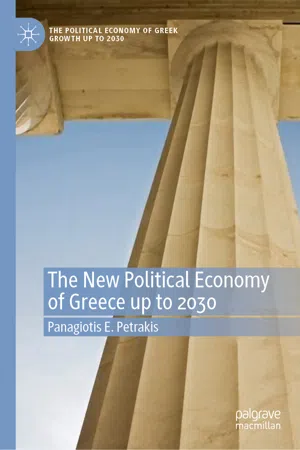
This book not only analyzes and evaluates the current state of economic growth and development in Greece, but also investigates the potential for growth and development in the mid- to long-term horizon. This book presents a unique theoretical framework drawing on structural elements of political economy such as institutions, cultural background, and the complex nature of politics and political power, as well as neoclassical economics and behavioral economics. The first part of the book introduces readers to some key concepts of normative analysis from a theoretical and methodological perspective, presents the relation between theory and policy, placing the Greek economy within the framework of the Eurozone, and provides the political economy of integrated growth and development in Greek economy. The second part of the book describes the current condition of Greece in the global economy and attempts to detect the major social, economic and political trends that will prevail inthe Greek society, while pointing the challenges that the Greek economy will face across the coming decade by taking into account the Covid-19 crisis. The third part of the book provides an overview of growth and development theory as specifically applied to Greece, focusing on the endogenous forces driving the economy, and portrays how the 2008 financial crisis and the crisis of Covid-19 transformed the framework of Greek growth and development policy, to the ground of a new consolidated situation of low growth, low inflation and low employment in the case of Greek economy.
- English
- ePUB (mobile friendly)
- Available on iOS & Android
eBook - ePub
The New Political Economy of Greece up to 2030
About this book
Information
Part IThe Theoretical Principles of Integrated Growth and Development of the Greek Economy
© The Author(s) 2020
P. E. PetrakisThe New Political Economy of Greece up to 2030The Political Economy of Greek Growth up to 2030https://doi.org/10.1007/978-3-030-47075-3_11. Introductory Chapter
Panagiotis E. Petrakis1
(1)
Department of Economics, National and Kapodistrian University of Athens, Athens, Greece
1.1 Introduction
The introductory chapter aims at making this book easier to read, by explaining the rules of the game in a way that facilitates the grasping of ideas often useful in following a book like this with concepts, hypotheses and assumptions. It also aims at specifying the standing point from which the author deals with basic conceptual issues. This way, the opportunity arises for readers to utilize their own views in evaluating points of discussion.
This chapter lists methodological principles (Sect. 1.2), basic theoretical assumptions (Sect. 1.3), and the fundamental analytical approach (Sect. 1.4) on which the book is based on. Additionally, the influence of prevailing ideology in basic aspects of development and growth is highlighted (Sect. 1.5), as well as the role of forecasts in shaping and predicting economic reality (Sect. 1.6).
1.2 The Methodological Principles
Development is when the effectiveness of the social and financial system improves and, subsequently, the quality of life gets better. It is about a broader, qualitative concept, which does not focus on gross domestic product (GDP) expansion, but rather on the improvement to prosperity. When the potential of an economy grows beyond the point marked by the full employment of its productive contributors, we assume that growth conditions of its productive capacity are formed. We can, however, also have growth of the productive capacity when there is a productivity gap, namely, when productive contributors are not fully employed.
In this book, the terms “development” and “growth” are used interchangeably. Development is a broad concept and refers to the increasing change of key factors and resources relating to a country’s expansion, such as human capital in qualitative dimensions (education, health, training, etc.), the state of its productive capacity, the quality of institutions, the way wealth is distributed in the economy, and the general well-being of citizens. Growth refers solely to the incremental change of production, namely GDP, a quantitative variable.
It is, therefore, obvious that the authors need to adopt a perception of economic shifts based on the principles of understanding human actions as an influence of change. In these books from the series The Political Economy of the Greek Growth up to 2030, the people of the Greek economy are treated as entities. Not only are they distinguished by their income and wealth, but also by their personality, which includes their mental makeup and physical health. Consequently, the discussion is broadened in order to include, not only quantitative reports of wealth and income, but also ones stemming from the quality of life. The broader human limits examined include dimensions, such as security and uncertainty for the future, which in the twenty-first century amount to basic components forming the quality of life.
1.3 Basic Assumptions
When readers get a book like this in their hands, they may ignore some of the critical assumptions the author uses. On the other hand, the author uses methodological tools that are responsible for the final result of the written work, such as ideological reference points, methodological and philosophical principles, without revealing them. They may do this out of ignorance. Often, however, the principles of their work are not clear even to the writers themselves. They may let personal ideological views and assumptions interfere with their conclusions, in a way which is not clear as to which part of the conclusion is a result of the methodological and philosophical hypotheses used, and which part of the conclusion is the product of rational analysis that is based on the cause and effect principle.1 It should also be noted, that the problem is bigger when the analysis is of a normative nature (what needs to be done) rather than when it is of a positivistic nature (what is about to happen).
Introductory comments on the basic principles adopted are therefore a valuable aid to readers, helping them discern the quality of the conclusions, without being influenced by the writer’s ideological and cognitive departure points.
Usually, a writer’s basic assumptions are limited. We have highlighted the four most important ones that need clarification.
The first assumption is that the book is based on a classical approach of political economy analysis, as opposed to a one-dimensional economic analysis (as far as the discussion of Greek social transformation is concerned). Political economy is a general and comprehensive perception of the study that covers key aspects of social phenomena: the economy, society, politics, administration, social psychology, possibly anthropology, biology, game theory, etc. As we will see later on, this is essential if we are to formulate integrated and effective development and growth policies.
The second assumption is that we have accepted the idea that current reality is the evolutionary result of a long historical process shaping financial, institutional, and cultural outcomes. This constitutes the financial, social, political, and cultural environment that makes up Greece’s reality. The assumption of evolutionary change—as opposed to the timeless depiction of reality—features the birth and existence of a series of determinants which are embedded in today’s financial reality. This finding helps us a great deal in eliminating the illusion of easy change taking place at a political, economic and social level. At the same time, it highlights the complexity of effects normally brought about by policies. Thus, we know from the outset that economic policies focusing on some of reality’s dimensions have limited effectiveness.2 Lastly, the evolutionary assumption introduces the element of time, a fact that influences characteristics of the theory and policies being used, as well as the depth of the analyses being called for.
The third assumption concerns the acceptance and prioritization of positivism versus normativism. The former accepts a theoretical suggestion as being true only when it is proven, directly or indirectly, through empirically verifiable conclusions.
The fourth assumption concerns human action, namely the theoretical background of human behavior and, particularly, the distinction between rational and natural human behavior. Rational behavior, mostly in relation to maximizing welfare, is a system of human thinking that has dominated mainly post-war economic thought, even though its origins can be dated back to classical economists. This school of thought is at odds with what we could define as natural human behavior. Located between the two extremes, in terms of economic activity, there are different types of human behavior, such as bounded rationality, the timeless-dynamic decision-making process, expected utility logic, and, finally, the generalized Darwinism and evolutionary perception of human behavior. Each of these systems brings to the surface certain aspects of human behavior lead by the role of uncertainty. As we will see later on, this book adopts the general theoretical principle of methodological pluralism. Therefore, the book is close to the logic of accepting human behavior in a broader sense, which of course includes rationality as an individual theoretical concept.
This principle is more relevant in the case of the Greek economy since, as it will be determined, the Greek economy exhibits systematic characteristics of social behavior that need particular study. It is very difficult to support that these are signs of collective rational behavior.
1.4 Fundamental Analysis Principles
The criteria by which interpretation theory can be adopted, when observing economic phenomenon, can either be empirical or logical.
Empirical criteria can be of two kinds: (a) testing the assimilations of a theory for the sake of controllability and realism and (b) comparing the prediction of a theory to reality.
Logical criteria has to do with whether the adopted theory is characterized by: (a) productivity and suggestiveness; (b) cohesion and consistency of the internal structure; (c) simplicity (specifying that simple and economically correct theories are preferred) or elegance (focusing on beauty, the aesthetic appeal of a theoretical structure); (d) generality (argues that a theory incorporating an existing and well-documented body of knowledge into a simple, unified framework has to be judged as superior) or scalability (a theory is preferred, if it allows for expansion through abductions in other research fields); and e) operationality.
When deciding which theory will be used in order to analyze a case, it is first necessary to determine the criteria that this decision will be based on. Hoping that we can choose a theory that is absolutely objective is, of course, exceedingly ambitious. The possibility of using pure theory for the interpretation of economic phenomena becomes even harder, especially when analyzing complex socioeconomic formations, such as the Greek one.
After identifying criteria by which we accept a hypothesis, theory or law, the next question is to determine the extent to which we are going to be monists, eclectics, or pluralists. Here there are two extremes: on the one hand, we have those who believe that we should be defined only by one methodological approach (monists) and, on the other hand, we have the pluralists, who believe in utilizing different methodological approaches. But the real question is to determine the extent that we need to (and can) be methodological pluralists.
In a contemporary changing world where uncertainty prevails, a complex view of the existing reality is essential, in order to support a complete growth theory. For the purpose of locating, for...
Table of contents
- Cover
- Front Matter
- Part I. The Theoretical Principles of Integrated Growth and Development of the Greek Economy
- Part II. The Inevitable Future Trends in the World Economy and the Position of the Greek Economy
- Part III. Sources of Growth and Development Policy in the Age of Global Low Growth and Low Inflation
- Back Matter
Trusted by 375,005 students
Access to over 1.5 million titles for a fair monthly price.
Study more efficiently using our study tools.
Frequently asked questions
Yes, you can cancel anytime from the Subscription tab in your account settings on the Perlego website. Your subscription will stay active until the end of your current billing period. Learn how to cancel your subscription
No, books cannot be downloaded as external files, such as PDFs, for use outside of Perlego. However, you can download books within the Perlego app for offline reading on mobile or tablet. Learn how to download books offline
Perlego offers two plans: Essential and Complete
- Essential is ideal for learners and professionals who enjoy exploring a wide range of subjects. Access the Essential Library with 800,000+ trusted titles and best-sellers across business, personal growth, and the humanities. Includes unlimited reading time and Standard Read Aloud voice.
- Complete: Perfect for advanced learners and researchers needing full, unrestricted access. Unlock 1.5M+ books across hundreds of subjects, including academic and specialized titles. The Complete Plan also includes advanced features like Premium Read Aloud and Research Assistant.
We are an online textbook subscription service, where you can get access to an entire online library for less than the price of a single book per month. With over 1.5 million books across 990+ topics, we’ve got you covered! Learn about our mission
Look out for the read-aloud symbol on your next book to see if you can listen to it. The read-aloud tool reads text aloud for you, highlighting the text as it is being read. You can pause it, speed it up and slow it down. Learn more about Read Aloud
Yes! You can use the Perlego app on both iOS and Android devices to read anytime, anywhere — even offline. Perfect for commutes or when you’re on the go.
Please note we cannot support devices running on iOS 13 and Android 7 or earlier. Learn more about using the app
Please note we cannot support devices running on iOS 13 and Android 7 or earlier. Learn more about using the app
Yes, you can access The New Political Economy of Greece up to 2030 by Panagiotis E. Petrakis in PDF and/or ePUB format, as well as other popular books in Economics & International Business. We have over 1.5 million books available in our catalogue for you to explore.