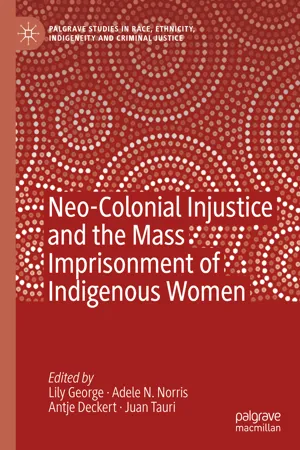
This book closes a gap in decolonizing intersectional and comparative research by addressing issues around the mass incarceration of Indigenous women in the US, Australia, Canada, and Aotearoa New Zealand. This edited collection seeks to add to the criminological discourse by increasing public awareness of the social problem of disproportionate incarceration rates. It illuminates how settler-colonial societies continue to deny many Indigenous peoples the life relatively free from state interference which most citizens enjoy. The authors explore how White-settler supremacy is exercised and preserved through neo-colonial institutions, policies and laws leading to failures in social and criminal justice reform and the impact of women's incarceration on their children, partners, families, and communities. It also explores the tools of activism and resistance that Indigenous peoples use to resist neo-colonial marginalisation tactics to decolonise their lives and communities. Withmost contributors embedded in their indigenous communities, this collection is written from academic as well as community and experiential perspectives. It will be a comprehensive resource for academics and students of criminology, sociology, Indigenous studies, women and gender studies and related academic disciplines, as well as non-academic audiences: offering new knowledge and insider insights both nationally and internationally.
eBook - ePub
Neo-Colonial Injustice and the Mass Imprisonment of Indigenous Women
- English
- ePUB (mobile friendly)
- Available on iOS & Android
eBook - ePub
Neo-Colonial Injustice and the Mass Imprisonment of Indigenous Women
About this book
Information
© The Author(s) 2020
L. George et al. (eds.)Neo-Colonial Injustice and the Mass Imprisonment of Indigenous WomenPalgrave Studies in Race, Ethnicity, Indigeneity and Criminal Justicehttps://doi.org/10.1007/978-3-030-44567-6_11. Introduction
Lily George1 , Adele N. Norris2 , Antje Deckert3 and Juan Tauri2
(1)
Victoria University of Wellington, Wellington, New Zealand
(2)
University of Waikato, Hamilton, New Zealand
(3)
Auckland University of Technology, Auckland, New Zealand
Keywords
Indigenous womenMass imprisonmentDecolonisationState-sanctioned violenceNeo-colonial societiesIndigenous experienceGordon (2011) states that “Policies of mass incarceration have been called a ‘waste management prison’ approach … where the problem becomes one of containment and storage, not of rehabilitation and preparation for reintegration” (p. 5). Most people know that the United States’ incarceration rate is the highest in the world. Many are also aware that Indigenous people are disproportionately incarcerated in the United States as well as in Australia, Canada, and in Aotearoa New Zealand (Cunneen & Tauri, 2016) and that the incarceration of women, in general, is on the rise. Only few people know, however, that Indigenous women represent the fastest-growing segment of the prison population in all four countries, with the incarceration rate for Indigenous women in Australia and New Zealand being higher than that in the United States and Canada (see Table 1.1). Māori imprisonment has steadily increased from 3% to over 50% since the nineteenth century, and Māori women now make up over 60% of the female prison population (George et al., 2014).
Table 1.1
Scope of Indigenous women imprisonment in Australia, Canada, New Zealand, and the United States
• 1 in 30 Australian women are Indigenous • 1 in 20 Canadian women are Indigenous • 1 in 6 New Zealand women are Indigenous • 1 in 118 United States women are Indigenous |
• 1 in 345 Australian Indigenous women are in prison • 1 in 56 Canadian Indigenous women are in prison • 1 in 334 New Zealand Indigenous women are in prison • 1 in 242 United States Indigenous women are in prison |
• 1 in 86 Australian Indigenous women are under correctional control • 1 in 37 Canadian Indigenous women are under correctional control • 1 in 61 New Zealand Indigenous women are under correctional control |
• Australian Indigenous women are ten times more likely to be in prison than non-Indigenous women • Canadistian Indigenous women are nine times more likely to be in prison than non-Indigenous women • New Zealand Indigenous women are four times more likely to be in prison than non-Indigenous women • United States Indigenous women are three times more likely to be in prison than non-Indigenous women |
It has been over 20 years since Luana Ross (1998) published Inventing the savage: The social construction of Native American criminality in which she advanced the concept of neo-colonial racism to articulate the specific, interwoven strategies of systematic denial of freedom and sovereignty that neo-colonial societies use for the social control of Indigenous peoples. Since Luana Ross’ seminal book was published, Indigenous women’s imprisonment has increased sharply. Voices of Indigenous women detailing specific ways settler colonialism exposes Indigenous women to a system of state-sanctioned violence has been around for several decades, speaking across diverse domains. Such voices are pertinent to elevating the awareness of and advancing the discussion of high imprisonment rates, violence and safety experienced and articulated by Indigenous women, which remain largely invisible in national political discourses. As Indigenous women’s voices and activism engage in strategies of resistance and emancipation, it is the purpose of this volume to capture these voices as they articulate the depth of systemic violence against Indigenous women and the remarkable agency Indigenous women wield in the struggle towards liberation.
Decolonising our futures: Neo-colonial criminal injustice and the mass imprisonment of Indigenous women seeks to contribute to the decolonising, intersectional and comparative literature by addressing issues around the mass incarceration of Indigenous women. As Deckert (2014) has pointed out, a dearth of publications on the subject contributes “to the ongoing marginalisation of Indigenous peoples” because “an inadequate quantity of criminological discourse inhibits public attention to the social problem of disproportionate incarceration rates” (p. 39). Furthermore, Norris (2017) has noted that “the absence of a critical lens toward contemporary forms and experiences of racism undergirding the mass criminalisation of Indigenous people perpetuates a colour blindness that in turn works to normalise mass female incarceration” (p. 2). Therefore, it is both important and timely to examine the contemporary mechanisms that drive the mass imprisonment of Indigenous women and to discuss strategies for grappling with the realities of racism. Luana Ross and other Indigenous scholars have recognised that a thorough examination of the mechanisms that generate and perpetuate neo-colonial racism is required to enable and sharpen resistance to racist practices and policies.
In this edited collection, Indigenous scholars—some jointly with non-Indigenous peers—illuminate how neo-colonial societies continue to deny many Indigenous peoples a life relatively free from state interference as most citizens enjoy it. The book covers three main subject matters. Firstly, it seeks to explain the recent surge in the incarceration of Indigenous women in neo-colonial states. Secondly, it investigates implications that the mass incarceration of Indigenous women has for their children, partners, and whānau/mob/communities. Perhaps most importantly, the book addresses activism, resistance and Indigenous strategies against the mass incarceration of Indigenous women. Over the course of the following 11 chapters, the authors explore how White-settler supremacy is exercised and preserved through neo-colonial institutions, policies and laws, leading to failures in social and criminal justice reform; the impact of women’s incarceration on the...
Table of contents
- Cover
- Front Matter
- 1. Introduction
- 2. Stigmatising Gang Narratives, Housing, and the Social Policing of Māori Women
- 3. The Relationship Between Restorative Justice and Prison Abolition
- 4. Colonial Policies and Indigenous Women in Canada
- 5. The Mass Incarceration of Indigenous Women in Canada: A Colonial Tactic of Control and Assimilation
- 6. Transcending Colonial Legacies: From Criminal Justice to Indigenous Women’s Healing
- 7. Aboriginal and Torres Strait Islander Women in Australian Prisons
- 8. Mana Wahine Leadership After Prison
- 9. What Was My Crime? Being an American Indian Woman
- 10. Trauma, Healing, and Justice: Native Hawaiian Women in Hawaii’s Criminal Justice System
- 11. Prison as Destiny? Descent or Dissent?
- 12. Te Piringa Poho: Healing, Potential and Transformation for Māori Women
- Back Matter
Trusted by 375,005 students
Access to over 1.5 million titles for a fair monthly price.
Study more efficiently using our study tools.
Frequently asked questions
Yes, you can cancel anytime from the Subscription tab in your account settings on the Perlego website. Your subscription will stay active until the end of your current billing period. Learn how to cancel your subscription
No, books cannot be downloaded as external files, such as PDFs, for use outside of Perlego. However, you can download books within the Perlego app for offline reading on mobile or tablet. Learn how to download books offline
Perlego offers two plans: Essential and Complete
- Essential is ideal for learners and professionals who enjoy exploring a wide range of subjects. Access the Essential Library with 800,000+ trusted titles and best-sellers across business, personal growth, and the humanities. Includes unlimited reading time and Standard Read Aloud voice.
- Complete: Perfect for advanced learners and researchers needing full, unrestricted access. Unlock 1.5M+ books across hundreds of subjects, including academic and specialized titles. The Complete Plan also includes advanced features like Premium Read Aloud and Research Assistant.
We are an online textbook subscription service, where you can get access to an entire online library for less than the price of a single book per month. With over 1.5 million books across 990+ topics, we’ve got you covered! Learn about our mission
Look out for the read-aloud symbol on your next book to see if you can listen to it. The read-aloud tool reads text aloud for you, highlighting the text as it is being read. You can pause it, speed it up and slow it down. Learn more about Read Aloud
Yes! You can use the Perlego app on both iOS and Android devices to read anytime, anywhere — even offline. Perfect for commutes or when you’re on the go.
Please note we cannot support devices running on iOS 13 and Android 7 or earlier. Learn more about using the app
Please note we cannot support devices running on iOS 13 and Android 7 or earlier. Learn more about using the app
Yes, you can access Neo-Colonial Injustice and the Mass Imprisonment of Indigenous Women by Lily George, Adele N. Norris, Antje Deckert, Juan Tauri, Lily George,Adele N. Norris,Antje Deckert,Juan Tauri in PDF and/or ePUB format, as well as other popular books in Social Sciences & Criminology. We have over 1.5 million books available in our catalogue for you to explore.