This book challenges the modern myth that tolerance grows as societies become less religious. The myth inseparably links the progress of toleration to the secularization of modern society. This volume scrutinizes this grand narrative theoretically and empirically, and proposes alternative accounts of the varied relationships between diverse interpretations of religion and secularity and multiple secularizations, desecularizations, and forms of toleration. The authors show how both secular and religious orthodoxies inform toleration and persecution, and how secularizations and desecularizations engender repressive or pluralistic regimes. Ultimately, the book offers an agency-focused perspective which links the variation in toleration and persecution to the actors of secularization and desecularization and their cultural programs.
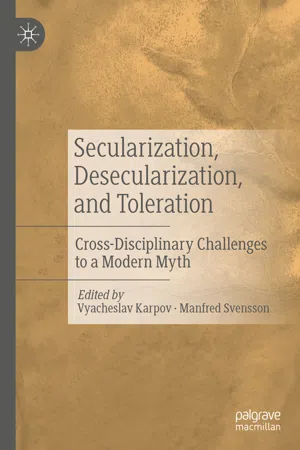
eBook - ePub
Secularization, Desecularization, and Toleration
Cross-Disciplinary Challenges to a Modern Myth
- English
- ePUB (mobile friendly)
- Available on iOS & Android
eBook - ePub
Secularization, Desecularization, and Toleration
Cross-Disciplinary Challenges to a Modern Myth
About this book
Information
Topic
Scienze socialiSubtopic
Sociologia delle religioni© The Author(s) 2020
V. Karpov, M. Svensson (eds.)Secularization, Desecularization, and Tolerationhttps://doi.org/10.1007/978-3-030-54046-3_11. Secularization, Desecularization, and Toleration: Toward an Agency-Focused Reassessment
Vyacheslav Karpov1 and Manfred Svensson2
(1)
Sociology, Western Michigan University, Kalamazoo, MI, USA
(2)
Philosophy, Universidad de los Andes, Las Condes, Chile
Keywords
EnlightenmentSecularizationTolerationDesecularizationProcessAgency1.1 The Intertwined Histories of Toleration and Secularization
While hiding after being branded a traitor for his criticism of the 1793 French Constitution, the Marquis de Condorcet wrote one of the most representative works of Enlightenment historical thought, the Outlines of an Historical View of the Progress of the Human Mind. Published posthumously in 1795, it not only argued for a discernable pattern of development in human history but also for specific links between individual freedom, secular science, and tolerance. Thus, Condorcet described the epoch of Crusades as a time when “theological reveries, superstitious delusions, are become the sole genius of man, religious intolerance his only morality.”1 The time from Descartes to the formation of the French Republic, in contrast, he depicted as a period in which “religious intolerance still survives,” but merely “as a homage to the prejudices of the people.” However somber this past may be, a more promising future could be expected thanks to the “general diffusion of the philosophical ideas of justice and equality.”2 The view so forthrightly expressed by Condorcet has outlived the Enlightenment era, morphed into the mainstream of Western humanities and social sciences, and has persisted well into the twenty-first century. A hundred and seventy years after the publication of Condorcet’s Outlines, Harvey Cox used sociological arguments to herald the dawn of a “secular city” where secularization and urbanization bring about an age of “no religion at all.” “Pluralism and tolerance,” Cox wrote, “are the children of secularization. They represent a society’s unwillingness to enforce any particular worldview in its citizens.”3 Lately, such sweeping and candid statements of this view have become less common, at least in academic literature. Yet, the view itself has persisted, albeit in more sophisticated versions. Thus, for instance, more recently, the sociologist Bryan Wilson has argued that toleration owes its origins exclusively to secularization and rationalization of society. By this he means neither the ideas of tolerationists, nor those of secularists (Condorcet’s “philosophical ideas of justice”), who, Wilson says, can be as intolerant as religious proselytizers. He simply refers to the social and technological changes which did away with religion’s influence over other dimensions of human existence. Once that process leads to a secular state, the conditions for the toleration of multiple religions would be ripe.4
Although separated by more than two centuries and by a growing sophistication, Condorcet’s and Wilson’s formulations reflect essentially the same persistent and influential view. Integrated into variable narratives of modernity and progress, the view inseparably links toleration to secularization. Thus, toleration’s ideational sources have been mostly found within secular thought or within unorthodox religious currents, while its structural sources were found in institutions freed from religious influence. In contrast, religious orthodoxies have been typically presumed to serve as grounds for intolerance and persecution. The purportedly irreversible movement toward secularity was credited with bringing about greater religious tolerance and inclusion. Religious resurgences were not supposed to take place; and if they did, they were looked at as undermining tolerance and engendering persecution.
We encounter these ideas in a variety of forms. Sometimes it is a popular belief, a weapon in the ongoing culture wars. Sometimes it is a guiding thread in grand narratives of modernity, as in Jonathan Israel’s massive history of Enlightenment thought.5 But often the link between toleration and secularization has been more of an implicit assumption than an explicitly stated thesis. If we want to test this assumption, its logic must be made explicit.
The aforesaid logic builds, at least in large part, on a linear and, ultimately, teleological conception of history. In the case of the genesis of toleration, a classical example of such a conception has been the influential view that the Protestant Reformation inaugurated a future of freedom.6 Here, the implicit telos of human history was, more or less, an “Enlightened” understanding of the Protestant faith. In other words, it was a privatized or internalized religion, a faith less concerned with right belief and obedience to church authority, which made toleration possible. A logical flipside of this thesis is that a more orthodox, traditional, and churchly faith is, inevitably, the source of intolerance. In his 1931 book The Whig Interpretation of History, Herbert Butterfield provided a powerful indictment of this view. After that rebuttal, the simplistic link between Reformation and toleration has been banished from serious studies of the period. Yet, for Butterfield, this narrative was only one example of a more general and persistent way of writing history, the tendency “to emphasise certain principles of progress in the past and to produce a story which is the ratification if not the glorification of the present.”7 The causal attribution of toleration to secularization that we address in the present book is a form that the aforesaid persistent view took after its Reformation version had vanished. As Benjamin Kaplan writes, “The secularization story was heir and successor to the Whig interpretation, and so it remains.”8 But any version of this view of history must exclude a host of riots, wars, exclusions, and murders, which have taken place precisely during times conceived as of ascendant tolerance.9 It is always possible to dismiss all these well-known events as exceptions (which might leave us with a surprisingly small number of non-exceptional cases). But if we do not indulge in such self-deception, any history of monocausal progress toward greater toleration becomes problematic.
Alongside the questionable assumptions and accounts about the history of toleration, the influential view that we reassess in this volume employs a simplistic notion of secularization itself. As long as secularization is understood as a single, monolithic, and universal process, it is relatively easy to make generalized claims about the effects it will have. As we will discuss in detail later, however, this changes dramatically once we become attentive to multiple types of secularization. Secularization can be approached as a process and as a project, and in the latter case, whether it brings about tolerance or persecution will significantly depend upon the secularizing actors, their motivations, and their interpretations of religion and secularity.
As contributions to this volume will show, different visions of the secular future have also gone hand in hand with quite different conceptions and policies of tolerance. When secularization is understood as the disestablishment of religion, as a secularization of the state, for instance, toleration of actual religious differences appears more likely. Yet, even then the norms and practices of toleration will differ drastically along the lines of different understandings of what disestablishment and a secular state mean; consider, for instance, the contrast between the non-establishment practices in the United States and laicism in France. Andrew Murphy’s account of William Penn in this volume highlights the intricate nature of envisioning and constructing a secular space that accommodates religious pluralism. However, when secularizing actors envision a general secularization of culture and society, the outcomes for toleration are even less predictable. In many cases, such grandiose secularization projects unleashed ruthless persecution, decades-long repressions, and wars of resistance (consider, for instance, Jean Meyer’s chapter on Mexico in this volume). Theoretically, one may also arrive at a more peaceful coexistence. Yet, to the extent that secularization of culture and society succeeds, there will be no substantive religious claims opposing each other, and, thus, there will not be much to actually tolerate. Moreover, it is also possib...
Table of contents
- Cover
- Front Matter
- 1. Secularization, Desecularization, and Toleration: Toward an Agency-Focused Reassessment
- Part I. Religion, Secularization, and Toleration in the History of Ideas
- Part II. Secularizations and Regimes of Toleration: Comparative Perspectives
- Back Matter
Trusted by 375,005 students
Access to over 1.5 million titles for a fair monthly price.
Study more efficiently using our study tools.
Frequently asked questions
Yes, you can cancel anytime from the Subscription tab in your account settings on the Perlego website. Your subscription will stay active until the end of your current billing period. Learn how to cancel your subscription
No, books cannot be downloaded as external files, such as PDFs, for use outside of Perlego. However, you can download books within the Perlego app for offline reading on mobile or tablet. Learn how to download books offline
Perlego offers two plans: Essential and Complete
- Essential is ideal for learners and professionals who enjoy exploring a wide range of subjects. Access the Essential Library with 800,000+ trusted titles and best-sellers across business, personal growth, and the humanities. Includes unlimited reading time and Standard Read Aloud voice.
- Complete: Perfect for advanced learners and researchers needing full, unrestricted access. Unlock 1.5M+ books across hundreds of subjects, including academic and specialized titles. The Complete Plan also includes advanced features like Premium Read Aloud and Research Assistant.
We are an online textbook subscription service, where you can get access to an entire online library for less than the price of a single book per month. With over 1.5 million books across 990+ topics, we’ve got you covered! Learn about our mission
Look out for the read-aloud symbol on your next book to see if you can listen to it. The read-aloud tool reads text aloud for you, highlighting the text as it is being read. You can pause it, speed it up and slow it down. Learn more about Read Aloud
Yes! You can use the Perlego app on both iOS and Android devices to read anytime, anywhere — even offline. Perfect for commutes or when you’re on the go.
Please note we cannot support devices running on iOS 13 and Android 7 or earlier. Learn more about using the app
Please note we cannot support devices running on iOS 13 and Android 7 or earlier. Learn more about using the app
Yes, you can access Secularization, Desecularization, and Toleration by Vyacheslav Karpov, Manfred Svensson, Vyacheslav Karpov,Manfred Svensson in PDF and/or ePUB format, as well as other popular books in Scienze sociali & Sociologia delle religioni. We have over 1.5 million books available in our catalogue for you to explore.