- 106 pages
- English
- ePUB (mobile friendly)
- Available on iOS & Android
eBook - ePub
About this book
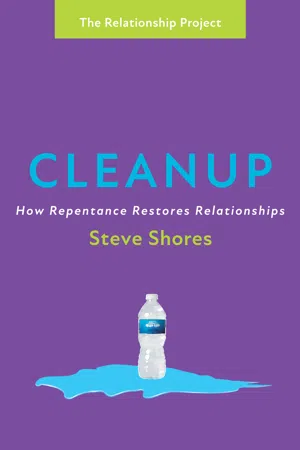
Imagine a runner, deep into a marathon, who, instead of catching much-needed water bottles generously tossed by the crowd, throws into the crowd toxicity balloons that burst on impact. This scenario pictures the damaging offload that selfishness dumps into relationships. Scripture calls this selfishness "the flesh," and this book will show how repentance--a vital change of heart--drains the toxicity from relationships and fosters a joyous self-giving otherwise known as love. The exhaustion of defensiveness begins to lift. When love enters the bloodstream of relationships, our frantic striving for safety and control gives way to fresh air, the hope of knowing and being known.
Information
Topic
Theology & ReligionSubtopic
EcologyChapter 1
Closed People and Relational Debt
Some years ago, I traveled to St. John in the US Virgin Islands. At a local restaurant, I listened while the owner passionately warned of the environmental impact of sunscreen: “What do you think?! It’s a petroleum-based product. Tourists slather it on and swim all over the place. All those petrochemicals go right into the ecosystem and bleach the coral.” That night, I went to a lecture on the ecological threat posed by the lionfish, an invasive species probably brought from the Indian Ocean in ships’ bilgewater. Lionfish have no natural enemies in the Caribbean, are serious eaters, and will devour anything up to three-fourths their own size. They’re basically voracious vacuum cleaners. I continued to learn: later in the week, a local activist told me that developers on St. John often don’t follow requirements to install barriers for diverting runoff from newly paved driveways and parking lots. The unimpeded runoff finds its way into the ocean and into the coral, with devastating effects.
Let’s take that last example and work with it. In the absence of diverting barriers, runoff carries motor oil and fertilizers into the waters around the island. This noxious soup overburdens the aquatic world with substances it can’t neutralize. The result is the nasty reality called coral bleaching referred to by the restaurant owner. Bleaching occurs because the coastal water’s new chemical toxins distress critters called zooxanthellae and run them out of the coral. A vital symbiotic relationship ends, and the coral begins to die. Dead coral is no longer a viable ecosystem, so fish, turtles, lobsters, crabs, worms, octopi, cuttlefish, and other animals and plants lose vital habitat in a devastating ripple effect.
We’ll now work with our ecological example some more, using it to deepen our understanding of the internal world of people. Within every human, a set of routines called “the flesh” exerts itself. These habitual routines form strategic patterns of behavior aimed at self-protection. The result is that the “good life” is now defined as follows: “When I feel comfortable and safe on terms that make sense to me, that’s the good life.” The problem with that reasoning is that one’s sense-making capacities may be deeply, subtly influenced by the flesh. With that in mind, let’s imagine that human flesh patterns can be viewed from an ecological standpoint. Just as the physical environment needs a balance of resources to remain healthy, the same is true of human relationships. But the flesh is not thinking relationally; it’s thinking selfishly. Its self-protective patterns “pave over” acres of relational territory just as monied self-interest paves over the landscape of St. John to make “development” easier.
In an ideal world, the honesty and vulnerability of flesh-free relationships would keep the relational ecology fresh between human beings. But the flesh is quick to frown down the honest and the vulnerable, because these invite us to drop our defenses. Honesty and vulnerability crash against the selfishness of the fallen heart. The flesh flattens (“paves”) relationships into arrangements (see introduction to the first volume, Stuck) of undiscussed procedures and maneuvers based on domination, fear, hiding, manipulation, defense, neutralization. In other words, the flesh develops predictable habits that don’t allow for honest, potentially creative risks in relationships.
We’ll define the flesh as understood biblically later on; for now, it’s enough to know that the flesh is our inborn propensity to sin, and it is well described as our allergy to God. The idea is that of a deep recoil from God inside the “me” who wants to skipper my own ship.
The flesh is defensive: “Briefly put, it is the creature who, turned from its Lord, orbits about itself and intends to make its own way.”1 Under the illusion of having dethroned God, it seeks that personal safety and control we’ve been discussing. It exclusively asks, “Am I getting the outcomes I deem will make me feel safe and in control on my terms?” This limited, me-first focus flattens relationships into mere arrangements along the lines of “I do my thing, and you’re free to do yours as long as you don’t step on my outcomes.” Relationships cannot be mutual in any real way under such conditions. For example, if I’m always shepherding my outcomes along and keeping danger away from my “flock,” I won’t give you the full attention that a real relationship needs. The urge for safety and control creates a situation analogous to that environmental runoff we’ve described. My pursuing my own outcomes always causes a bad relational impact. As that impact goes undiscussed and unresolved, these suppressed forces “flatten” arrangements between people. These arrangements pose as relationships while their toxins seep into the relational “ecosystem.”
For example, let’s imagine a husband who’s prone to bouts of intense anger. The eruptions are meant to let others know that he’s not to be trifled with. Deploying these strategies helps him feel he’s in control. But he’s oblivious to their impact on his wife. When she tries to be honest with him about her pain and fear, he reads her feedback as an intense threat to his campaign for safety and control (a campaign to which he’s blind), so he blows up. When she points out, “This is the scary behavior I’m talking about,” he accuses her of thinking she’s perfect. Losing her battle with herself, she deploys one of her own strategies: sarcasm. “Oh, so I guess you think your little tantrum is the pinnacle of Christ-likeness!” To which he yells, “Oh, so I guess the other day when you were angry, that was perfectly justified!” And so on.
It’s not hard to predict how the argument will continue. And it’s not hard to predict that toxic thoughts and emotions toward one another will dominate this marriage for the next hours or days. The tragedy and toxicity seep into their hearts and darken their very prayers. Such relational “runoff” can be thought of as a rising debt made up of bypassed wounds. These wounds of the heart are of two kinds: wounds we’ve received and wounds we’ve perpetrated. Perpetration introduces the idea of an uneasy conscience, which becomes part of the load under which the relationship groans. The “chemistry” of the relationship gradually erodes as it takes on more and more debt. By “debt,” I mean that the longer a person is self-protective in a relationship, the more he or she “owes” the relationship a compensating, corrective “payment.” If this payment is made early (through reflection, risk, repentance, growth, godly sorrow, behavioral change), the relationship has a chance to recover. But if the debt mounts for years and years, the structure of the relationship is less and less able to support the debt. Just as the coral reef eventually cannot work off the load of pollution if it continues unchecked, so a relationship becomes less and less able to counteract the toxic buildup that flesh patterns impose on it.
A similar analogy is that of a car that keeps running for years without an oil change. The lack of fresh oil slowly builds up a debt to the engine. That structure comes under the stress of a larger and larger “unpaid bill” consisting of the clean oil it regularly needs to maintain its integrity. Eventually, the structural debt will be paid in the form of engine inefficiency and eventual failure. Relationships have a structure, too. They’re meant to be built on real love, respect, honesty, compassion, risk-taking, vulnerability, prayer. The relational structure loses strength and suppleness when pride, unkindness, selfishness, distance, manipulation, lying, power games, etc. result in “unpaid bills”—i.e., missed opportunities for relational nourishment.
Dead coral is lifeless and pale, an underwater firmament of skull-colored tragedy, a poisoned badlands, a desert of sorrow (bones without hope, as in Ezek 37:11). Just so, relationships too easily become empty, thin, hollowed out. They devolve into sad, leaning frameworks, tottering dead zones blighted from within. Coral dies owing to lack of ecological knowledge. The same is true of relationships, which also, as we’re seeing, have an ecology. But coming to know this, coming to see, presents a challenge. Seeing clearly disturbs the hidden procedures we use to survive, bringing to light their relational costs. Something in the human does not want to know. Most don’t want to see the creeping deadness in their relationships. Those who do see tend to be lonely, because their vantage point threatens those who prefer the convenience of blindness. Aldo Leopold, one of our early writers on ecology, puts it this way:
One of the penalties of an ecological education is that one lives alone in a world of wounds. Much of the damage inflicted on land is quite invisible to the layman. An ecologist must either harden his shell and make believe that the consequences of science are none of his business, or he must be the doctor who sees the marks of death in a community that believes itself well, and does not want to be told otherwise. One sometimes envies the ignorance of those who rhapsodize about the lovely countryside in process of losing its topsoil, or afflicted with some degenerative disease in its water systems, fauna, or flora.2
Just as the physical ecologist may suffer loneliness as the cost of seeing damage others find hard to spot, so the “relational ecologist” can feel alienated from his or her fellows. The price of saying what one sees “can cause deep and permanent damage to the most intimate of relationships, as Jesus forewarned” in Luke 12:51–53.3 The questions become difficult: Are you in a relational dead zone? Do you contribute deadness of your own? Because the flesh is always seeking to express itself, the answers are almost inevitably yes and yes. Where do we get the courage to face these questions?
By way of seeking an answer, let’s again take the questions into a specific type of relationship: marriage. The couple we just saw tragically locking horns is not rare. Many couples go for years accruing a relational debt until it becomes large enough to suffocate the marriage. One way to understand the prevalence of divorce is to use this idea of relational debt. Divorce happens when the relationship can no longer tolerate what one or both partners owe to the structure of the relationship. The emotional “payments” become too great, and the relationship fractures.
Take, for example, a husband who drives a truck for a living. Most of his trips are long-haul, so he is gone three-fourths of the time. When at home, he’s so stressed out from fighting traffic and deadlines that he retreats into himself, spending hours nestled in his recliner, cocooned with the television. It’s as though he’s still in the cab of the truck, isolated and protected. His wife, longing for emotional connection, brings up, from time to time, the distance between them. He gets defensive, saying things like “I can’t do anything right. I could be some super-sensitive metrosexual, and it still wouldn’t be enough for you!” His wife then shuts down and turns her emotional needs toward parenting their daughter. The husband, in turn, feels left out of the increasing bond between his wife and daughter. He hardens his heart so it won’t hurt. He finds reasons to stay on the road longer, which increases his wife’s isolation, which tempt...
Table of contents
- Title Page
- Preface
- Acknowledgments
- Chapter 1: Closed People and Relational Debt
- Chapter 2: Pain (Fallen World 1)
- Chapter 3: Fear and Shame (Fallen World 2)
- Chapter 4: Flesh (Anesthesia)
- Chapter 5: Control and Safety (Sleep)
- Chapter 6: The Role of Repentance (Waking)
- Chapter 7: Love (Reaching)
- Chapter 8: Synthesis
- Bibliography
Trusted by 375,005 students
Access to over 1.5 million titles for a fair monthly price.
Study more efficiently using our study tools.
Frequently asked questions
Yes, you can cancel anytime from the Subscription tab in your account settings on the Perlego website. Your subscription will stay active until the end of your current billing period. Learn how to cancel your subscription
No, books cannot be downloaded as external files, such as PDFs, for use outside of Perlego. However, you can download books within the Perlego app for offline reading on mobile or tablet. Learn how to download books offline
Perlego offers two plans: Essential and Complete
- Essential is ideal for learners and professionals who enjoy exploring a wide range of subjects. Access the Essential Library with 800,000+ trusted titles and best-sellers across business, personal growth, and the humanities. Includes unlimited reading time and Standard Read Aloud voice.
- Complete: Perfect for advanced learners and researchers needing full, unrestricted access. Unlock 1.5M+ books across hundreds of subjects, including academic and specialized titles. The Complete Plan also includes advanced features like Premium Read Aloud and Research Assistant.
We are an online textbook subscription service, where you can get access to an entire online library for less than the price of a single book per month. With over 1.5 million books across 990+ topics, we’ve got you covered! Learn about our mission
Look out for the read-aloud symbol on your next book to see if you can listen to it. The read-aloud tool reads text aloud for you, highlighting the text as it is being read. You can pause it, speed it up and slow it down. Learn more about Read Aloud
Yes! You can use the Perlego app on both iOS and Android devices to read anytime, anywhere — even offline. Perfect for commutes or when you’re on the go.
Please note we cannot support devices running on iOS 13 and Android 7 or earlier. Learn more about using the app
Please note we cannot support devices running on iOS 13 and Android 7 or earlier. Learn more about using the app
Yes, you can access Cleanup by Steve Shores in PDF and/or ePUB format, as well as other popular books in Theology & Religion & Ecology. We have over 1.5 million books available in our catalogue for you to explore.