- 198 pages
- English
- ePUB (mobile friendly)
- Available on iOS & Android
eBook - ePub
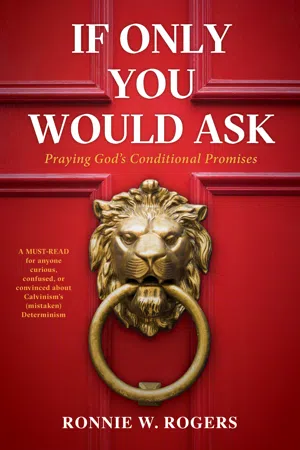
About this book
We can know that if we pray, some outcomes will be different than if we do not pray because God made many promises conditioned on whether we ask. These promises relate to a galaxy of concerns and needs that are important to us and God, such as faithfully serving God and experiencing his blessings in our life, health, marriage, children, family, and job. If we fail to pray about everything as the Scripture commands (Phil 4:6), we will enter heaven and learn there were many things God would have done in and through us if only we'd asked!
Sadly, Calvinism's determinism has turned these wonderful promises into nothing more than a promise that God will do what he predetermined to do regardless of whether we pray or not. Do not allow Calvinism's deterministic beliefs and distortions of Scripture to rob you of this blessed intimate prayer relationship with God.
Information
Topic
Theology & ReligionSubtopic
Religion1
Why We Might Not Pray as We Should
I do not mean to discount the reasons others write about for not praying, such as the flesh, weak faith, or sin in a person's life, but I would like to add some prayer discouragers that do not seem to be sufficiently addressed. I would also like to resolve them so that rather than being discouragers to prayer, they become encouragers.
There are many reasons why we as Christians do not pray as we should, but there are also many great resources to address the normal reasons Christians fail to pray as we should. This book is not trying to replace those, but rather, I pray, contribute to encouraging Christians to pray. I seek to address some of the lesser spoken of belief issues that hinder passionate and consistent prayer. This chapter suggests some of the thoughts, questions, and considerations that can discourage prayer; we will seek to clear them up in the remainder of the book. To summarize what this book will address, consider the following:
•If God is in sovereign control of everything, and if he is omniscient (foreknows the future), how can our prayers change things? How can we change tomorrow by praying if God already knows what is going to happen tomorrow? Would that not make God wrong, or at least in a position of having to learn from our prayers?
•If our prayers are meaningful in the sense that they change events, how can God be sovereign? If there are almost eight billion people on earth, and Christians are offering up hundreds of thousands of prayers to change things, how can God eternally know the future; how can he be sovereign over a future that is changed by the prayers of his people?
•If we are to pray for God's will to be done (Matt 6:10), and if God's will is set from eternity (Eph 1:11), then why should we think our prayers can change anything? If God's will is perfect, can we change that, and if we did, would that make it a less perfect will?
•If God's will is perfect, and it is, do we even want to change it?
•Since we must pray, “Your will be done,” and his will is most assuredly going to be done, what is the point of making our requests known to God? Should we not just pray “Your will be done” and be done with it?
In light of these thoughts, it is understandable why we struggle to be passionate about making our requests known to God. When we just think about the biblical teaching that prayer changes things and events, we do OK Conversely, when we think about God, who knows everything and is working everything according to his divine plan, we are OK But when we think about how those two realities work together, confusion abounds. And this confusion can hinder our prayer life, which is closely followed by the partner to a weak prayer life, which is a cold and distant relationship with God. Focusing too much on the power of prayer to change things will diminish our respect and understanding of God’s sovereignty and will. Focusing too much on God’s divine immutable will and sovereignty will erode our belief in the essentialness of prayer, as far as being able to walk with God and see changes in outcomes from our prayers.
Not understanding how these two realities work together is a prayer killer, finally arriving at praying out of believing that whether I pray or do not pray, things will work out according to God’s sovereign will. Although we continue to pray out of obedience because we are told to pray (Matt 6:9–15), we do so hoping it will help in some way. As we say, you can always pray even if you cannot do anything else. Sometimes involving that if we can do something else, we should prioritize that over prayer.
We agree that God is sovereign, God knows all things, and God is in control, which are all true. But what do they mean concerning prayer, and particularly in the area of the Bible’s conditional promises? A conditional is a statement or command made with a stated or implied corresponding dependent outcome. The outcome is based on meeting the condition. For example, Jesus said, “Whatever you ask in My name, that will I do” (John 14:13). The condition is to ask in Jesus’ name, and the outcome or promise is that if you ask, he will do what you ask. Quite commonly, but not always, “if” identifies conditionals or if not by the word “if,” by the idea of “if.” Another example of a conditional is Matt 6:14, which says, “For if you forgive others for their transgressions, your heavenly Father will also forgive you.” The Father’s forgiveness of us is conditioned on whether or not we forgive others. When Scripture calls on humans to choose between options with corresponding consequences, that is a conditional.
While comfort surely is derived from such beliefs as God’s sovereignty and omniscience, these beliefs can also leave us confused about how prayer fits in with these great truths, which leaves us with a less passionate prayer life; at least we are not praying with a strong belief that our prayers matter in how things develop or end up. Further weakening of our prayer life often takes place when we pray for something, and nothing happens, or even worse, things go from bad to dreadful. After that happens a few times, even if we do not say it out loud, we can begin to wonder if our prayers matter. We may also begin to question if prayer can truly change an event or outcome. Meaning, will the outcome of what I pray about be different if I pray than if I had not prayed at all? If so, how, and how will I know? Are there things we cannot change with prayer? If so, how can we know them?
The Holy Spirit commands us, “So then do not be foolish, but understand what the will of the Lord is” (Eph 5:17). To which, we all can say a hearty amen! But the nagging questions that come on the heels of our amen are: Where does prayer fit in with the will of the Lord? What about all the areas that Scripture does not speak to directly? How do Scriptures that tell us to pray specifically, which clearly either imply or even explicitly state that outcomes depend on our praying, matter in light of God’s sovereign will?
Paul tells us, “With all prayer and petition pray at all times” (Eph 6:18a). Every other aspect of preparation for spiritual warfare outlined in Eph 6:10–21 has a specific protective element to it. But the instruction to pray seems to be a general directive that permeates all areas of protection and spiritual armor and warfare. Then, in the next verse, Paul personally requests prayer saying, “pray on my behalf” (Eph 6:19a). As Paul has done, we also request others to pray on our behalf. But do we pray for others as though their life, or ours, will be different if we pray than if we do not pray, believing Mark 11:23–24? You know, how does praying for someone matter in light of the truth that “also we . . . having been predestined according to His purpose who works all things after the counsel of His will” (Eph 1:11)?
Think about this specific prayer request of Paul. “And pray on my behalf, that utterance may be given to me in the opening of my mouth, to make known with boldness the mystery of the gospel, for which I am an ambassador in chains; that in proclaiming it I may speak boldly, as I ought to speak” (Eph 6:19–20). This specific request raises the question, could the prayers of the Ephesians really have impacted the spread of the gospel? Could their prayers have impacted people hearing the gospel and even being saved? That is to say, would Paul’s spreading of the gospel have been different or even more effective if the Ephesians prayed than it would be if they did not pray?
We find this kind of emphasis on prayer making a difference throughout Scripture, but, again, how do we reconcile this with “Your will be done,” other people having free will, and the outcome of the gospel encounter (Matt 26:42)? What if Jesus had not prayed for the disciples (John 17:13–19), for those who heard the gospel through them, and those who came after them, which includes us? He prayed “so that the world may believe that you sent me” (John 17:20–21). What if he had not prayed for us and the unsaved of our day? Would lives have turned out differently? And if it does have an effect, how does it work?
Further confusing these issues is the teaching known as Calvinism. While I will explain these concepts in chapters 3 and 4, I mention them here preliminarily since they are relevant to this chapter and chapter 2.
Calvinism claims that God decreed (foreordained or predetermined) everything and gave man compatible moral freedom, meaning there is nothing man can do to change anything because God predetermined everything, and man cannot override that. This perspective raises the question, what possible difference can prayer make in what God has determined it to be, whether it was Paul beseeching the Ephesians to pray or Jesus praying for others? If Calvinism is true, then the truth is none of these prayers make a difference in the way things turn out, even though it seems that Jesus chose to pray, and Paul chose to implore the Ephesians to pray for the precise purpose of changing outcomes to be different than if they did not pray.
There is no indication that either Jesus or Paul understood their choice to pray as a determined event in which they could not have chosen otherwise. In an attempt to reconcile Scripture’s conditional statements with Calvinism’s determinism, Calvinists often say prayer and the words prayed are a part of the process. But within Calvinism, whether one prays or not, including the very words prayed, the prayer and words are as determined as everything else, and any thought that a person could choose to act differently than he did is a delusion.
But Scripture portrays prayer undeniably differently. Scripture teaches that prayer, at least some of the time, results in different outcomes than if the person did not pray, and that the person chose to pray that specific prayer because he wanted a different outcome than the one happening or about to happen. He was not predetermined to pray, and he did not see the event he was praying about as determined. I believe a normal reading of Scripture, particularly the passages depicting human interaction with each other or with God, God’s promises, conditional statements, and prayer, along with much of the language employed, becomes nonsensical and even misleading if a person is consistent with Calvinism’s belief that everything is decreed in unconditional election and compatible moral freedom.1 Calvinism, therefore, by its actual nature, reduces most of the normal language of Scripture depicting people making choices between accessible options with their comparable encouragements and warnings to utterly meaningless gibberish to maintain their view that God determines everything.
I believe there are accessible options in con...
Table of contents
- Title Page
- Foreword
- Introduction
- Acknowledgments
- Chapter 1: Why We Might Not Pray as We Should
- Chapter 2: Three Reasons to Pray
- Chapter 3: Understanding Who God Is
- Chapter 4: Understanding Who Man Is
- Chapter 5: Biblical Examples of People Choosing to Serve or Not Serve God
- Chapter 6: Biblical Examples of God Determining Events without Human Influence
- Chapter 7: Biblical Examples of God’s Determinism and Man’s Free Will
- Chapter 8: Biblical Examples of People Choosing to Follow Christ before and after Salvation
- Chapter 9: Biblical Examples of God Rewarding and Judging People’s Choices
- Chapter 10: Biblical Examples of Our Choice in Prayer
- Chapter 11: Praying in the Objective and Subjective Will of God
- Chapter 12: We Must Believe as If We Have Received to Receive
- Chapter 13: We Need to Pray for Ourselves
- Chapter 14: Eight Biblical Examples of Praying for Other People
- Chapter 15: Can Our Prayers about the Past Make a Difference?
- Chapter 16: Biblical and Applicable Examples of God Overriding Man’s Free Will
- Appendix 1: Calvinism Makes Conditional Statements and Commands Nonsensical
- Appendix 2: God’s Essential Omniscience Does Not Require Calvinism’s Determinism
- Authorial Glossary
- Bibliography
Trusted by 375,005 students
Access to over 1.5 million titles for a fair monthly price.
Study more efficiently using our study tools.
Frequently asked questions
Yes, you can cancel anytime from the Subscription tab in your account settings on the Perlego website. Your subscription will stay active until the end of your current billing period. Learn how to cancel your subscription
No, books cannot be downloaded as external files, such as PDFs, for use outside of Perlego. However, you can download books within the Perlego app for offline reading on mobile or tablet. Learn how to download books offline
Perlego offers two plans: Essential and Complete
- Essential is ideal for learners and professionals who enjoy exploring a wide range of subjects. Access the Essential Library with 800,000+ trusted titles and best-sellers across business, personal growth, and the humanities. Includes unlimited reading time and Standard Read Aloud voice.
- Complete: Perfect for advanced learners and researchers needing full, unrestricted access. Unlock 1.5M+ books across hundreds of subjects, including academic and specialized titles. The Complete Plan also includes advanced features like Premium Read Aloud and Research Assistant.
We are an online textbook subscription service, where you can get access to an entire online library for less than the price of a single book per month. With over 1.5 million books across 990+ topics, we’ve got you covered! Learn about our mission
Look out for the read-aloud symbol on your next book to see if you can listen to it. The read-aloud tool reads text aloud for you, highlighting the text as it is being read. You can pause it, speed it up and slow it down. Learn more about Read Aloud
Yes! You can use the Perlego app on both iOS and Android devices to read anytime, anywhere — even offline. Perfect for commutes or when you’re on the go.
Please note we cannot support devices running on iOS 13 and Android 7 or earlier. Learn more about using the app
Please note we cannot support devices running on iOS 13 and Android 7 or earlier. Learn more about using the app
Yes, you can access If Only You Would Ask by Ronnie W. Rogers in PDF and/or ePUB format, as well as other popular books in Theology & Religion & Religion. We have over 1.5 million books available in our catalogue for you to explore.