eBook - ePub
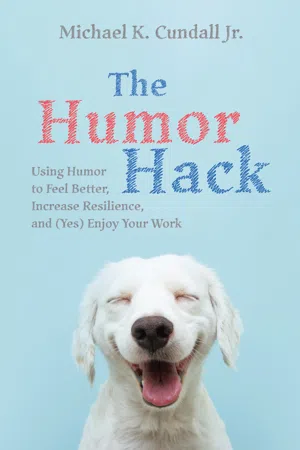
The Humor Hack
Using Humor to Feel Better, Increase Resilience, and (Yes) Enjoy Your Work
- 134 pages
- English
- ePUB (mobile friendly)
- Available on iOS & Android
eBook - ePub
The Humor Hack
Using Humor to Feel Better, Increase Resilience, and (Yes) Enjoy Your Work
About this book
The Humor Hack is an entirely different book about using humor to lead a more engaged life. It's a playbook filled with anecdotes, exercises, and discussion of topics that will provide readers a way to understand how humor works and how they can take this knowledge and enrich their personal and professional lives with more laughs, enjoyment, and mirth. The book's content is based in research, but not academic in tone or format, and is accessible to the general reader. The subject matter is broken into chapters that teach people how to understand, recognize, and produce more humor in their day-to-day lives. It is written in a friendly and warm tone and avoids being nothing more than a series of stories about humor or an overly theory-laden academic book. It provides readers with a book that is enjoyable to read, informative, playful, and educational. That's why this is best described as a playbook. The book is meant to provide a sort of text that is missing in the current books out there that profess to be humor how-tos. It takes research related to humor and discusses it in an informed yet accessible fashion.
Information
Topic
Theology & ReligionSubtopic
ReligionChapter 1
This isn’t a Workbook, it’s a Playbook
Most of the books you find on humor tend to be one of two sorts. The first is a sort of handbook or compilation of examples, where the author hopes you will be able to use to help you use more humor. See how this was funny over here? Go try it over there. The second kind is a deep dive into the research and theory of humor. This one arms you to the teeth with the latest research, the theory extolled by philosophers, psychologists, and comedians. But these tend to do little to tell us how to move from theory to practice. Both are good. I’ve a number of both on my bookshelf and enjoyed them. Writers will focus on humor and spiritual matters (Between Heaven and Mirth), others will focus on humor in your life (Using Humor to Maximize Living), while still others focus on humor use across peoples and eras (Mirth of Nations). Some are long (The Humor Primer) and some are shorter (Jokes: Philosophical Thoughts on Laughing Matters). Some are more like textbooks you’d find in an intro class in a college. Others are more scholarly and focus on a particular discipline. They’ve all strengths and weaknesses.
I thought what was missing from all of these was a book that the individual could work with and have fun with. One that provided you opportunity and space to play not only with the ideas, but with the book itself. My hope is that this book is a mix of reader, playbook, and humor lab where you get to make things up, read, explore, and have some fun.

Exercise: Make up a joke about the stuff within 5 feet of you. Don’t worry if all you have is a chair and the floor beneath your feet—you’re not writing for a comedy show. This joke may never meet the eyes of anyone but you.
Sample Answer: Near me right now there are two pillows. The best I got is this. Two pillows are sitting in a house while the house is on fire. The one pillow says to the other “Hey man, the house is on fire. We should leave.” The other pillow responds “Holy crap! A talking pillow.” This isn’t a great joke and it’s not even original—I heard a version of it about muffins in an oven. But at least it was a riff. If all you do is alter a knock-knock joke, or riff like I did on a joke you know, you’re already far along in your humor journey. We all have to start somewhere.
I encourage you to really play around with this book. I hope that this book is your companion as you grow and build those humor muscles. We’re going start with your expertise on humor and move on from there. We’re going to rely on what you know and supplement it with some of the know-how that comes from good old research done by some wonderfully clever folks.
This book is designed to be played with. One of the things I constantly say, and you’ve picked up on, is that we need to reintroduce play into our lives. Go into any elementary school and you will see that often the most engaged and effective classrooms have good doses of play in them. The room is decked out to be fun and visually interesting. I am not saying make your office space or bedroom décor be dictated by a preschool color palette, but greige may not be the best way to go. Pay attention for opportunities to increase humor in your life. They’re quite a few if you go looking.
Exercise: Find a notebook nearby, or a scrap piece of paper. Rip out a piece. Pretend you’re ripping it from the book. Then crumple it up and make the contested basketball shot at the buzzer to win the game. Don’t wait too long. Those precious seconds are ticking away. You’re moments away from being a hero.
(In an early draft of this book I envisioned a perforated page people could just rip out. Publishers were not as enamored of the idea as I was. So we get to a little make-believe and go a different route.)
If crumpling up a perfectly good piece of paper rubs you the wrong way, then make a paper airplane from a separate piece of paper and fly it. Throw it at a friend. What was their response? Really, stop reading and do it. I’ll wait.
Get in the habit of actually engaging with humor. You’ll find that you see more of it around and your life and those around you will be enriched. Humor is often related to seeing things just a little differently. That page isn’t just a blank page, it’s a chance to doodle a funny picture, a chance to be the hero at the end of the game, or design an awesome paper airplane and see how well it does. The more you open up your world to finding funny things, by encouraging play, the more engaged you will be whether you’re at work, at home, or riding the subway. Try it out. It may feel weird at first, but you’ll find yourself seeing more and more opportunities for humor.
For example, I was getting a flu shot the other day and since we’re in a pandemic (at the time of writing), the pharmacist asked me if I was up to date on my other shots. I had no idea and asked “What sorts of shots?” She said, “For folks over 50 we recommend the shingles vaccine.” I responded, “Well, I am not over 50. But thanks for that!” I was teasing/being sarcastic which I hope my exaggerated voicing showed, and her response indicated she meant no offense (I wasn’t offended) and said all the things to assure me that I really didn’t look over 50. I really looked young, but she just didn’t want to assume. I was simply teasing. I told her I wasn’t miffed, and we had a good chuckle. It’s moments like this that I cherish. I had a little fun with someone who was doing her job, and it made the process more enjoyable. There was also no need for her to feel embarrassed, so hopefully my humor allayed her worries.
If we’re going to bring humor into our lives more, then perhaps another little story can show where you can begin looking and the benefits humor can bring. Again, the opportunities for humor abound. I was calling to pay a bill for one of my son’s doctor visits. I made it through the touch-tone phone labyrinth and got the billing manager on the line. I don’t know if you’ve visited a medical office recently, but they are laid out such that the office/billing manager is typically located in the center of the building surrounded by a moat of files, fax machines, printers, all far more imposing to guest and worker than the traditional cubicle walls. That girdle of technology isolating her from the rest of her colleagues. Here is our billing manager whose entire existence is dedicated to the most awesome of all things in our modern world: bills. A steady stream of insurance companies denying coverage, people disputing charges, people like yours truly who didn’t pay the bill on their way out the door, adding to the paper trail she gets to deal with. Any and all the headaches that come with money and bills, sitting in an office with no windows, isolated from colleagues, make for a great working environment. It’s a thankless job.
When the individual got on the line with me, you could hear her disengagement. Her entire presence was flat and lifeless. There was nothing there but a person going through the routine. I would have been more engaged if it was more of an automated system. At least I could make sarcastic comments without anyone getting angry. It was unnerving and unpleasant for both of us. It’s also totally understandable.
She asked why I was calling, what the account number was (of course I didn’t have it), what the date of birth of the patient was, etc. It was like talking to a computer that had given up hope. She asked me if I wanted to pay the bill in full, and I said I did. She then asked me how I wanted to pay. I told her a credit card, and then she asked which credit card I wanted to use. It was then that I saw the opportunity to change the tenor of the conversation. At that moment I had this little flash, a little impishness took hold of my brain. I ran with it and said, “Well, can I use your credit card?” And there was this silence. An almost complete dead silence. Though I swear I heard the gears in her head turning to process what this doofus had just said. And just when I thought it was going to go wrong, you could hear the smile break in her voice (we are really good at hearing levity in people’s voices by the by) and she said “No you can’t use my credit card!” I playfully responded “Are you sure, ‘cause I’d really like to.” And she said “no” still laughing and shocked by what had just happened. I paid the bill, exchanged the pleasantries we all do as we close a call, hung up and that was that.
The big difference, and the thing that is so amazing about humor, was the complete change in her voice and interaction with me. After my little joke—if it was that— the whole interchange was different; she was animated and engaged. I talked with her, and she with me. Though I never got her name, I knew that there was smile on the other end of that line, not simply a person watching the clock. We actually conversed rather than traded information—though that obviously happened too. Oh, and she got my money. It was a win win for her.
The interaction was rewarding for both of us. I’d like to think, and there’s evidence to support it, that for the next few hours, her day was all the better. I’ll wager her coworkers noticed it too. She may have even told them the story of the goofy guy on the phone asking to use her credit card. I’ll bet her significant other heard the story too and smiled. Humor like this reverberates out into our lives like ripples on a lake. Humor like this improves our lives. I remember the incident not just because I think it’s funny, but also because it was such a change in our interaction. When we began the interaction it was customer and biller. By the end, we were two people having a more enjoyable conversation. We weren’t friends, but we could have been.
Exercise: When have you used or been around a situation where you noticed humor making things better?
Sample Answer: I see kids using humor to diffuse tense situations all the time. They try to get folks to laugh and get beyond the bad feelings.
The above examples give you a good idea of how the book will go. Throughout the book I’ll use examples to introduce ideas and give you an anchor point to work from. I’ll also spend some time on some of the research that will help further our understanding of humor and why and how we can use it with that research in mind. I’ll get you to think of times in your life when humor worked, or didn’t. I want you to remember those times and save them for later. That credit card bit has had more mileage than just the doctor’s office. I use it in books (wink wink) and talks and it has never failed to make the point I want it to. Humor is really impor...
Table of contents
- Title Page
- Preface
- Chapter 1: This isn’t a Workbook, it’s a Playbook
- Chapter 2: Humor as a House—An Allegory of Course
- Chapter 3: Humor and Health: An Overview
- Chapter 4: Humor Basics: Incongruity
- Chapter 5: Mirthful Meetings
- Chapter 6: Lighthearted Workspaces: Designing for Levity
- Chapter 7: Lead with a Joke
- Chapter 8: Humor Under Pressure
- Chapter 9: Office Humor
- Chapter 10: Classrooms and Teaching Spaces
- Chapter 11: Electronic Laughs and Digital Spaces
- Chapter 12: Humor and Apologies
- Chapter 13: He Who Laughs Lasts: Concluding Thoughts
- About the Author
- Appendix 1: More Playbook Activities
- Appendix 2: Further Reading
Trusted by 375,005 students
Access to over 1.5 million titles for a fair monthly price.
Study more efficiently using our study tools.
Frequently asked questions
Yes, you can cancel anytime from the Subscription tab in your account settings on the Perlego website. Your subscription will stay active until the end of your current billing period. Learn how to cancel your subscription
No, books cannot be downloaded as external files, such as PDFs, for use outside of Perlego. However, you can download books within the Perlego app for offline reading on mobile or tablet. Learn how to download books offline
We are an online textbook subscription service, where you can get access to an entire online library for less than the price of a single book per month. With over 1.5 million books across 990+ topics, we’ve got you covered! Learn about our mission
Look out for the read-aloud symbol on your next book to see if you can listen to it. The read-aloud tool reads text aloud for you, highlighting the text as it is being read. You can pause it, speed it up and slow it down. Learn more about Read Aloud
Yes! You can use the Perlego app on both iOS and Android devices to read anytime, anywhere — even offline. Perfect for commutes or when you’re on the go.
Please note we cannot support devices running on iOS 13 and Android 7 or earlier. Learn more about using the app
Please note we cannot support devices running on iOS 13 and Android 7 or earlier. Learn more about using the app
Yes, you can access The Humor Hack by Michael K. Cundall Jr. in PDF and/or ePUB format, as well as other popular books in Theology & Religion & Religion. We have over 1.5 million books available in our catalogue for you to explore.