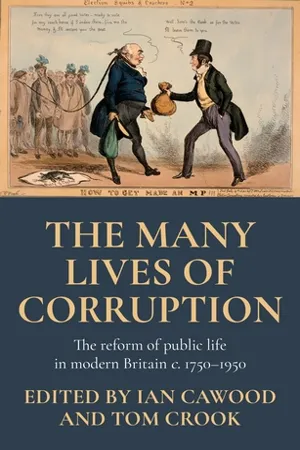
How has corruption shaped – and undermined – the history of public life in modern Britain? This collection begins the task of piecing together this history over the past two and a half centuries, from the first assaults on Old Corruption and aristocratic privilege during the late eighteenth century through to the corruption scandals that blighted the worlds of Westminster and municipal government during the twentieth century.
It offers the first account that pays equal attention to the successes and limitations of anticorruption reforms and the shifting meanings of 'corruption'. It does so across a range of different sites – electoral, political and administrative, domestic and colonial – presenting new research on neglected areas of reform, while revisiting well known scandals and corrupt practices.
eBook - ePub
The many lives of corruption
The reform of public life in modern Britain, <i>c.</i> 1750–1950
- 310 pages
- English
- ePUB (mobile friendly)
- Available on iOS & Android
eBook - ePub
The many lives of corruption
The reform of public life in modern Britain, <i>c.</i> 1750–1950
About this book
Trusted by 375,005 students
Access to over 1.5 million titles for a fair monthly price.
Study more efficiently using our study tools.
Information
1
Public spirit and corruption in the Scottish Enlightenment: a reconsideration
Since the 1970s the Scottish Enlightenment has become the subject of study across a range of branches of intellectual history. The development of this scholarship occurred alongside the moves in the history of political thought that stressed the need to recover the republican or civic humanist vocabulary of politics that had been obscured by an excessive focus on the natural law tradition and the tendency to read early-modern thinkers as precursors of liberalism. The chief proponent of this agenda was J. G. A. Pocock.1 In Pocock’s own work, and in the work of those influenced by and reacting to him, the thinkers of the Scottish Enlightenment were understood as grappling with the shift from republican to liberal conceptual languages. Among the tensions that are identified in this literature is that of older, classical ideas of citizen virtue and commitment to community coming into contact with the more individualistic conceptual universe of political economy. A large literature, including work by John Robertson, Richard B. Sher and David Allan, has developed that stresses the tensions in the social and political thought of the period and places thinkers such as Adam Smith, David Hume and Adam Ferguson on a spectrum ranging between civic republicanism and commercial liberalism.2 In a celebrated collection of essays on the issue Istvan Hont and Michael Ignatieff referred to this as the tension between ‘Wealth and Virtue’.
The aim of this chapter is to reassess the usefulness of this approach as a lens for interpreting the thought of the period. It seeks to do this by focusing on the account of virtue and corruption that has been developed as part of the ‘Wealth and Virtue’ approach to the social and political thought of eighteenth-century Scotland. More particularly, it seeks to do this by examining the member of the Scottish Enlightenment who is often held to be most worried by the possible corruption of commercial modernity: Adam Ferguson.
Adam Ferguson was the Professor of Moral Philosophy at the University of Edinburgh during the central years of the Scottish Enlightenment. Ferguson is often seen as the foremost Scottish sceptic of commerce, whose analysis of corruption serves as a foil for Hume and Smith’s more optimistic view.3 Pocock himself refers to Ferguson as the ‘most Machiavellian’ of the Scottish writers.4 This has led to Ferguson’s reputation as a nostalgic moralist, a backward-looking defender of the ideal of the virtuous citizen and a critic of eighteenth-century British politics.5 However, such readings often fail to consider the fact that across his writings Ferguson was broadly favourable towards commerce and had a developed theory of public service and education that he regarded as a suitable palliative for the corruption of eighteenth-century Britain. By grasping this fact about Ferguson we get a very different view of him from that encouraged by the sliding scale of republicanism and liberalism that has been so influential on the historiography of the period.
The chapter begins by briefly surveying the literature on Ferguson and the civic tradition’s analysis of corruption. It then demonstrates that Ferguson’s understanding of, and concerns about, corruption were not identical with that tradition. It argues that he was comfortable with limited political participation, accepted the reality of the politics of sinecure and was a supporter of commercial society. Ferguson’s response to corruption was not to bemoan the absence of citizen assemblies, but rather to educate the gentleman class who would manage the new British institutions.
Wealth and virtue
As the introduction to this volume has demonstrated, J. G. A. Pocock’s analysis of the concern with corruption in early-modern political thinking has become one of the dominant frameworks for our understanding of the concept. The Scottish Enlightenment is understood as a pivotal point for the republican tradition that Pocock and his followers sought to recover.6 It is pivotal because it represents the ‘limits’ of the tradition, to borrow a term from John Robertson.7 In such discussions Adam Ferguson is often portrayed as an outlier whose Highland upbringing and preoccupations with the need for a citizen militia mark him out from the Lowland and more commercially minded David Hume and Adam Smith.8 More often than not such readings are underscored by discussions of Ferguson’s concerns about the impact of the division of labour (so influential on Karl Marx), and his fascination with Rome and the impact of empire and luxury upon it. Read through such a lens Ferguson seems to fit comfortably alongside those who regard corruption as a decline or degeneration, or in the work of Rousseau as a loss of innocence, that came with civilisation. The fact that the final sections of his Essay on the History of Civil Society (1767) provide a conjectural history of the corruption and dissolution of civil societies accounts for Pocock reading Ferguson as sceptical about commercial society.9
I have argued elsewhere that there are a number of reasons to be wary of this interpretation of Ferguson’s views on corruption.10 The chief of these is that they are almost always based solely upon the Essay and ignore the discussions of commercial modernity and corruption elsewhere in Ferguson’s work. Of Ferguson’s other published works The History of the Progress and Termination of the Roman Republic (1783) and Reflections Previous to the Establishment of a Militia (1756) are often taken to confirm his civic republican credentials as they outline the corruption of the Roman republic and defend the need for active citizen soldiers in Hanoverian Britain.11 However, this literature pays far less attention to the three books based on his Edinburgh lectures: Analysis of Pneumatics and Moral Philosophy (1766), the widely read and translated Institutes of Moral Philosophy (1769) and his own confessed final statement of his views, Principles of Moral and Political Science (1792).12
The Ferguson revealed in these books and in his correspondence is indeed a man preoccupied by corruption, but he is not one who fits easily into a reading that stresses republicanism in either its ancient, Florentine or commonwealth forms. This is underlined by some of his other publications, perhaps most notably his contribution to the pamphlet war surrounding the American crisis, Remarks on a Pamphlet lately published by Dr Price (1776), where Ferguson roundly criticises Price’s notion of liberty as self-government and instead advances a thoroughly modern, ‘negative’ conception of liberty under the rule of law.13 Moreover, the Ferguson found in these books is far less hostile to commerce, and far more Smithian in his view of the economy. Indeed, this is also something found in the Essay, where he explicitly argues that ‘private interest is a better patron of commerce and plenty, than the refinements of state’.14
Perhaps the greatest challenge to the reading of Ferguson as sceptical about commerce is his letter to Adam Smith on the publication of the Wealth of Nations. In it he says that he is willing to take Smith’s side on everything in the book except his attack on the citizen militia. This is often taken as confirmation of Ferguson’s distance from Smith on commerce.15 But this is a misreading, and one brought about by the lens of civic republicanism. Ferguson is agreeing with everything apart from Smith’s critique of the militia as a fighting force. But Smith accepts the usefulness of the militia as a civic defence force, and Ferguson accepts that a militia must be combined with a standing army, so the difference between the two is next to meaningless in terms of the substance of what they advocate: both support a standing army coupled with a militia.16 The reason for this misunderstanding of Ferguson is that we are not reading him; rather, we are reading him as a context for others. Read within his own system, and his own understanding of what that was, a different Ferguson, and a different analyst of corruption, emerges. The argument here is that Ferguson has a coherent, lifelong, academic and practical project that is focused on the problem of corruption in his own society, and that reading him through the civic analysis of corruption leaves a misleading impression of his thinking and its novelty.
Ferguson’s anti-republicanism
The proper context for Ferguson in the history of political thought is one in which the chaos of seventeenth- and early eighteenth-century Britain has been overcome. This is especially true in Scotland, where the more extreme forms of republicanism associated with the Popular party in the Church of Scotland are the last place a man like Ferguson would look for inspiration. Ferguson was a central figure in the Moderate, or enlightened, faction in the Church of Scotland. He supported patronage in the Kirk against the Popular faction’s demand for congregational elections, but was equally opposed to the Jacobite rebellion. For Ferguson the Union of Parliaments and the Hanoverian succession represented an opportunity to reform a corrupt political order in Scotland, an order which had made life precarious for people like him. The old Scottish forms of dependence and predatory behaviour by the nobility would be swept away, and a new, less oppressive and less corrupt order would take its place. This new system was itself based on a complex web of patronage and dependence, but crucially it operated under the rule of law.
Ferguson’s own career is a fine example of the skilful playing of the game of place and patronage. Throughout his long career he maintained close relations with Lord Milton, patronage agent for the 3rd Duke of Argyll, and later with Henry Dundas, who managed Scotland in the government interest. His early career, nearly ten years as a military chaplain to the Black Watch (1745–54), was supported by his family’s connection with the Duke of Atholl. He was at various points Keeper of the Faculty of Advocate’s Library (1757–8), tutor to the sons of Lord Bute (1758–9), a tutor to the 5th Earl of Chesterfield (1774–5), Secretary of the Carlisle Commission (1778–9) and holder of three professorships at the University of Edinburgh: in Natural Philosophy (1759–64), Moral Philosophy and Pneumatics (1764–85) and, by way of a sinecure, Mathematics (1785–1816). His activities included being a regular member of the General Assembly of the Church of Scotland acting in the interests of the Moderate faction (1762–91), being active in parliamentary campaigning and the distribution of place and money that went along with that (particularly in the 1780 election in the Perth Burghs, though he is unlikely to have had a vote of his own given the highly restricted franchise in Scotland) and pamphlet writing in the government cause during the American crisis. Ferguson was an ambitious man and his correspondence is filled with letters seeking to advance his own career, putting himself forward as a potential governor for West Florida (1766), canvassing for the Principalship of Edinburgh University (1762) and seeking to place his sons in secure military positions. Ironically, given the republican reading of him, he even sought to buy one son out of militia service so that he could take a more lucrative professional commission elsewhere.17
Ferguson knew how the world worked, and he knew how to navigate the world of patronage and limited participation that characterised Enlightenment Edinburgh. He liv...
Table of contents
- Cover
- Title Page
- Copyright
- Contents
- List of contributors
- Acknowledgements
- Introduction: corruption and the reform of public life in modern Britain
- 1 Public spirit and corruption in the Scottish Enlightenment: a reconsideration
- 2 From the ‘old’ to the ‘new’: corruption and the police, c. 1750–1910
- 3 ‘A new tide of corruption’: economical reform and the regulation of the East India Company, 1765–84
- 4 ‘A monster in politics’: corruption and economical reform in Jamaica, 1783–91
- 5 Corrupt practices and the reform of voting behaviour in Britain, France and the United States, c. 1789–1914
- 6 Corruption, despotism and the Colonial Office, c. 1820–50
- 7 The ‘most difficult’ subject for legislation: parliament and electoral corruption in the nineteenth century
- 8 Politics, patronage or public service? Conservatives at the Foreign Office, 1858–9
- 9 Gladstonian Liberalism, public service and private interests: reforming endowments
- 10 After Old Corruption: Westminster scandals and the problem of corruption, c. 1880–1914
- 11 Socialism and corruption: Conservative responses to nationalisation and Poplarism, 1900–40
- 12 Civic corruption in the twentieth century: the case of Belfast and Glasgow, c. 1920–70
- Epilogue: the British way in corruption
- Index
Frequently asked questions
Yes, you can cancel anytime from the Subscription tab in your account settings on the Perlego website. Your subscription will stay active until the end of your current billing period. Learn how to cancel your subscription
No, books cannot be downloaded as external files, such as PDFs, for use outside of Perlego. However, you can download books within the Perlego app for offline reading on mobile or tablet. Learn how to download books offline
Perlego offers two plans: Essential and Complete
- Essential is ideal for learners and professionals who enjoy exploring a wide range of subjects. Access the Essential Library with 800,000+ trusted titles and best-sellers across business, personal growth, and the humanities. Includes unlimited reading time and Standard Read Aloud voice.
- Complete: Perfect for advanced learners and researchers needing full, unrestricted access. Unlock 1.5M+ books across hundreds of subjects, including academic and specialized titles. The Complete Plan also includes advanced features like Premium Read Aloud and Research Assistant.
We are an online textbook subscription service, where you can get access to an entire online library for less than the price of a single book per month. With over 1.5 million books across 990+ topics, we’ve got you covered! Learn about our mission
Look out for the read-aloud symbol on your next book to see if you can listen to it. The read-aloud tool reads text aloud for you, highlighting the text as it is being read. You can pause it, speed it up and slow it down. Learn more about Read Aloud
Yes! You can use the Perlego app on both iOS and Android devices to read anytime, anywhere — even offline. Perfect for commutes or when you’re on the go.
Please note we cannot support devices running on iOS 13 and Android 7 or earlier. Learn more about using the app
Please note we cannot support devices running on iOS 13 and Android 7 or earlier. Learn more about using the app
Yes, you can access The many lives of corruption by Ian Cawood, Tom Crook, Ian Cawood,Tom Crook in PDF and/or ePUB format, as well as other popular books in History & British History. We have over 1.5 million books available in our catalogue for you to explore.