- English
- ePUB (mobile friendly)
- Available on iOS & Android
eBook - ePub
About this book
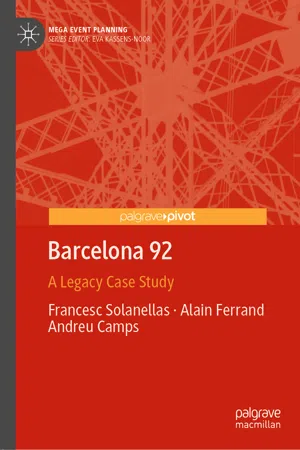
Barcelona 92: A Legacy Case Study examines the effects of the organisation of Barcelona's Olympic Games in 1992. Divided into five compelling chapters, the authors discuss issues concerning the definition of legacy, whilst also presenting new models of legacy management and measurement methods, and providing an in-depth examination of sporting, economic and social dimensions. This book offers the most significant studies and research on the 92 Olympics to date, presenting cutting-edge proposals for comparing different Olympic hosting cities into the future.
Information
© The Author(s) 2020
F. Solanellas et al.Barcelona 92Mega Event Planninghttps://doi.org/10.1007/978-981-13-9038-8_11. Introduction
Francesc Solanellas1 , Alain Ferrand2 and Andreu Camps3
(1)
GISEAFE-Research Group on Social and Educational Research on Physical Education and Sport, INEFC-Institute of Physical Education of Catalonia, Barcelona, Spain
(2)
Faculty of Sport Sciences-CEREGE (EA 1722), University of Poitiers, Poitiers, France
(3)
GISEAFE-Research Group on Social and Educational Research on Physical Education and Sport, INEFC-Institute of Physical Education of Catalonia, Lleida, Spain
Abstract
The introduction discusses the concept of legacy that was introduced into the Olympic Charter in 2004 by the IOC. It encompasses the long-term benefits initiated or accelerated by the hosting of the Olympic Games. The legacy of the Barcelona Olympic Games is often highlighted as an example of good practice. According to the IOC, the political figures of the country and the local authorities concerned, the Olympic Games held twenty-five years ago in Barcelona left a legacy that is both tangible and intangible. The former is more precisely the urban renewal of the city, first-class sports facilities at local and municipal level, the increase in sports practice. For the latter, they underline the strong feeling of pride and belonging to the city and identification with the project.
Keywords
LegacyOlympic GamesAssessmentBarcelonaPolicy-makersManagementThe 91st International Olympic Committee (IOC) session held in Lausanne on 17 October 1986 assigned the organisation of the 1992 Summer Olympic Games to the city of Barcelona from a choice of six candidates. The 1992 Summer Olympic Games, the Games of the 25th Olympiad of the Modern Age, were held in Barcelona, the capital of Catalonia, from 25 July to 9 August 1992. These were the first Olympic Games to be held in Spain.
On 13 September 2017, the 131st IOC session in Lima simultaneously awarded the organisation of the 2024 and 2028 Summer Olympic Games to the cities of Paris and Los Angeles respectively. These two cities were the only candidates for the 2024 Games. According to the IOC, this was a historic decision “paving the way for a ‘win-win-win’ situation for the Olympic Movement, Los Angeles and Paris”. The IOC also referred to “exceptional circumstances” and recognised “the unique opportunities presented by the Los Angeles and Paris bids for the 2024 Olympic Games”. A gradual decrease in the number of candidate cities had led to these “exceptional circumstances”. Indeed, there were six candidates for the 1996 Games, five for those of 2000, 2004, 2008 and 2012, four in 2016 and finally three for the 2020 Games.
The cities of Hamburg, Rome, Boston and Budapest have withdrawn their bids to host the 2024 Olympic Games. Among the reasons was, in particular, “the concern of public opinion and political leaders about an organisational cost that amounts to billions of dollars and systematically exceeds forecasts”. Academic literature (Molloy and Chetty 2015; Andreff 2012) has pointed out that the IOC has difficulty motivating applications because of a lack of enthusiasm due to the cost of hosting the Games, as well as the fact that the provisional budget has been exceeded. Indeed, the organisation of the world’s largest sporting event alone does not justify the colossal investment of the various resources (financial, human, infrastructure, technological, etc.), and the question of heritage has become a very important issue for the IOC and candidate cities. This fact is stressed by Scheu and Preuss (2017: 1): “cities that bid for the Olympic Games need to have positive legacies to justify the hosting of the Games”.
The IOC introduced the term legacy into the Olympic Charter in 2004. Indeed, rule 2.14 stipulates: “to promote a positive legacy from the Olympic Games to the host cities and host countries” (IOC 2004: 12). Ten years later, the IOC introduced the issue of sustainability into the Olympic Agenda 2020. The fourth recommendation states that sustainability must be included in all aspects of the Olympic Games. The third point of this recommendation is concerned specifically with the legacy of the Games. It states: “The IOC is to ensure post-Games monitoring of the Games legacy with the support of the NOC and external organisations such as the World Union of Olympic Cites (UMVO)” (IOC 2014: 12). In this context, the IOC Sustainability and Legacy Commission proposed a new strategic approach to legacy in October 2017. It integrates its planning during the bidding and preparation of the Games to help host cities create value for decades to come. This planning must be synchronised with the long-term urban development objectives of the host city.
1.1 What Is Legacy?
The term legacy was first used in 1956 in the bidding file for the Melbourne Olympic Games. According to the IOC (2017: 13):
Olympic legacy is the result of a vision. It encompasses all the tangible and intangible long-term benefits initiated or accelerated by the hosting of the Olympic Games/sport events for people, cities/territories and the Olympic Movement. The Olympic legacy is directly linked to the highly social goal of the Olympic Movement. Indeed, the goal of Olympism is to place sport at the service of the harmonious development of humankind, with a view to promoting a peaceful society concerned with the preservation of human dignity.
This goal is combined with the one of a city or a territory.
At the academic level, Kassens-Noor et al. (2015: 3) point out that “the term mega-event legacy has acquired different meanings in different fields to different people”. Two definitions are taken up in the literature. Firstly, there is Preuss’s definition (2007: 211): “irrespective of time of production and space, legacy is all planned and unplanned, positive and negative, tangible and intangible structures created for and by a sport event that remain longer than the event itself”. As well as that of Chappelet (2012: 76), who defines legacy in a stakeholder perspective “as positive or negative, tangible or intangible, territorial or personal, intentional or unintentional, global or local, short- or long-term, sport- or non-sport-related, and can also be seen from the various event stakeholders’ perspectives”. Referring to the assessment of the legacy of the 2012 Olympic Games, the Royal Economic Society defines legacy in simple terms:
So what is Games legacy? It is defined here simply as: any net impact arising from the Games. The term “impact” refers to any change or transformation, for better or for worse, that has taken place, and which can be attributed to the Games—in other words the linkage, direct or indirect, to the Games needs to be understood. However, the key term in the definition is “net”, that is, the impact that has occurred over and above what would have happened without the Games. Hosting something like the Olympic Games is rarely context-free or designed on a tabula rasa; it is superimposed on existing trajectories of historical development. Establishing a plausible counterfactual to measure net impact is therefore critical to knowing what the true legacy of the Games is.
Despite the points of convergence between these definitions, the conceptualisation of the term legacy remains an issue.
1.2 A Key Issue but There Are Very Few Ex-post Studies Concerning Legacy
Scheu and Preuss (2017: ii) conducted a systematic review of the academic literature on the legacy of the Olympic Games from 1896 to 2016. They noted that “Very few studies succeed in really measuring legacy. … The evaluation framework for the London 2012 Games (DCMS 2009) offers a promising approach, but the framework was not applied for most of the evaluation of the London legacies. However, some general recommendations could be retrieved from this framework.”
These two authors highlighted the challenges and methodological issues related to the measurement of the mega-event legacy:
Measuring mega-event legacies is challenging for several reasons: 1) legacy as a retrospective concept, 2) measuring intangible legacies, 3) the same legacy affects different stakeholders differently, 4) distinguishing the net vs. the gross legacy, 5) difficulty of isolating an event legacy from non-event-related city development, 6) evaluating the legacy effect over time, 7) measuring something relatively small in terms of the overall economy. (Scheu and Preuss 2017: 83)
Another difficulty is related to the funding of these studies. Baade (2006: 181) underlines that “Ex-post studies (on real data) are rare because few organisations, whether supporters or opponents, are prepared to finance them, especially after the event. Most ex-ante (and ex-post) studies have been marred by important biases, not to mention numerous methodological errors.” Finally, the measurement of the legacy considers long-term effects, while the Organising Committee of the Olympic Games (OCOG) is dissolved within two years after the event. This raises the question of which organisation should take responsibility for this review.
1.3 The Legacy of the Barcelona Olympic Games Is Often Highlighted as Good Example Despite the Fact That There Is Little Data to Support This Statement
The legacy of the Barcelona Games is often cited as an example by the IOC and the city and regional elected representatives.1 Thomas Bach,2 President of the IOC, at the celebration of the 25th anniversary of the hosting of the 1992 Barcelona Olympic Games, stated that
The magic of the Olympic Games brought the world to Barcelona—and the Olympic Games brought a new Barcelona to the world. The Olympic Games transformed Barcelona. Until the Olympic Games, Barcelona was living with its back turned to the beautiful Mediterranean. The Olympic Games allowed Barcelona to turn around and truly embrace the sea. It also brought many other improvements that the citizens of Barcelona still enjoy today.
King Felipe VI of Spain pointed out that the Games were “an extraordinary set of events, which hold a special place in our country’s memory, as a precious milestone in our most recent history”. The city’s mayor, Ada Colau, speaking in February 2018 at an event to kick off the 25th anniversary celebrations, said that the 1992 Barcelona Olympic Games had left an indelible legacy of which the city could be proud. She stressed the fact that Barcelona has opened up to the world and to its inhabitants, thus creating a collective project that is receptive both to the inside and the outside world. Addressing the members of the IOC Olympic Solidarity Commission during the celebrations, Carles Puigdemont, President of the Generalitat of Catalonia, recalled how Barcelona had been modernised in 1992. The Olympic Games made the city known around the world and enabled a major urban transformation, while leaving sports facilities that are still in use today. According to him, “The Games were a boost to the internationalisation and the opening of Barcelona and Catalonia to the world.” The Catalan Secretary General of Sport, Gerard Figueras, during the opening session of the Olympic Solidarity Commission meeting, explained that twenty-five years later, Barcelona was still benefiting from the tremendous legacy left by the Games:
Not only were the Barcelona Olympic Games a great example of sustainability thanks to infrastructures that are still fully functional today, but they also had a big impact on the place of sport in Catalonia. Today, 50 per cent of Catalans practise physical activi...
Table of contents
- Cover
- Front Matter
- 1. Introduction
- 2. The Olympic Games Influence
- 3. The Sport Dimension
- 4. The Economic Dimension
- 5. The Social Dimension
- 6. Conclusions
- Back Matter
Trusted by 375,005 students
Access to over 1.5 million titles for a fair monthly price.
Study more efficiently using our study tools.
Frequently asked questions
Yes, you can cancel anytime from the Subscription tab in your account settings on the Perlego website. Your subscription will stay active until the end of your current billing period. Learn how to cancel your subscription
No, books cannot be downloaded as external files, such as PDFs, for use outside of Perlego. However, you can download books within the Perlego app for offline reading on mobile or tablet. Learn how to download books offline
Perlego offers two plans: Essential and Complete
- Essential is ideal for learners and professionals who enjoy exploring a wide range of subjects. Access the Essential Library with 800,000+ trusted titles and best-sellers across business, personal growth, and the humanities. Includes unlimited reading time and Standard Read Aloud voice.
- Complete: Perfect for advanced learners and researchers needing full, unrestricted access. Unlock 1.5M+ books across hundreds of subjects, including academic and specialized titles. The Complete Plan also includes advanced features like Premium Read Aloud and Research Assistant.
We are an online textbook subscription service, where you can get access to an entire online library for less than the price of a single book per month. With over 1.5 million books across 990+ topics, we’ve got you covered! Learn about our mission
Look out for the read-aloud symbol on your next book to see if you can listen to it. The read-aloud tool reads text aloud for you, highlighting the text as it is being read. You can pause it, speed it up and slow it down. Learn more about Read Aloud
Yes! You can use the Perlego app on both iOS and Android devices to read anytime, anywhere — even offline. Perfect for commutes or when you’re on the go.
Please note we cannot support devices running on iOS 13 and Android 7 or earlier. Learn more about using the app
Please note we cannot support devices running on iOS 13 and Android 7 or earlier. Learn more about using the app
Yes, you can access Barcelona 92 by Francesc Solanellas,Alain Ferrand,Andreu Camps in PDF and/or ePUB format, as well as other popular books in Social Sciences & Business General. We have over 1.5 million books available in our catalogue for you to explore.