- English
- ePUB (mobile friendly)
- Available on iOS & Android
eBook - ePub
About this book
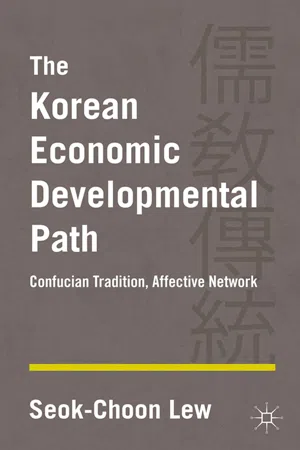
This book defines the Korean development as the moral economy of growth derived from a synergy between strong state and strong society and argues that Confucian cultural orientation has played a critical role in the process.
Information
Part I
The Cultural Dimension: Confucian Tradition
Chapter 2
Confucian Ethics and the Spirit of Capitalism in Korea: The Significance of Filial Piety*
with Woo-Young Choi and Hye Suk Wang
Introduction
Max Weber (1930[1920]) presented a remarkable analysis of the social effects of religious values. In this sociological canon, Weber indicated that value orientation in Protestant Christianity contributed to the formation of a “diligent” work ethic, which characterized modern Western capitalism. However, Weber went on to say that the spontaneous development of capitalism could not be found in non-Western societies for the reason that religious values imbuing economic motives for development were missing (Bellah, 1957). A typical example cited was Confucian culture in China (Weber, 1951[1920]), but Korean society was not an exception (Tu, 1991; Cha S.-H., 1992; Park S.-H., 1994).
This raises questions on Weber’s perspective of Confucianism and seeks theoretical foundations for an alternative argument involving the Confucian value of filial piety (孝, xiao in Chinese, hyo in Korean, and kou in Japanese). The point of the argument is not criticism of Weber’s theory of capitalism but his interpretation of Confucianism. We suggest that the developmental significance of traditional values may be found by exploring the psychocultural effects of filial piety on the economic orientation of the people. Some may criticize that it is difficult to find economic impetus in filial piety—the former being the crystallization of instrumental rationality and the latter a purely normative virtue. Moreover, others would be skeptical about such efforts since the mere existence of an economic impetus in filial piety never guarantees spontaneous capitalistic development.
Paradoxically, however, support for this work is found in Weber’s discussion on Western Europe. Although it is admitted that “Weber’s last theory of capitalism” (Collins, 1980) is predominantly institutional and involves a sequence of causal conditions, the emphasis on religious ideas and motivations that are specific to Western Europe is central. We do not deny that the development of capitalism is contingent not only on psychocultural orientations but also on various structural conditions and sociopolitical institutions. Nonetheless, within the context of these macro-social determinants, there is still ample room for a causal relationship between cultural beliefs, work ethic, educational achievement, and—through those mechanisms—economic growth.
In this context, we explore the “religious” aspect of filial piety to demonstrate the economic effects of this value orientation. In particular, filial piety is assumed to have a distinct and far-reaching religious significance that cannot be found in any other Confucian values (Taylor, 1990). Filial piety is a mechanism specific to Confucianism that deals with the issue of death and immortality. In the process, filial piety presents itself as a latent but powerful link to economic motives by putting into practice characteristic rituals of “remembrance and representation” of ancestors. The economic motive concomitant with filial piety is also manifested in the formation of “familism” in Confucian culture. Filial piety generates strong normative pressures offering sociocultural grounds for “developmental,” “successive,” and “collective” representation and remembrance among family members. The ultimate intention of this work is to establish filial piety as a fundamental basis of the spirit of capitalism in Korea leading to a psychological mechanism, from religious ethos to personal predisposition toward work and education.
Filial Piety: from Mortality to Eternity
Filial Piety as a Religion
It is generally known that religion is the most basic and fundamental mechanism of consciousness confirming human existence. Although confirmation of existence has many dimensions, only religion extends human existence to immortality. The religious assurance of eternal life inevitably collides with the issue of death, because the death of a physical body is not only something to fear in itself but also an obstacle to eternal existence. In this sense, religion, which attempts to guarantee eternal life, must make the interpretation and handling of death its “hardcore” (Eliade, 1985: 9–11).
The fact that Weber hesitated to categorize Confucianism as a religion carries important implications for this study. Weber noticed the absence of religious features in Confucianism such as the transcendent Absolute, messages of redemption, and “the Kingdom of a thousand years” (or Heaven). It was therefore natural for him to perceive Confucianism as nothing more than a secular ethic or as a colossal code of law, political principle, and social protocol for the cultured class (Weber, 1951[1920]: 225). To Weber, Confucianism was devoid of religion’s hardcore—that is, the need to extend existence into eternity by handling death in an appropriate manner. The only alternative left to Confucians whose existence failed to extend to eternity was an adamant attachment to this world. This is why Weber designated “the secular adaptation to this world” as a characteristic of Confucianism (Weber, 1951[1920]: 350).
The problem with this is that Weber ultimately failed to grasp the religious nature of Confucianism, which can be found in the norm of filial piety. How does Confucianism, as a religion, deal with the issue of death and eternity? Let us examine the case of Christianity before answering this question. How Christianity deals with death and hence guarantees eternal life is well explained in the work of Weber (1930[1920]). Christianity presupposes the flawless will and action of the Absolute, which are manifested in evident objects. The “Kingdom of a thousand years,” Heaven, is a spatial and temporal manifestation of eternal life, and this space and time is de-historicized from a human perspective (Troeltsch, 1958[1912]). Human beings can extend their existence into eternity in the Kingdom of a thousand years by entering the gate to salvation, because the Kingdom is the ultimate refuge that the Absolute designed for humankind at the beginning of the world.
However, the problem of salvation—all important to Christians—was solely the territory of priests of the Catholic Church before the Reformation. During the Middle Ages, under absolute church power and resulting corruption, some Christians began to protest the church’s doctrine of salvation. They argued that the main criterion for salvation lay in faithfully following God’s (or the Bible’s) teachings in one’s life. This new doctrine argued that anyone could gain salvation by leading a sinless life and diligently working in one’s own calling. Thus, Protestants worked diligently to become rich in this life, in part, due to anxiety over uncertainty about gaining access to heaven and eternal life after death. Finally, after the Reformation, the goal of Protestantism became the accumulation of worldly goods through hard work and frugality—a sign that one is of the “saved.” By means of working toward salvation—gaining eternal life—Europe was able to construct a diligent work ethic that became the “spirit of capitalism” (Weber, 1930[1920]).
However, unlike Christianity, Confucianism does not presuppose a priori teleology or divine will (Ching, 1977). Instead, Confucians believe that the abstract universal principle that operates in nature and in the normative world constitutes and governs the real world (Keum J.-T., 1992: 215). The fundamental principles of Confucianism such as the Way (Dao, 道), the Principle (Li, 裡), and the Supreme Ultimate (Tai Ji, 太極) are basically depersonalized and there is no divine plan for the afterlife. These fundamental principles are omnipresent in the cosmos, in nature, and in human beings as exemplars that constitute and normalize the world. They are external and transcendental—and at the same time immanent and internal—to humans (de Bary, 1998: 40–41). It is humankind’s natural and normative obligation to realize these principles by achieving a state of supreme good (Lee K. K., 1998: 262). Discussion on Confucianism thus far has revealed only the ethical or metaphysical aspect; its religious features have not been manifested yet.
The fundamental principle of Li retains the immortal essence that governs birth, extinction, and rebirth of nature and the universe (Hahm C.-B., 1998: 262–266). Therefore, the determination of Li is not confined to the present world but rather extends to eternity. Indeed, the end of existence cannot stop Li’s governance; rather, extinction is a natural manifestation of and an eternal return to Li. Thus, death is “relativized” here from the perspective of religious ontology. Biological death does not terminate a person’s existence but makes it possible for that person to return to immortal and fundamental principles. Of course, this implies the following condition: human beings should make themselves one with Li through practices in the present world (Metzger, 1977). Death is not the critical point that terminates human’s existence as long as this conditional imperative is fulfilled; rather, death is the beginning of eternal existence. From this we can comprehend the religious logic of Confucianism in the context of death and eternal existence.
Still, a simple but important question remains: the problem of abstraction and elitism of Confucianism in the context of the practice. As discussed earlier, there are only a constrained few who can overcome death and achieve everlasting existence. Li, Dao, or Tai Ji is available to the religious virtuosi; the masses can only meet more minimal religious requirements (Hill, 1973).1 This minimal religious requirement sheds light on the importance of the practical norms of Confucianism, which prescribe standards for everyday life. It is this very context in which the Five Cardinal Relationships (Wu-Lun, 五倫) are highlighted for commoners. However, among the Five Relationships, the practice of filial piety in the form of “affection between father and son” (父子有親) precedes all other relationships.2 In particular, filial piety after the death of parents is the zenith of a religious solution of Confucianism on the issue of death.
In Confucianism, filial piety is not merely a secular norm but a sublime religious imperative, and its essence is in “remembering” and “representing” one’s ancestors, including one’s parents. What then is the rationale for remembering and representing? Here lies the clue to the Confucian solution to death. Although this solution involves a rational return to one’s nature in principle, as mentioned previously, it needs to be materialized in a tangible way so that commoners can follow and practice. That is, eternal existence of ancestors should be practically confirmed. Confucianism acquires religious persuasive power only when this demand is satisfied, and Confucianism finds the solution to this religious demand in remembrance and representation of ancestors. In other words, remembering and representing ancestors is a mean to guarantee eternal existence.
Consequently, Confucianism places high emphasis on “ancestor worship” (祖上崇拜). The eternal existence of ancestors is confirmed as long as their descendants remember and represent them. Conversely, eternal existence cannot be guaranteed without the descendants’ remembrance and representation of their ancestors. As a result, lack of ancestor worship becomes a heretical act against the religious imperative of Confucianism. This explains why filial piety is so highly appreciated while filial impiety is so harshly reviled.
In effect, the biological constraint on existence is supplemented in Confucianism through remembrance and vicarious representation by one’s descendants. One can be lifted up to eternal existence through remembrance and representation by one’s children, their children, and successive descendants. Every human being without exception belongs somewhere in this ceaseless chain of memories and representations, thereby playing an important role that guarantees eternal existence. This is designated by Confucianism as the natural principle and categorically religious imperative. In this context, remembering and representing ancestors are the core practices of Li in Confucian metaphysics, and their execution takes the form of filial piety.
Through remembrance and representation of descendants, death is transformed into immortal life. Hence, Confucianism places more emphasis on filial piety toward the deceased over the living. Filial piety from this perspective is a pressing religious imperative that transcends mere secular norms; thus, it is placed first among the Five Cardinal Relationships. In such a way, Confucianism does have a religious hardcore that manages death and guarantees eternal life. Rather, the hardcore is handled quite practically and rationally through the practice of filial piety. Not by relying solely on divine will but by appealing to humane voluntary practices does filial piety present a rational solution to the religious demand to address the issue of death.
Economic Motives in Filial Piety
All historical religions have relativized reality in principle, but they have also intervened in it directly or indirectly. Confucianism is not an exception. This is especially true in the Confucian world where the sacred and the secular are highly amalgamated (Park Y.-S., 1983) and where religion and politics are unified as well.3 Confucianism made forceful demands to reflect its religious orientation through the practice of filial piety (Sung K. T., 2005; Lee K. K., 1997; Hsu, 1967). The practice of filial piety had to be “objectified” by a verifiable method, internally as well as externally. It is for this contextual reason that the demand to ritualize important events of life related to filial piety carries so much importance in Confucianism. These events are “coming-of-age” (冠), “marriage” (婚), “funeral” (喪), and “ancestor memorial” (祭) ceremonies (Keum J.-T., 2000; Kim D.-G., 2004). Of course, no culture or religion can deny the importance of these ceremonies in general. However, it is only Confucianism that lends religious meaning to these rituals or institutionalized events. In other words, these ceremonies are concrete processes that deal with the religious hardcore of death and eternity in Confucianism.
The “coming-of-age ceremony” is a religious recognition of a new subject who will remember and represent. The “marriage ceremony” is a religious recognition of a biological union necessary for producing new subjects who will continue remembrance and representation. The “funeral rites” permit humans to overcome sorrow and allow the biological death of ancestors to be sublimated to eternity. Last, the “ancestor memorial cerem...
Table of contents
- Cover
- Title
- Introduction
- Part I The Cultural Dimension: Confucian Tradition
- Part II The Social Dimension: Affective Networks
- Part III The Political Dimension: State–Society Relations
- Conclusion
- References in English Language
- References in Korean Language
- Index
Trusted by 375,005 students
Access to over 1.5 million titles for a fair monthly price.
Study more efficiently using our study tools.
Frequently asked questions
Yes, you can cancel anytime from the Subscription tab in your account settings on the Perlego website. Your subscription will stay active until the end of your current billing period. Learn how to cancel your subscription
No, books cannot be downloaded as external files, such as PDFs, for use outside of Perlego. However, you can download books within the Perlego app for offline reading on mobile or tablet. Learn how to download books offline
Perlego offers two plans: Essential and Complete
- Essential is ideal for learners and professionals who enjoy exploring a wide range of subjects. Access the Essential Library with 800,000+ trusted titles and best-sellers across business, personal growth, and the humanities. Includes unlimited reading time and Standard Read Aloud voice.
- Complete: Perfect for advanced learners and researchers needing full, unrestricted access. Unlock 1.5M+ books across hundreds of subjects, including academic and specialized titles. The Complete Plan also includes advanced features like Premium Read Aloud and Research Assistant.
We are an online textbook subscription service, where you can get access to an entire online library for less than the price of a single book per month. With over 1.5 million books across 990+ topics, we’ve got you covered! Learn about our mission
Look out for the read-aloud symbol on your next book to see if you can listen to it. The read-aloud tool reads text aloud for you, highlighting the text as it is being read. You can pause it, speed it up and slow it down. Learn more about Read Aloud
Yes! You can use the Perlego app on both iOS and Android devices to read anytime, anywhere — even offline. Perfect for commutes or when you’re on the go.
Please note we cannot support devices running on iOS 13 and Android 7 or earlier. Learn more about using the app
Please note we cannot support devices running on iOS 13 and Android 7 or earlier. Learn more about using the app
Yes, you can access The Korean Economic Developmental Path by S. Lew in PDF and/or ePUB format, as well as other popular books in Politics & International Relations & American Government. We have over 1.5 million books available in our catalogue for you to explore.