This book analyses the origins of security dilemmas in the South China Sea (SCS) and the significance of China's actions in asserting its claim from the perspective of defensive realist theory. In its analysis, the book argues that security dilemmas in the SCS first arose between China and other SCS claimants, and then between China and the United States. Research in this book provides significant support to the defensive realist theory vis-à-vis offensive realism. It encourages adopting a reassurance policy to reach a peaceful resolution to the SCS disputes between China, the other claimants, and the United States. The book will be useful for policymakers, academics, researchers and students.
eBook - ePub
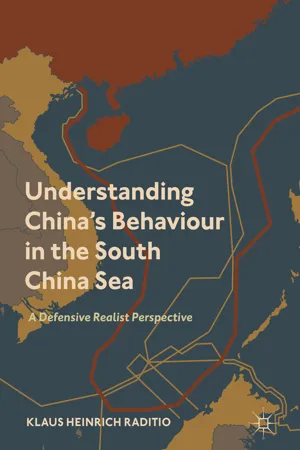
Understanding China’s Behaviour in the South China Sea
A Defensive Realist Perspective
- English
- ePUB (mobile friendly)
- Available on iOS & Android
eBook - ePub
Understanding China’s Behaviour in the South China Sea
A Defensive Realist Perspective
About this book
Information
© The Author(s) 2019
Klaus Heinrich RaditioUnderstanding China’s Behaviour in the South China Seahttps://doi.org/10.1007/978-981-13-1283-0_11. Introduction
Klaus Heinrich Raditio1
(1)
University of Sydney, Sydney, NSW, Australia
Klaus Heinrich Raditio
1.1 Background
The dispute over the South China Sea (SCS) is one of the hottest territorial and jurisdictional disputes in modern history. This resources-rich area is claimed by China and four other countries in the Southeast Asian region (Vietnam, the Philippines, Malaysia, and Brunei), and by Taiwan. There have been numerous incidents in the SCS since the mid-1970s. In most of the high-profile incidents—such as the 1974 Paracel Islands incidents, the 1988 Johnson Reef incidents, the 1995 Mischief Reef incidents, and the 2012 Scarborough Shoal incidents—they have all involved China vis-à-vis other claimant states. Neither the incidents among non-China claimant states themselves receive high-profile coverage nor are they considered significant. China’s behaviour has been at the centre of gravity with regard to stability in the region. This might be because China is the latecomer in establishing a presence in the SCS, especially in the Spratlys, regardless of the fact that its claim dates back to a time before the founding of the People’s Republic of China in 1949. This research’s primary interest is to analyse the nature of China’s SCS behaviour, its rationale, and development that has led to its defection in the early part of the twenty-first century.
Prior to the recent tension, China’s behaviour in the Southeast Asian region was described as relatively self-restrained, accommodating, and reassuring. Ralf Emmers describes this period as one of de-escalation which lasted from the aftermath of the 1995 Mischief Reef incident to between 2007 and 2009.1 During this period of de-escalation, however, the situation in the SCS was not completely free of conflict. Some skirmishes between maritime law enforcement ships and fishing boats from China and other claimants did take place, but overall, the disputes were low profile and no dramatic tension occurred.2 Until the late 1990s, the SCS tension was reduced, and the parties concerned seemed content to keep the status quo.3 China itself became more open to discussing the SCS issue in the context of ASEAN .4 The friction among the claimant states was reduced in the early 2000s because of China’s adoption of a reassurance policy towards its ASEAN counterparts—stressing the peaceful nature of its ascent.5 China realised that without regional stability, development and modernisation of the country would be hard to attain. This reassurance policy towards ASEAN was adopted as the good neighbour (mulin waijiao wending zhoubian) guideline gained prominence in Chinese foreign policy.6
This conducive situation contributed to the signing of the Declaration on the Conduct of Parties in the South China Sea (DoC) in November 2002. The following year, China signed the Treaty of Amity and Cooperation (TAC) in Southeast Asia, which prevents the signatories from using a military approach in dealing with disputes in the region. In the following years, these two agreements were effective in restraining the claimant states from making any provocative moves. In March 2005, China, the Philippines, and Vietnam signed an agreement, the Joint Marine Seismic Undertaking (JMSU), which was applauded as a breakthrough in the dispute.7 In brief, the SCS experienced a period of tension de-escalation in the mid-1990s until between 2007 and 2009 due to China’s reassurance policy towards ASEAN countries.
However, with the recent conditions in the SCS, it is easy to consider that such a situation no longer applies due to a series of events such as China’s stand-off with the Philippines in the 2012 Scarborough Shoal incident, China-Vietnam tension in the 2014 HSY Oil Rig incident, and China’s massive reclamation in the SCS, which all reflect the heightened tension. In the aftermath of the Scarborough Shoal incident, the Philippines initiated a United Nations Convention on the Law of the Sea (UNCLOS) Tribunal in January 2013, which was unofficially supported by Vietnam and Malaysia; the other claimant state, Brunei, seems to keep a low-profile attitude towards the disputes.8
In addition to the dispute between claimant states, the US plays a significant role in the SCS. It has officially been involved in the SCS since the then US Secretary of State Hillary Clinton affirmed that the US has an interest in maintaining freedom of navigation in the SCS in the ASEAN Regional Forum (ARF) in Hanoi, July 20109—which seriously irritates Beijing. The US pivot to Asia in 2011–2012 also contributes to tension between China and the US in the SCS. The US has also increased its assistance to the Philippine military in the framework of the Enhanced Defence Cooperation Agreement (EDCA) in 2014. On 5 February 2014, the US Department of State issued an official statement dismissing China’s nine-dash line claim to the SCS, calling it “inconsistent with international law”.10
The above-mentioned cases have contributed to re-escalation of tension in the SCS. In view of China’s status as the rising power in the region, this research is interested in whether the nature of China’s behaviour in the SCS is changing, from reassurance and self-restraint in the period of de-escalation to the opposite.
This research attempts to uncover the nature, rationale, and development of China’s recent behaviour in the SCS from the perspective of defensive realist theory. Regarding policy, this research is significant because as a paramount power in the region, China’s behaviour will have a great impact on regional order and stability. China’s behaviour in the SCS is a “litmus test” for the whole of its foreign policy.11 This means that China’s behaviour in the SCS will determine how it pursues its national interest externally, in both the present and the future.
1.2 Literature Review
1.2.1 Is the Nature of China’s SCS Behaviour Changing?
Most of the literature does not discuss much about the nature of China’s behaviour in the SCS. Studies indicate the events that signify China’s changing behaviour in the SCS. They differ in presenting the timing of the behavioural shift, ranging from as early as 2007 up to 2012. Table 1.1 summarises the various views on the timing and events that signify China’s changing behaviour in the SCS.
Table 1.1
The events that signify China’s changing behaviour
Authors | Events |
|---|---|
2007 | |
Carlyle A. Thayer12 | • China’s intimidation towards US energy companies to end joint cooperation with Vietnam in the SCS • China’s unilateral fishing ban in the SCS • China’s protest against a claim for extended continental shelves and renewal of its claim, which covers 80% of the SCS |
Tran Truong Thuy13 | • China’s intimidation towards US energy companies to end joint cooperation wi... |
Table of contents
- Cover
- Front Matter
- 1. Introduction
- 2. Theoretical Framework: Security Dilemma Reconsidered
- 3. China’s Claim in the South China Sea
- 4. China’s Interests in the South China Sea
- 5. China’s Defection in the South China Sea
- 6. Security Dilemma Between China and Other South China Sea Claimant States
- 7. Security Dilemma Between China vis-à-vis the United States of America in the South China Sea
- 8. Conclusion
- Back Matter
Trusted by 375,005 students
Access to over 1.5 million titles for a fair monthly price.
Study more efficiently using our study tools.
Frequently asked questions
Yes, you can cancel anytime from the Subscription tab in your account settings on the Perlego website. Your subscription will stay active until the end of your current billing period. Learn how to cancel your subscription
No, books cannot be downloaded as external files, such as PDFs, for use outside of Perlego. However, you can download books within the Perlego app for offline reading on mobile or tablet. Learn how to download books offline
Perlego offers two plans: Essential and Complete
- Essential is ideal for learners and professionals who enjoy exploring a wide range of subjects. Access the Essential Library with 800,000+ trusted titles and best-sellers across business, personal growth, and the humanities. Includes unlimited reading time and Standard Read Aloud voice.
- Complete: Perfect for advanced learners and researchers needing full, unrestricted access. Unlock 1.5M+ books across hundreds of subjects, including academic and specialized titles. The Complete Plan also includes advanced features like Premium Read Aloud and Research Assistant.
We are an online textbook subscription service, where you can get access to an entire online library for less than the price of a single book per month. With over 1.5 million books across 990+ topics, we’ve got you covered! Learn about our mission
Look out for the read-aloud symbol on your next book to see if you can listen to it. The read-aloud tool reads text aloud for you, highlighting the text as it is being read. You can pause it, speed it up and slow it down. Learn more about Read Aloud
Yes! You can use the Perlego app on both iOS and Android devices to read anytime, anywhere — even offline. Perfect for commutes or when you’re on the go.
Please note we cannot support devices running on iOS 13 and Android 7 or earlier. Learn more about using the app
Please note we cannot support devices running on iOS 13 and Android 7 or earlier. Learn more about using the app
Yes, you can access Understanding China’s Behaviour in the South China Sea by Klaus Heinrich Raditio in PDF and/or ePUB format, as well as other popular books in Politics & International Relations & Arbitration, Negotiation & Mediation in Law. We have over 1.5 million books available in our catalogue for you to explore.