- English
- ePUB (mobile friendly)
- Available on iOS & Android
eBook - ePub
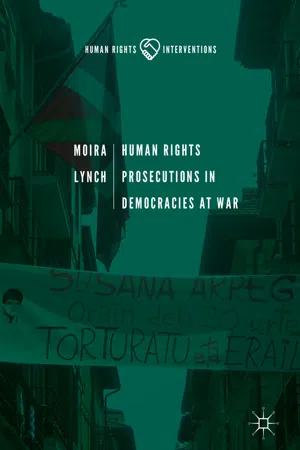
Human Rights Prosecutions in Democracies at War
About this book
Though many of the longest and most devastating internal armed conflicts have been fought within the boundaries of democratic states, these countries employ some of the highest numbers of human rights prosecutions. What conditions prompt this outcome and what explains the variable patterns of prosecutions in democracies at war? Prosecutions may be enabled by existing democratic norms and institutions, but given their role in a violent conflict, democratic governments may go to great lengths to avoid judicial accountability. Through qualitative and quantitative research of four cases, Sri Lanka, Northern Ireland, Spain and Colombia, this book argues that emergency and anti-terrorism laws issued during the conflict created barriers to the investigation and prosecution of state human rights violations. The extent to which state actors were held accountable was shaped by citizens, NGOs and political actors who challenged or upheld impunity provisions within emergency legislation.
Information
© The Author(s) 2019
Moira LynchHuman Rights Prosecutions in Democracies at WarHuman Rights Interventionshttps://doi.org/10.1007/978-3-319-96908-4_11. Introduction
Moira Lynch1
(1)
Department of Political Science, Loyola University Maryland, Baltimore, MD, USA
Moira Lynch
In the summer of 2015, I sat with Padre Alberto Franco in the offices of Comisión Intereclesial de Justicia y Paz to discuss the use of emergency law in Colombia’s war. Padre Franco compared the power of the military via emergency decrees in guerilla-controlled regions to a method of eliminar el agua de los peces, or removing the water (civil society) from the fish (guerillas). He explained to me that the emergency laws gave legal support to the state’s logic by which the internal enemy, suspected guerillas in civil society, was viewed as having no rights.1 For Padre Franco, the war was fundamentally against civil society and the devastatingly high number of civilian deaths reflects this reality. The picture Padre Franco paints is not uncommon to war zones. Emergency laws foster various forms of rights violations. But Padre Franco also highlighted one of the most significant aspects of these laws: they support a particular logic, one that serves to legitimize actions taken by the state against civilians during conflict. When citizens pursued human rights prosecutions during the Colombian conflict, the state and the military fell back on this logic, using the legitimizing force of law to defend all actions taken in the service of war.
A few years prior to my conversation with Padre Franco, I discovered a similar link between justice efforts and emergency legislation during my field research in Sri Lanka, Northern Ireland, and Spain. My research in these countries focused on how human rights prosecutions were held during armed conflict and why at particular moments. Many of the people I interviewed about human rights prosecutions pointed to the ways in which emergency and anti-terrorism laws restricted investigations of state violence . Certainly, I had expected to find that citizens who sought justice during a war would confront a host of barriers to their efforts. What was most surprising was the extent to which these laws were specifically designed or manipulated to protect state actors from prosecution. Additionally, when I began to trace the origin and evolution of emergency laws across the cases, evidence of resistance emerged. Victims and their families, political actors, human rights attorneys, and members of the judiciary challenged these laws, and the logic of impunity within them, throughout the conflict. The story of human rights prosecutions in democracies at war has not yet been told. This book carefully documents how, within such a highly restrictive environment, citizens sought justice for state violations, and it explains the conditions that made these efforts possible.2
The use of justice processes, such as human rights prosecutions and truth commissions, on a global scale is a relatively new phenomenon. A surge in justice mechanisms accompanied the third wave of democratization, and since this time, the burgeoning field of transitional justice has analyzed why some countries pursue justice while others do not. One of the least understood realms of this scholarship involves the pursuit of justice in democracies experiencing internal armed conflict. Though democracies have often been included in large-n studies and comparative case study research that examines the conditions for justice, much of this work employs theories only relevant to post-authoritarian and post-conflict countries.3 These theories provide explanations for how and why justice is sought after a period of violence or repression has largely ended. In democracies at war, in contrast, a number of prosecutions have been held during the conflict.
Since human rights prosecutions were held during the conflict in these cases, the level of violence may explain whether and when state actors are investigated for serious abuses. Higher numbers of civilian deaths tend to correlate with fewer domestic prosecutions.4 Based on this notion, Sri Lanka and Colombia, two countries that endured civilian deaths numbering in the tens of thousands, would be expected to have similar experiences in the realm of justice efforts: few or no prosecutions during the war. Yet, the pattern of prosecutions in these two cases is quite different. First, several prosecutions were held in both cases. Second, the record of prosecutions is actually quite different between the two cases. During Sri Lanka’s armed conflict, 211 state actors, including military personnel, politicians, and police, were prosecuted in 22 separate trials for human rights abuses. During Colombia’s civil war, 1073 state actors were prosecuted in 210 separate trials. Colombia prosecuted five times the number of state actors and held close to ten times the number of human rights prosecutions than those in Sri Lanka. Third, prosecutions in both cases do not emerge when the violence begins to wane. In Colombia, for example, prosecutions increase during some of the most violent periods of the war. Thus, the level or scope of violence does not help us to understand patterns of prosecution in these cases.
Alternatively, the timing of prosecutions in democracies at war might be explained by changes in political leadership during the conflict. In other words, it may be possible to predict the timing of human rights prosecutions as government officials assume power and, in order to retain power, attempt to punish their predecessors.5 Empirical evidence gathered for this book demonstrates, however, that this is not a common thread across the cases. Sri Lanka is an exception, and yet, the small number of prosecutions that are held under President Kumaratunga’s administration addresses crimes committed by her predecessor and crimes committed during her tenure. In the other three cases, human rights prosecutions are largely implemented by administrations that are responsible for the crimes. For example, in Spain, investigations and prosecutions concerning torture and extra-judicial killings conducted during the Partido Socialista Obrero Español (PSOE) administration transpire while the political party is still in power . In Northern Ireland, prosecutions for civilian deaths caused by British armed forces stationed in the region were conducted throughout several years of Conservative Party rule in England. A careful analysis of the political conditions prompting prosecutions reveals that most often prosecutions do not emanate from the will of political officials.
Research on during-conflict justice, which examines the conditions under which justice processes are used as a conflict tactic by governments and rebel groups, has found that democracies are more likely than anocracies and autocracies to enact trials and that this is likely a reflection of domestic audience costs and the fact that international commitments will have a stronger impact on democratic governments. Democratic governments typically respect the rule of law, they are more likely to comply with international law during internal armed conflict, and they tend to have higher rates of judicial independence.6 Yet, prosecution trends vary across democracies at war, and within individual cases, prosecutions are not a constant throughout the conflict. Explanations that frame justice-seeking efforts as a conflict tactic miss the agency of other key actors who are advocating for justice. Prosecutions are not solely a government or rebel group calculation. On the contrary, prosecutions often emerge and are made possible through the actions of ordinary citizens, civil society organizations, and those working in the legal and judicial sectors.7
Human rights prosecutions for serious human rights violations were held in Sr...
Table of contents
- Cover
- Front Matter
- 1. Introduction
- 2. Human Rights Prosecutions and Institutional Continuity in Sri Lanka
- 3. Conversion, Layering, and Human Rights Prosecutions in Northern Ireland
- 4. “Resorting to Authoritarian Habits”: Anti-terrorism Laws, State Violence, and Human Rights Prosecutions in Democratic Spain
- 5. The Constitutional Court, Military Jurisdiction, and Human Rights Prosecutions in Colombia
- 6. Human Rights Prosecutions and Democracies at War in Comparative Perspective
- Back Matter
Trusted by 375,005 students
Access to over 1.5 million titles for a fair monthly price.
Study more efficiently using our study tools.
Frequently asked questions
Yes, you can cancel anytime from the Subscription tab in your account settings on the Perlego website. Your subscription will stay active until the end of your current billing period. Learn how to cancel your subscription
No, books cannot be downloaded as external files, such as PDFs, for use outside of Perlego. However, you can download books within the Perlego app for offline reading on mobile or tablet. Learn how to download books offline
Perlego offers two plans: Essential and Complete
- Essential is ideal for learners and professionals who enjoy exploring a wide range of subjects. Access the Essential Library with 800,000+ trusted titles and best-sellers across business, personal growth, and the humanities. Includes unlimited reading time and Standard Read Aloud voice.
- Complete: Perfect for advanced learners and researchers needing full, unrestricted access. Unlock 1.5M+ books across hundreds of subjects, including academic and specialized titles. The Complete Plan also includes advanced features like Premium Read Aloud and Research Assistant.
We are an online textbook subscription service, where you can get access to an entire online library for less than the price of a single book per month. With over 1.5 million books across 990+ topics, we’ve got you covered! Learn about our mission
Look out for the read-aloud symbol on your next book to see if you can listen to it. The read-aloud tool reads text aloud for you, highlighting the text as it is being read. You can pause it, speed it up and slow it down. Learn more about Read Aloud
Yes! You can use the Perlego app on both iOS and Android devices to read anytime, anywhere — even offline. Perfect for commutes or when you’re on the go.
Please note we cannot support devices running on iOS 13 and Android 7 or earlier. Learn more about using the app
Please note we cannot support devices running on iOS 13 and Android 7 or earlier. Learn more about using the app
Yes, you can access Human Rights Prosecutions in Democracies at War by Moira Lynch in PDF and/or ePUB format, as well as other popular books in Politics & International Relations & Civil Rights in Law. We have over 1.5 million books available in our catalogue for you to explore.