- English
- ePUB (mobile friendly)
- Available on iOS & Android
eBook - ePub
About this book
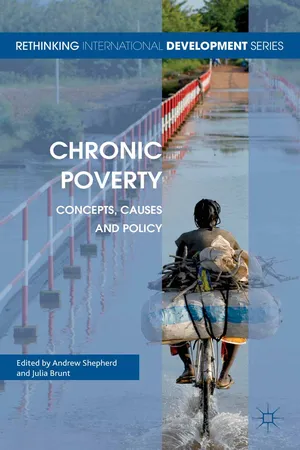
Based on a decade of research by the Chronic Poverty Research Centre, this volume includes material on inter-generational transmission, the importance of assets and vulnerability, and conflict, and new thinking about the close relationship between social exclusion and adverse incorporation.
Information
1
Introduction
Karen Moore and Julia Brunt
1.1 The distinguishing feature of chronic poverty is its extended duration
Chronically poor people are those who experience deprivation over many years, often over their entire lives. If and when they have work, it is insecure, casual, and at extremely low rates of pay. They generally endure hunger and illiteracy, and lack access to basic necessities such as safe drinking water and health services. They experience discrimination, stigmatisation, or ‘invisibility’. In order to manage and obtain some sort of security for themselves and their families, they often trade away their own agency.
Chronic poverty exists in all regions, and chronically poor people live in many different situations. They are socially marginalised ethnic, religious, indigenous, nomadic, and caste groups; migrants and bonded labourers; refugees and internally displaced persons; and people with disabilities and certain illnesses such as HIV/AIDS. In many contexts, poor women and girls, children, and older people (especially widows) are more likely to be trapped in poverty. For people living in marginal rural areas, the disabled, older people, child-headed households, and displaced people and refugees, poverty is frequently carried from one generation to the next.
Such poverty is hard to reverse. To do so, we need to understand what it means to be chronically poor and to identify those characteristics and underlying social processes that result in sustained and intractable poverty. We also need to engage key policymakers. A significant hurdle is the limited political interest, at international, national, and local levels. Although their wellbeing is severely constrained, the chronically poor often remain invisible, occupying a blind spot when it comes to the design of development policy and the delivery of public services.
As a result of limited interest and indeed knowledge, the problem proliferates. Chronic poverty blights the lives of hundreds of millions of people across the world, at least 400 million according to the latest estimates. In many countries in sub-Saharan Africa, it is likely that chronic poverty describes the situation of around 25% of the population. Meanwhile, even in rapidly growing economies like those of India and China, tens of millions of people remain trapped in poverty, seeing little benefit from their country’s increasing prosperity. Chronic poverty is, therefore, not the problem of a ‘residual’ few, waiting to be reached by development; it exists even in some of contemporary international development’s ‘success stories’.
1.2 Why does chronic poverty matter?
Chronic poverty is morally unacceptable. Those trapped endure severely low levels of welfare. But with sound policy analysis and effective engagement, their and their children’s wellbeing can significantly be enhanced.
Crucially, reaching the chronically poor is not simply a matter of implementing current policies more fully. Although contemporary analyses of, and approaches to, poverty treat it largely as a transitory phenomena, research suggests that millions of people will remain in chronic poverty without policies that specifically address their situation with substantial and well-targeted assistance. Understanding the manifestations, attributes, and social dynamics of chronic poverty is essential in developing such effective public interventions. Time spent in poverty may itself have effects, as well as being the result of complexity of structures and processes. We need to understand these dynamics.
It is important to focus on chronic poverty now. If left to become yet more entrenched, the challenges will only grow. The longer we leave it, the more costly, technically complex and politically difficult it will become for countries and aid efforts to have a significant impact on poverty.
Addressing chronic poverty is also integral to the Millennium Development Goals and poverty eradication. Persistent impoverishment is not only a symptom of past deprivation, but also a cause of future destitution. There is increasing evidence that growth and the prospects for long-term poverty reduction are held back by inequality and by the low returns that the poorest people get on their labour. At the most basic level, people cannot be productive unless their food intake is enough to ensure that they can work.
1.3 What is required?
We need to deepen our understanding of chronic poverty. This requires learning about poverty dynamics and particularly the nature, causes, and remedies of chronic poverty, including what the chronically poor already do to try to escape poverty. This can be achieved through analysis and development of appropriate combinations of research methodologies. To this end, in this volume, experts on chronic poverty provide a comprehensive yet concise tour of the main analytical approaches to chronic poverty, the strengths of framing broader cross-cutting issues in terms of poverty dynamics and persistence, and four country case studies on the application of these ideas.
1.4 Overview
In Chapter 2, the first of six chapters on analytic approaches, Andrew Shepherd guides the reader through the key concepts that structure this volume: poverty dynamics, the intergenerational transmission of poverty, resilience, vulnerability, economic growth, assets, social exclusion, poverty traps, and adverse incorporation. He then looks at context, particularly that of state performance.
In Chapter 3, Bob Baulch examines the conceptualisation and measurement of poverty dynamics and economic mobility. He argues that descriptive analysis and a Q2 approach that combines panel survey with life histories in an integrated and sequenced manner offer great potential for gaining a more nuanced understanding of poverty dynamics and economic mobility.
In Chapter 4, Kate Bird reviews the international literature on the intergenerational transmission of poverty, identifying the factors and processes that, within the broader economic and sociopolitical context, determine the poverty status of individuals and their households, the likelihood that poverty is passed from one generation to another, and the potential ‘poverty trajectories’ for those growing up in poor households.
In Chapter 5, Armando Barrientos discusses whether vulnerability generates poverty traps. He does so by reviewing existing models of poverty traps and exploring whether these can accommodate vulnerability. He also discusses the empirical evidence available in support of these models and looks at their policy implications.
In Chapter 6, Andy McKay discusses the relationship between assets and vulnerability. He considers the role of changes in asset holdings in poverty transitions, leading to a discussion of asset-based poverty traps and of the potential role of discrimination as a factor in the access to and use of assets.
In Chapter 7, Sam Hickey and Andries du Toit encourage us to focus on the ways in which the processes and relations of adverse incorporation and social exclusion underpin chronic poverty. Additionally, like the other authors, they suggest a number of fruitful areas for, and methods of, research.
In Chapter 8, Tony Addison, Kathryn Bach, and Tim Braunholtz examine some of the links between violent conflict and chronic poverty, including the ability of violent conflict to create political space for action to reduce poverty. Both the ways in which poverty can lead to violent conflict and the impoverishing effects of conflict are considered. The authors argue for an increased focus on the chronically poor during post-conflict reconstruction.
The next four chapters set out a number of country reflections on how the key themes outlined in earlier chapters pertain to chronic poverty in a particular context.
In Chapter 9, Binayak Sen reflects on why the chronically poor cannot escape poverty in Bangladesh. The ‘triple disadvantage’ of chronic poverty (‘below threshold level’ asset accumulation, exposure to greater risk and vulnerability, and exclusion through geographic remoteness and social marginality) makes escape extremely difficult. He argues that specific policies are needed to address chronic poverty.
In Chapter 10, Yisak Tafere considers chronic poverty in Ethiopia from the perspective of the transition from childhood to young adulthood in order to better understand youth life-course poverty. The role of changing norms in mutual expectations and obligations between children and parents and the effect on the intergenerational transmission of poverty are given particular attention. He concludes with suggestions for interventions that are needed to overcome intergenerationally transmitted poverty in Ethiopia.
In Chapter 11, Aasha Kapur Mehta, Amita Shah, Trishna Satpathy, Shashanka Bhide, and Anand Kumar review chronic poverty in India. The major factors keeping people in poverty, driving people into poverty, and enabling them to escape it are identified, and possible policy approaches to address the problem are recommended.
In Chapter 12, Charles Lwanga-Ntale reflects on 10 years of chronic poverty research in Uganda. He identifies the causes and characteristics of chronic poverty in the country and poverty reduction approaches which have been implemented. The rise of social protection as a policy response is given particular attention. He observes that policies have not always benefited those living in chronic poverty and highlights challenges for successful policy responses to chronic poverty and the critical importance of taking the political economy into account.
In the concluding chapter, Andrew Shepherd reflects on the key themes emerging from this book. He concludes that chronic poverty is not a residual problem, but that there are structural barriers to poor people emerging from poverty in many situations. Many of these are illustrated in the country reflections. A number of recurring themes have been addressed in the various chapters: Do poverty traps exist? What factors prevent impoverishment and facilitate escape from poverty? Have poor people’s own strategies been understood and given sufficient support? Are critical groups ignored by policymakers? Thoughts on these are drawn together in this conclusion. In a final reflection, it is judged that the analytical framework presented in Chapter 2 has stood the test of time relatively well, providing a useful coordinating device for a research effort stretching over different countries and continents and a number of academic disciplines.
1.5 Background information on the Chronic Poverty Research Centre
This edited volume draws from the analytical and empirical work undertaken and commissioned by the DFID-funded Chronic Poverty Research Centre (www.chronicpoverty.org).
Established in 2000 with initial funding from the United Kingdom’s Department for International Development (DFID), the CPRC is an international partnership of universities, research institutes, and NGOs which exists to focus attention on chronic poverty, to stimulate national and international debates, to deepen understanding of the causes of chronic poverty, and to provide research, analysis, and policy guidance that will contribute to its reduction. (The partners are based in Bangladesh, Benin, Burkina Faso, Ghana, India, Niger, Senegal, South Africa, Uganda, and the United Kingdom.)
In 2004, the Centre published the first Chronic Poverty Report, the first major international development report to focus on chronic poverty. This report examined the dimensions of chronic poverty – the number of people who suffer it, where they live, who they are, and why chronic poverty exists.
In 2008, the Centre published the second Chronic Poverty Report, which looks in more depth at possible solutions. It identifies five main traps which create chronic poverty and sets out key policy responses. The publication of this report is accompanied by policy briefs, highlighting key arguments and policy points in a shorter format, and 50 background papers offering a wealth of extra detail and research.
The CPRC partners around the world also publish national Chronic Poverty Reports, looking at the dimensions of chronic poverty, and possible policy responses, in their countries or regions.
The CPRC expects its research and analysis to result in policy relevant findings which will be useful to all those working to combat poverty. This will include people in community level organisations, government and official agencies, NGOs, political parties, other researchers, the media, trade unions, and the private sector.
The ultimate beneficiaries should be those whose deprivation is sustained over many years and who are least likely to benefit from current national and international development efforts.
2
An Evolving Framework for Understanding and Explaining Chronic Poverty
Andrew Shepherd
2.1 Introduction
In order to explain chronic poverty and to determine how best to interrupt it, a clear and coherent conceptual framework is necessary.
The framework developed by the Chronic Poverty Research Centre (CPRC) has three levels. The first is a statement of the problem ‘chronic poverty’. The second is an elaboration of how the CPRC is looking at this problem through the lenses of poverty dynamics and intergenerational transmission. The third level proposes concepts that are useful in understanding and explaining chronic poverty, economic growth, insecurity and assetlessness, and politics and power. The framework suggests that there is an interdisciplinary meeting point between the concepts of ‘poverty traps’ and ‘adverse incorporation’ and also that the cutting edge of research on chronic poverty lies in the interaction of asset dynamics and changing social relations. This framework also explores the key components of context. Consideration of one of these – the performance of the state and, in particular, the underperformance of ‘fragile states’ or chronically deprived countries – suggests that not only does chronic poverty research have something to say to the ‘fragile s...
Table of contents
- Cover
- Title
- Copyright
- Contents
- List of Figures, Tables and Boxes
- Preface and Acknowledgements: ‘going that extra mile’
- Notes on Contributors
- List of Abbreviations
- 1 Introduction
- 2 An Evolving Framework for Understanding and Explaining Chronic Poverty
- 3 Understanding Poverty Dynamics and Economic Mobility
- 4 The Intergenerational Transmission of Poverty: An Overview
- 5 Does Vulnerability Create Poverty Traps?
- 6 Assets and Chronic Poverty
- 7 Adverse Incorporation, Social Exclusion, and Chronic Poverty
- 8 Violent Conflict and Chronic Poverty
- 9 Low Accumulation, High Vulnerability, and Greater Exclusion: Why the Chronically Poor Cannot Escape Poverty in Bangladesh, or Elsewhere in South Asia
- 10 Understanding Youth Life-Course Poverty in Ethiopia
- 11 Policies to Address Chronic Poverty in India
- 12 Chronic Poverty in Uganda: Lessons from 10 Years of Research and Policy Engagement
- 13 Conclusion and Policy Implications
- Index
Trusted by 375,005 students
Access to over 1.5 million titles for a fair monthly price.
Study more efficiently using our study tools.
Frequently asked questions
Yes, you can cancel anytime from the Subscription tab in your account settings on the Perlego website. Your subscription will stay active until the end of your current billing period. Learn how to cancel your subscription
No, books cannot be downloaded as external files, such as PDFs, for use outside of Perlego. However, you can download books within the Perlego app for offline reading on mobile or tablet. Learn how to download books offline
Perlego offers two plans: Essential and Complete
- Essential is ideal for learners and professionals who enjoy exploring a wide range of subjects. Access the Essential Library with 800,000+ trusted titles and best-sellers across business, personal growth, and the humanities. Includes unlimited reading time and Standard Read Aloud voice.
- Complete: Perfect for advanced learners and researchers needing full, unrestricted access. Unlock 1.5M+ books across hundreds of subjects, including academic and specialized titles. The Complete Plan also includes advanced features like Premium Read Aloud and Research Assistant.
We are an online textbook subscription service, where you can get access to an entire online library for less than the price of a single book per month. With over 1.5 million books across 990+ topics, we’ve got you covered! Learn about our mission
Look out for the read-aloud symbol on your next book to see if you can listen to it. The read-aloud tool reads text aloud for you, highlighting the text as it is being read. You can pause it, speed it up and slow it down. Learn more about Read Aloud
Yes! You can use the Perlego app on both iOS and Android devices to read anytime, anywhere — even offline. Perfect for commutes or when you’re on the go.
Please note we cannot support devices running on iOS 13 and Android 7 or earlier. Learn more about using the app
Please note we cannot support devices running on iOS 13 and Android 7 or earlier. Learn more about using the app
Yes, you can access Chronic Poverty by A. Shepherd, J. Brunt, A. Shepherd,J. Brunt in PDF and/or ePUB format, as well as other popular books in Politics & International Relations & International Relations. We have over 1.5 million books available in our catalogue for you to explore.