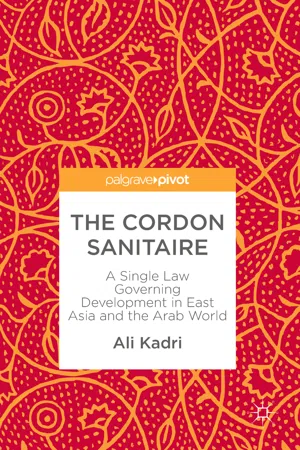
This work compares the development experiences of East Asia and the Arab world. It posits that in view of the collapse in socialism and its ideological retreat, their development performances are intensely over determined by their modes of integration with world capital. For East Asia, it's through manufacturing of civilian-end use commodities and for the Arab World, through militarism. The book is a unique attempt approaching the topic from the theoretical angle using an analytical comparative perspective.
eBook - ePub
The Cordon Sanitaire
A Single Law Governing Development in East Asia and the Arab World
- English
- ePUB (mobile friendly)
- Available on iOS & Android
eBook - ePub
About this book
Information
© The Author(s) 2018
Ali KadriThe Cordon Sanitairehttps://doi.org/10.1007/978-981-10-4822-7_11. Introduction and Background
Ali Kadri1
(1)
National University of Singapore, Singapore, Singapore
Abstract
This chapter introduces the objective, which is to compare the development of the Arab World and East Asia and posits that development occurs in the shadow of a cordon sanitaire strategically serving the security concerns of US-led imperialism. It tackles the problem of East Asia and the Arab World as representing two cases of imperilist practice and their corresponding policies leading to different developments. It concludes that the way to approach comparatives is not by spotting the infinite heterogeneity of actuality so that no conclusions can be drawn. It stresses that the apparent parallels or departures between the development courses of the Arab World and East Asia are not the result of good or bad capitalism, because there is only one capitalism whose practice of the law of value assumes different measures of repression reducing the value of labour power way below the wages paid out to the working class. Unless the comparative is posited in terms of class history as the practice of the law of value, all comparisons would be confined to an epiphenomenon in which only differences are the rule.
Keywords
Comparative developmentDevelopment methodologyEconomic policyThe impressive economic growth record of East Asia (EA) in the second half of the twentieth century transformed the economies of this region into a purported model for other developing countries and a benchmark against which to evaluate their policies. 1 The successful interface of their financial, trade and macro policies with their particular conditions was touted as the procedure to emulate (WESS 2008). The economic role of the state was re-acknowledged as crucial for catching up, including the way they dodged the straightjacket of neoliberalism, calibrating their degree of ‘openness’ to certain development needs (Amsden and chu 2003). However, the case may be that these impressive economic results have been raised to the level of dogma, reifying these experiences into a set of universal policies, when in reality they could not be replicated in other contexts. This work compares the development experiences of EA, especially the experience of the richer nations that have broken through the development barrier (the breakthroughs), and the Arab world (AW) and posits that these regional development performances are intensely overdetermined by their modes of integration with world capital 2 : EA through accumulation by manufacturing of civilian-end use commodities and the AW through accumulation by militarism. 3
Political and historical conditions for successful development vary, and so does the outcome of development. The EA–AW comparison cannot be framed in terms of two competing and universal models, in turn reduced to a debate between state-led and market-led development. Once the comparison is formalised, the choice of variables intended to prove similitude or difference becomes either arbitrary or argued according to blatant ideological proclivities. Not that any interpretation could stand above ideology, but arguments grounded in a reading of history disallow facile hypothetical theorisation or falsification of fact. Formalisation, the art of cross-sectioning and de-historicising social processes, only attests to the truth of the proverb that ‘all comparisons are lame’ and situates similitudes and differences at the level of epiphenomena, which easily lend themselves to quantification. Quantification cannot be eschewed, but if knowledge is to be reverse-constructed from appearances and quantities, qualities and/or the history of the development of objects, their laws of historical self-differentiation that demonstrate likenesses or variances, disappear.
In terms of economic success, Israel, a settler-colonial social formation transplanted into the AW, flooded with financial and military aid and situated in one of the hottest war zones on the planet, is roughly as successful as South Korea. 4 Not all the Arab region failed and not all EA succeeded. When class lines that cross national boundaries are the starting point for theories of development, stories of success or failure are linked together by class ties, while geographic or spatial conventions assume secondary relevance. The comparative development experience is never solely regional; it cuts across regions. Integrated within the American security nexus, highly developed states and imperialist security outposts such as Israel and South Korea are more at ease with the command of their policy space and resources than many others. This work argues that similarities and differences in social development between EA and the AW are principally products of an objective and impersonal class history that delegates to national forces the autonomy and the policy space in which to develop. As the power of the social and national revolutions in contradiction with imperilism wanes, it is the latter (imperialism) that develops or de-develops, and it does so by moulding social conditions to the requisites of rising profit rates.
The East Asian growth experience is based, among other factors, on the existence of states that enjoy a certain level of autonomy in relation to and by protection of imperial reach. The top performers who leapt into the advanced club have managed to guide the processes of structural transformation and economic growth in tandem with their joint national/imperialist security concerns. That empires strengthen, invest and securitise advanced outposts to defend themselves from potential competitors is an age-old practice. The many prosperous Levantine cities lying at the edge of the Syrian Badiya (desert), of which Palmyra in Syria still makes the news, were projects of the Roman empire to cultivate the loyalties of the local population and solidify its defences against the Parthians (Hilou 2004). 5 In the same vein, the East Asian countries that have caught up with the advanced industrial club; they have done so a fortiori as a result of US-led imperialist and geostrategic objectives. These states industrialised, built national security and considered industrialisation as a subcomponent of national security, just as Soviet industrial policy initially took off to strengthen defence or as George Marshall envisaged for post-WWII Germany.
Regionally, the Arab dystopia as demonstrated by the recent uprisings began with the ebbing of the Nasserite period, the successive Arab defeats, especially in 1967 and 1973, combined with the collapse of the Soviet Union, the introjection of defeatism and the rise of the merchant mode of accumulation that steers resources away from industry. The Arab state has since been reduced to either a repressive apparatus that administers strategic resources at the behest of foreign powers or a fragmented class composed of internecine warring factions that realise imperialist surplus and devalorise the national formation through self-destruction. Unlike the market for civilian end-use commodities mode of integration of EA, the AW is integrated into the global economy via the channels of war and oil.
Conventional explanations of development revert to notions of trans-historical cultural attributes that have suddenly awoken in the collective mind of the country in question as reasons for take-off or descent. They flaunt nationalistically bred success stories of elites coalescing around conjured nationalist ideals to empower the state as the ultimate resource allocator and marker of cross-country of variances (Migdal 1988). Conversely, countries that have failed the development test are implicitly or explicitly slotted into the category of undeveloped spirits whose time for fruition has not yet dawned (Collier et al. 2003). Whichever way one looks at it, the cultural discourse relies on unchanging historical attributes couched in a selective reading and periodisation of history. In an uneven global context in which there must be winners and losers, often by the use or the threat of military force, the articulation of historical forces that affords a degree of autonomy to developing states holds primacy over the role that nationally spawned relationships and institutions play in the race for development. Peripheral social forms, states and policies are subsidiary to the full weight of history and only mediate its outstanding contradictions. Spatially, global antagonisms materialised in a cordon sanitaire, may provide entente and more resources destined to civilian end-use, as in the case of EA, or conflict and the erosion of sovereignty steering accumulation to military ends and value destruction, as was the Arab case. The impact of development nationally is necessarily conditioned by the degree of power and autonomy a nationalist capitalist class enjoys vis-à-vis international capital in order to retain and recirculate its surpluses. Hence, it is within a post-WWII configuration in which US-led imperialism sought arresting the expansion of China and promoting the expansion of Israel that the relative success of EA and the derailed development of the AW are to be gauged.
However, the steep rise of China as an economic power in search of a political foothold is changing the rules of the game. Just in the same way that militarism and open conflict debilitated the AW, the recent rise of China is triggering a militarisation of Asia and a re-militarisation of Japan, which may, contingent upon shifting alliances, reverse Asian developmental achievements. The rate of surplus value is much higher under modes of commercial exploitation and war than super-exploitation. Through depopulation, commercial exploitation consumes labour power by prematurely extinguishing lives at a much faster rate relative to other modes of exploitation. In re-conditioning the East Asian mode of production to higher profit rates, the time may have come for US-led imperialism to restructure power or draw more resources from that region by means of war, just as it does with the AW. In the final chapter, this work will touch on the crucial issue of the growth of China and its likely impact on its surrounding region. There is no clear answer to such a debacle; however, if the working classes of China and EA rein in the comprador elements in their ruling classes, the region may not slip into oblivion as happened in the AW.
In the main, this lengthy research will examine the balance of historical forces, their realisation of the law of value by the practice of imperilism, manifest in a shifting cordon sanitaire, which leads to divergent developmental paths in EA and the Arab region, respectively. In particular, it will highlight the importance of working-class security as the substance of sovereignty to restructuring societies in ways that resulted in sturdy economic growth with a closing income gap in EA—or in the opposite, extremely poor long-term averages of real per capita growth rates with widening income gaps, in the Arab regions. 6
Situating the Issue
The promotion of the East Asian experience to the status of a developmental model had a positive effect on questioning the recommendations of the neoliberal economic model (Yin 2011; Naqib 2016). By offering evasive manoeuvres around the diktat of received theory, manoeuvres intended to achieve tangible retention of the social product by the national economy, the emergence of the ‘East Asian Model’ pierced through the dogma surrounding developmental policies and the well-worn state-versus-markets fallacy. Apart from the dip in growth during the 1997–1998 Asian crisis, EA growth rates per capita remained in the healthy range, especially if China is added to the group (UNCTAD-TDR 2012). During the East Asian crisis of 1997–1998, which was ignited by a severe dip in chip prices, and accentuated into a bust as a result of excessive capital inflows trailing East Asian growth initially and whizzing out over long-term confidence in national markets combined with a dollar rally, was a one-time event after which the economy resumed its growth course (UNCTAD-TDR 1999). The bust occurred as a Minsky moment, or a point at which the buoyant real economy drew in far more private debt than it could pay off when the real cycle recedes. However, the leading economies of EA are located/integrated in what would later become the most buoyant region globally (the China effect) and their export revenues are based on high value-added, science-laden content, and manufactured product to which the terms of trade are favourable. 7 However, the lower end partners of developed North East Asia remain underdeveloped, with the FDI and other geopolitical rent components characterising their potentially unsteady path on the road to future development.
The East Asian social crisis lingered a result of USA’s efforts to delay bailouts (through the IMF) and to undo the resonance of the alternative Asian model and simultaneously for Western capital to acquire higher ownership of Asian assets at cheap rates (Chandrasekhar and Ghosh 1998). Chandrasekhar and Ghosh (1998) also posit that the fall of the Soviet Union may have triggered a relaxation of the capital control restraints of the Asian model of development. But at that time, the neoliberals were dizzy with success celebrating their victory, and a spectre of dreadful market fundamentalism has captured the global imagination. Financialisation and the denationalisation of development were globally afoot to unlatch resources from their national origins and ideologically undermine labour. Crisis or no crisis, the comprador classes of EA, procuring and profiting off the avails of fragile exports or geopolitical rents, root their allegiance in the circle of US-led capital.
Although for lack of sufficient public sector-sponsored welfare nets and automatic stabilisers redressing demand, the East Asian crisis could have trailed longer, the length of the downturn was shortened because EA’s exports are high-demand/dynamic products. Asian high value-added and tech-upgraded products are the most dynamic globally (measured in trade-revenue performance), for which the 1999 rebound in demand re-energised higher employment and consumption levels (Meyer et al. 2002).
Patnaik (1999) correctly argues that although ‘many factors have been highlighted, and rightly so, as underlying the high growth of the East Asian tigers (some of which hold for Southeast Asia as well) such as land reforms; the achievement of high levels of literacy; the economic concessions (in the form inter alia of allowing substantial market access) made by the USA for geopolitical reasons (confronting communism); a seldom noted factor, which is the key factor,’ according to...
Table of contents
- Cover
- Frontmatter
- 1. Introduction and Background
- 2. The Higher Rates of Surplus Value Through Commercial Exploitation
- 3. Development in the Shadow of Imperialism
- 4. Security and Economic Development
- 5. The Rise of China and the Potential for East Asian Collapse
- Backmatter
Trusted by 375,005 students
Access to over 1.5 million titles for a fair monthly price.
Study more efficiently using our study tools.
Frequently asked questions
Yes, you can cancel anytime from the Subscription tab in your account settings on the Perlego website. Your subscription will stay active until the end of your current billing period. Learn how to cancel your subscription
No, books cannot be downloaded as external files, such as PDFs, for use outside of Perlego. However, you can download books within the Perlego app for offline reading on mobile or tablet. Learn how to download books offline
Perlego offers two plans: Essential and Complete
- Essential is ideal for learners and professionals who enjoy exploring a wide range of subjects. Access the Essential Library with 800,000+ trusted titles and best-sellers across business, personal growth, and the humanities. Includes unlimited reading time and Standard Read Aloud voice.
- Complete: Perfect for advanced learners and researchers needing full, unrestricted access. Unlock 1.5M+ books across hundreds of subjects, including academic and specialized titles. The Complete Plan also includes advanced features like Premium Read Aloud and Research Assistant.
We are an online textbook subscription service, where you can get access to an entire online library for less than the price of a single book per month. With over 1.5 million books across 990+ topics, we’ve got you covered! Learn about our mission
Look out for the read-aloud symbol on your next book to see if you can listen to it. The read-aloud tool reads text aloud for you, highlighting the text as it is being read. You can pause it, speed it up and slow it down. Learn more about Read Aloud
Yes! You can use the Perlego app on both iOS and Android devices to read anytime, anywhere — even offline. Perfect for commutes or when you’re on the go.
Please note we cannot support devices running on iOS 13 and Android 7 or earlier. Learn more about using the app
Please note we cannot support devices running on iOS 13 and Android 7 or earlier. Learn more about using the app
Yes, you can access The Cordon Sanitaire by Ali Kadri in PDF and/or ePUB format, as well as other popular books in Politics & International Relations & International Business. We have over 1.5 million books available in our catalogue for you to explore.