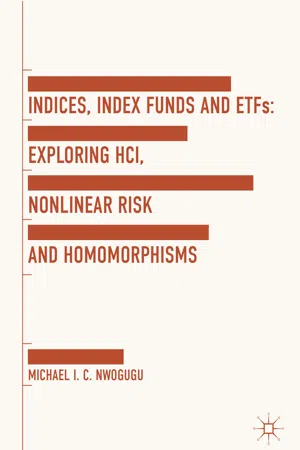
Indices, index funds and ETFs are grossly inaccurate and inefficient and affect more than €120 trillion worth of securities, debts and commodities worldwide. This book analyzes the mathematical/statistical biases, misrepresentations, recursiveness, nonlinear risk and homomorphisms inherent in equity, debt, risk-adjusted, options-based, CDS and commodity indices – and by extension, associated index funds and ETFs. The book characterizes the "Popular-Index Ecosystems," a phenomenon that provides artificial price-support for financial instruments, and can cause systemic risk, financial instability, earnings management and inflation. The book explains why indices and strategic alliances invalidate Third-Generation Prospect Theory (PT3), related approaches and most theories of Intertemporal Asset Pricing. This book introduces three new decision models, and some new types of indices that are more efficient than existing stock/bond indices. The book explains why the Mean-Variance framework, the Put-Call Parity theorem, ICAPM/CAPM, the Sharpe Ratio, Treynor Ratio, Jensen's Alpha, the Information Ratio, and DEA-Based Performance Measures are wrong. Leveraged/inverse ETFs and synthetic ETFs are misleading and inaccurate and non-legislative methods that reduce index arbitrage and ETF arbitrage are introduced.
eBook - ePub
Indices, Index Funds And ETFs
Exploring HCI, Nonlinear Risk and Homomorphisms
- English
- ePUB (mobile friendly)
- Available on iOS & Android
eBook - ePub
About this book
Information
© The Author(s) 2018
Michael I. C. NwoguguIndices, Index Funds And ETFshttps://doi.org/10.1057/978-1-137-44701-2_11. Introduction
Michael I. C. Nwogugu1
(1)
Enugu, Nigeria
Michael I. C. Nwogugu
Keywords
IndicesIndex fundsExchange-traded fundsDebtEquityRisk managementSystemic riskPortfolio managementAllocationIndices, index funds and exchange-traded funds (ETFs) have become major asset classes in debt, equity, real estate, derivatives, currency and commodity markets worldwide—and their management, maintenance and use often occurs within the context of human–computer interactions (HCI). As of 2018, there were more stock indices in the world than the number of exchange-traded companies.1 The significant growth of Indices, passive/active ETFs (exchange traded funds) and index funds during 1995–20182 (combined with the Internet; increasing volume of cross-border transactions; and improved global settlement/clearing systems) have increased the potential for systemic risk, financial instability and the failures of regulations. The major problem is that more than US$3.5 trillion is invested in indices through ETFs, index funds and equity swaps, apparently without adequate consideration of risk, business quality and valuation. Some of the net effects are that (i) the companies in these indices are overvalued and enjoy artificial price support (from these ETFs and index funds); (ii) there is significant overinvestment in the underlying companies (of the Indices, ETFs and index funds) and underinvestment in non-listed, small-cap, startup, micro-cap and emerging markets companies, which affects economic growth, sustainability, development and capital mobility; and (iii) these indices, index funds and ETF and their component companies pose increasing sustainability (economic, social, environmental and urban sustainability), systemic risk3 and financial instability4 threats.
Given the pervasiveness of automated financial services and electronic trading, ETFs, indices and index funds function almost entirely within the context of human–computer interaction factors (i.e. cognition and perception, user-interfaces, human biases, contagion across social networks, noise, psychological effects, systems-reliability, etc.) and latent/inherent mathematical issues (e.g. nonlinearity, homomorphisms, biases, etc.) but the associated problems have not been fully analyzed in the literature. Most of these indices, index funds and ETFs are maintained and managed with huge reserves of computing power and technical staff (programmers, computer engineers, systems engineers, math specialists, servers, bandwidth, and network infrastructure); and are calculated and processed by automated software systems (that collect and use real-time data from markets).
As of 2018, there were more than 4779 ETFs worldwide whose total assets exceeded US$3.5 trillion; and more than 60% of the ETFs were based or listed in the US. Indices are the foundation and “Core” for more than US$5 trillion that have been invested in index funds and index-based ETFs worldwide (and the equivalent of hundreds of billions, if not trillions, of dollars are invested in equity swaps, index options and index futures around the world). Stock indices are the basis for various types of international transactions (equity swaps, equity-linked debt, plain/currency-linked index options, executive compensation, competitive benchmarking, etc.) and foreign “persons” purchase index-based financial products. Thus the impact of financial indices on sustainability, the global economy and national economies is significant.
As of 2018, the major ETF providers were US-based companies such as Blackrock, State Street, Vanguard, Powershares, Charles Schwab, First Trust, Van Eck Vectors, Wisdom Tree, Guggenheim Investors and ProShares. Some of the top providers of Mutual Funds and index funds are Vanguard, Fidelity Investments, Capital Group, JP Morgan Chase, T. Rowe Price, Blackrock, Franklin Templeton Investments, PIMCO and Dimensional Fund Advisors.
In the US and some other countries, there are three principal types of index funds, which are open-end funds, unit investment trusts (UITs) and closed-end funds. Most US ETFs are exchange-traded open-end funds or unit investment trusts. Some index funds and ETFs are “traditional” (created with actual exchange-traded securities) while others are “synthetic” (created with only swaps and/or futures). In most countries, investors in index funds and ETFs pay five types of fees, which are the management fee, shareholder transaction fees, distribution charges (sales loads and 12b-1 fees), securities transaction fees and fund services charges. Some of these expenses reduce the value of an investor’s account while the fund pays other fees, which reduces its net asset value. See: Pozen and Hamacher (2015), Lemke et al. (2016), Fink (2011), and Investment Company Institute (2016). Although ETFs and index funds are more popular in the US, they are very likely to both gain a greater share of fund assets outside the US, and to increase in absolute volume due to concerns about fees charged by Mutual Funds; concerns about liquidity, transparency and pricing of funds; popularity of active and passive index investing; increased investor education; and the growth of capital markets in Japan, China, Mexico, India, Brazil, the MENA region, Thailand, Indonesia, Eastern Europe and Australia. Meziani (2016) provides a general overview of various types of ETFs and their uses in asset management, but that book is intended for a more general audience.
One major issue is the pervasive effects of the combinations of regulation (e.g. stop-trading orders by regulators, trading limitations, circuit-breakers, etc.), indices, index funds, ETF Arbitrage and greed. Given the discussions in Chaps. 3, 7 and 8 of this book, lawsuits against banks and securities brokerages in several countries for rigging of CDS markets and bond markets (and associated settlements), the prevalence of Index Arbitrage and ETF Arbitrage, and the heavy regulation of stock, commodity and bond markets, it appears that many of these markets are, or can be, rigged. It is now clear that “regulation” by itself can be a form of rigging, for example, where circuit breakers and/or trading rules in markets are unreasonable or, effectively, amount to collusion. See the comments in Diamond and Kuan (2018).
Indices, ETFs and index funds and their associated index methodologies and creation/rebalancing methods are essentially Algorithms, an interdisciplinary topic that has been analyzed mostly from mathematics (nonlinearity; dynamical systems),5 finance/economics,6 operations research,7 applied mathematics,8 statistics,9 computer science10 and physics11 (statistical physics, nonlinearity, complex systems) perspectives. However, most (if not all) of those articles, books and models are wrong or misleading because they don’t consider the biases, misrepresentations, conflicts of interest and “Structural Effects” introduced in this book and in Nwogugu (2017a, b, c). Furthermore, these same biases, errors and “Structural Effects” can have significant effects on sustainability (economic, social, environmental and urban sustainability) because they affect and/or determine worldwide capital allocation, expectations, inequality, noise, optimism, the mental states of humans, and the production activity and urban interactions that can reduce sustainability efforts (see Chap. 13). The term “Structural Effects” refers to biases, errors and effects that arise solely from the nature/structure of the mathematical formulas for the index and/or the method of constructing ETFs/ETNs/Mutual-Funds (thus, Structural Effects are not caused by human psychology, trading patterns, trading rules, decimalization of prices, etc.).
Another important related result is that the theorems in Nwogugu (2013) and Chap. 4 in this book about the invalidity of the Mean–Variance Framework renders null and void most (if not all) analysis about:
- (1)Global Sens...
Table of contents
- Cover
- Front Matter
- 1. Introduction
- 2. Number Theory, “Structural Biases” and Homomorphisms in Traditional Stock/Bond/Commodity Index Calculation Methods in Incomplete Markets with Partially Observable Un-aggregated Preferences, MN-Transferable-Utilities and Regret–Minimization Regimes
- 3. A Critique of Credit Default Swaps (CDS) Indices
- 4. Invariants and Homomorphisms Implicit in, and the Invalidity of the Mean-Variance Framework and Other Causality Approaches: Some Structural Effects
- 5. Decision-Making, Sub-additive Recursive “Matching” Noise and Biases in Risk-Weighted Stock/Bond Commodity Index Calculation Methods in Incomplete Markets with Partially Observable Multi-attribute Preferences
- 6. Informationless Trading and Biases in Performance Measurement: Inefficiency of the Sharpe Ratio, Treynor Ratio, Jensen’s Alpha, the Information Ratio and DEA-Based Performance Measures and Related Measures
- 7. Anomalies in Taylor Series, and Tracking Errors and Homomorphisms in the Returns of Leveraged/Inverse ETFs and Synthetic ETFs/Funds
- 8. Human Computer Interaction, Misrepresentation and Evolutionary Homomorphisms in the VIX and Options-Based Indices in Incomplete Markets with Unaggregated Preferences and NT-Utilities Under a Regret Minimization Regime
- 9. Human–Computer Interaction, Incentive-Conflicts and Methods for Eliminating Index Arbitrage, Index-Related Mutual Fund Arbitrage and ETF Arbitrage
- 10. Some New Index-Calculation Methods and Their Mathematical Properties
- 11. Financial Indices, Joint Ventures and Strategic Alliances Invalidate Cumulative Prospect Theory, Third-Generation Prospect Theory, Related Approaches and Intertemporal Asset Pricing Theory: HCI and Three New Decision Models
- 12. Economic Policy, Complex Adaptive Systems, Human-Computer-Interaction and Managerial Psychology: Popular-Index Ecosystems
- 13. Implications for Decision Theory, Enforcement, Financial Stability and Systemic Risk
Trusted by 375,005 students
Access to over 1.5 million titles for a fair monthly price.
Study more efficiently using our study tools.
Frequently asked questions
Yes, you can cancel anytime from the Subscription tab in your account settings on the Perlego website. Your subscription will stay active until the end of your current billing period. Learn how to cancel your subscription
No, books cannot be downloaded as external files, such as PDFs, for use outside of Perlego. However, you can download books within the Perlego app for offline reading on mobile or tablet. Learn how to download books offline
Perlego offers two plans: Essential and Complete
- Essential is ideal for learners and professionals who enjoy exploring a wide range of subjects. Access the Essential Library with 800,000+ trusted titles and best-sellers across business, personal growth, and the humanities. Includes unlimited reading time and Standard Read Aloud voice.
- Complete: Perfect for advanced learners and researchers needing full, unrestricted access. Unlock 1.5M+ books across hundreds of subjects, including academic and specialized titles. The Complete Plan also includes advanced features like Premium Read Aloud and Research Assistant.
We are an online textbook subscription service, where you can get access to an entire online library for less than the price of a single book per month. With over 1.5 million books across 990+ topics, we’ve got you covered! Learn about our mission
Look out for the read-aloud symbol on your next book to see if you can listen to it. The read-aloud tool reads text aloud for you, highlighting the text as it is being read. You can pause it, speed it up and slow it down. Learn more about Read Aloud
Yes! You can use the Perlego app on both iOS and Android devices to read anytime, anywhere — even offline. Perfect for commutes or when you’re on the go.
Please note we cannot support devices running on iOS 13 and Android 7 or earlier. Learn more about using the app
Please note we cannot support devices running on iOS 13 and Android 7 or earlier. Learn more about using the app
Yes, you can access Indices, Index Funds And ETFs by Michael I. C. Nwogugu in PDF and/or ePUB format, as well as other popular books in Business & Financial Services. We have over 1.5 million books available in our catalogue for you to explore.