eBook - ePub
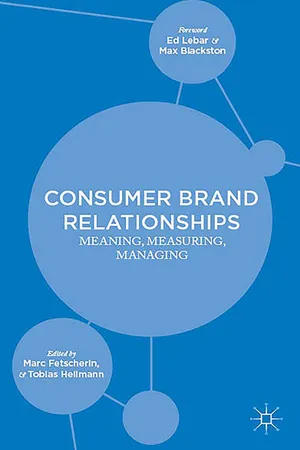
Consumer Brand Relationships
Meaning, Measuring, Managing
- English
- ePUB (mobile friendly)
- Available on iOS & Android
eBook - ePub
Consumer Brand Relationships
Meaning, Measuring, Managing
About this book
Consumer Brand Relationships further advances the understanding of consumers' relationships with brands. The book discusses what brand relationship means and how to measure and manage brand relationships by compiling eleven chapters written by leading experts to provide an important contribution to a better understanding of brand relationships.
Information
Part I
Love and Brand Relationships
1
Role of Brand Love in Consumer Brand Relationships
Noël Albert and Dwight Merunka
1 Introduction
Research into consumer brand relationships has proposed and tested various relational concepts, including brand trust (Hess, 1995), brand commitment (Fullerton, 2005) and brand identification (Escalas and Bettman, 2003). The brand relationship paradigm has been successful because of its relevance for understanding brand loyalty, conceptualized as long-lasting relationships with the brand that rely on deep, underlying feelings toward it (Fournier, 1998). More recent studies also demonstrate that consumers can experience a feeling of love for their brand (Albert et al., 2008a; Batra et al., 2012). Drawing on seminal work by Shimp and Madden (1988) and Ahuvia (1993), studies of brand love tend to focus on its conceptualization (Ahuvia, 1993) and measurement (Carroll and Ahuvia, 2006). But even as brand love has emerged as an important consumer brand relationship construct, we still know little about what generates a love relationship (e.g., trust) and what its behavioral consequences may be (e.g., repeat purchase). For example, brand love may be influenced by product or brand characteristics (e.g., hedonic product, brand quality) and may influence loyalty toward the brand (Batra et al., 2012; Carroll and Ahuvia, 2006). Yet few studies have conceptualized or explored how established constructs from the consumer brand relationship paradigm explain brand love (e.g., commitment, trust, identification). Because love is essentially a relational construct, it logically should be linked to other relational constructs. We therefore investigate how brand love might be explained by other consumer brand relationship (CBR) constructs and its position in a nomological framework.
Specifically, we consider two key research questions: is brand love distinguishable from other well-known relational constructs? How does brand love relate to these constructs? By addressing these questions, our research offers several contributions. We link love for the first time to two well-established relational constructs (trust and commitment) and confirm its link to brand identification. Love is conceptually similar to other relational constructs, which makes it important in establishing the nomological relationships of brand love with other established constructs, as well as in confirming that brand love is a distinguishable facet of CBR (i.e., discriminant validity). Finally, this study responds to Palmatier et al.’s (2006) concern about the lack of comparisons between the effects of relational constructs by comparing the impact of brand love and brand commitment (both mediator variables in our model) on willingness to pay a price premium and positive word of mouth (WOM) (two dependent variables). Overall, then, this research establishes the theoretical and managerial importance of the concept of love for a brand.
2 Theoretical framework
2.1 Brand love: conceptualization, antecedents, and outputs
Since it was introduced by Shimp and Madden (1988), brand love has been a topic of great interest for brand managers. Initially, researchers adapted the interpersonal love theory (Sternberg 1986) to consumption contexts, such that brand love appeared composed of three dimensions: passion, intimacy, and commitment (e.g., Lastovicka and Sirianni, 2011; Shimp and Madden, 1988). The self-inclusion theory of love (Aron and Aron, 1986) also has been adapted to marketing (Ahuvia, 1993). This theory posits that people need to become part of another to feel loved. Therefore, Ahuvia (1993) proposes that when a brand reaches both a high real and desired level of integration with the consumer’s sense of self, that consumer feels love for the brand.
Another stream of research has investigated brand love without referring to an interpersonal theory of love. Carroll and Ahuvia (2006) do not refer explicitly to interpersonal love, and propose instead that brand love consists of passion, attachment, positive evaluations of the brand, positive emotions in response to the brand, and declarations of love for the brand. However, their measurement of brand love is unidimensional and may fail to catch the complexity of love, a construct usually presented as multidimensional (Albert et al., 2008b; Batra et al., 2012). Investigating CBR, Fournier (1998) identifies six possible relationships: love and passion, self-connection, commitment, interdependence, intimacy, and brand partner quality. The brand love relationship is deep and enduring (beyond simple affect), such that the loved brand is considered irreplaceable. The consumer suffers when deprived of the brand for any extended period of time. Brand love also leads to biased, positive perceptions of the brand. Albert et al. (2008b) identify six first-order dimensions of brand love (idealization, intimacy, pleasure, dream, memories, unicity) that constitute two second-order dimensions (passion and affection). Passion and affection also appear as critical dimensions of interpersonal love (Baumeister and Bratslavsky, 1999). Finally, Batra et al. (2012) establish that consumers’ love for a brand consists of seven dimensions: perceived functional quality, self-related cognitions, positive affect, negative affect, satisfaction, attitude strength, and loyalty.
A growing literature on brand love has concentrated on its conceptualization rather than its antecedents and consequences, however. Some studies propose several antecedents of brand love, such as status as a hedonic brand (i.e., brands for which fun, pleasure, or enjoyment are primary benefits) or a self-expressive brand (i.e., the brand enhances the social self or reflects the inner self; Carroll and Ahuvia, 2006), brand quality (Batra et al., 2012), and brand identification (Bergkvist et al., 2010). Other research offers a few consequences, including influences on brand loyalty (Batra et al., 2012; Bergkvist et al., 2010; Carroll and Ahuvia, 2006) or active participation in a brand community (Bergkvist et al., 2010).
Because only these few antecedents and consequences have been associated with brand love, we still lack a good understanding of how it relates to CBR constructs in a nomological framework. Brand love pertains to the relational paradigm (Fournier, 1998); therefore, it should connect with other relational constructs. However, the distinction between other, well-known relational constructs and brand love, as well as brand love’s place in the relevant nomological framework, is yet to be established. In turn, we model brand love within a nomological framework that includes several well-established CBR constructs (brand trust, commitment, and identification) and establish causal relationships between the constructs.
2.2 Relational concepts
Three well-known CBR constructs likely associate with brand love. We highlight their links as well as their differences.
2.2.1 Brand identification
Consumers choose products and brands not only for their utilitarian values but also for their symbolic benefits. Brands possess deep meaning (MacCraken, 1989) and serve to build consumers’ self-concept or identities. Consumers use brands to construct their selves, present themselves to others, or achieve their identity goals (Escalas and Bettman, 2003). Consumers identify with brands to the “degree to which the brand delivers on important identity concerns, tasks, or themes, thereby expressing a significant aspect of the self” (Fournier, 1998, p. 364). Furthermore, brands have the ability to reflect important facets of the consumer’s identity and express significant aspects of the self (Fournier, 1998). Studies on brand identification thus identify two sources of congruency between the consumer and the brand: one that stems from the brand’s image, values, or personality, referred to as “brand identification” (Escalas et al., 2003; Fournier, 1998), and another that is external to the brand and is based instead on the typical consumer of the brand (Escalas and Bettman, 2003). Because this second source refers to the focal consumer’s identification with typical consumers of the brand, it is termed ‘customer identification.’ Therefore, overall brand identification comprises both brand identification and customer identification.
2.2.2 Brand trust
A key construct in relational marketing (e.g., Morgan and Hunt, 1994), brand trust offers an important component of successful marketing relationships (Garbarino and Johnson, 1999). In a consumer brand relationship context, trust reflects assumptions about reliability, honesty, and altruism that consumers attribute to brands (Hess, 1995). This construct encompasses both cognitive and affective elements (Delgado-Ballester et al., 2003). The cognitive dimension indicates a perception that the brand will meet expectations and respect its obligations (Chaudhuri and Holbrook, 2001). The affective dimension, in contrast, is based on perceptions of honesty and altruism (Delgado-Ballester et al., 2003).
2.2.3 Brand commitment
Brand commitment is a psychological disposition that implies a positive attitude toward the brand and a willingness to maintain a valued relationship with it (Chaudhuri and Holbrook, 2001; Evanschitzky et al., 2006). Commitment also consists of two components: affective and continuance. Continuance commitment is “rooted in economic and psychological switching costs and scarcity of alternatives” (Fullerton, 2005, p. 101), such that it results from the consumer’s perception that no other brands are of interest or that switching costs are too high (Evanschitzky et al., 2006; Fullerton, 2005). Affective brand commitment is more emotional, with “its roots in identification, shared values, attachment and trust” (Fullerton, 2005, p. 100). This emotional and affective connection influences consumer behavior (retention, brand repurchase, positive WOM). Furthermore, commitment may lead to brand loyalty, which is the main objective of brand managers, because it provides in turn advantages such as greater resistance to competitors’ marketing actions, positive word-of-mouth effects, or reduced marketing costs (Aaker, 1991; Dick and Basu, 1994).
2.2.4 Contrasts
The conceptual differences between love and trust are explicit: love is a feeling the consumer develops toward the brand, whereas trust is rooted in the consumer’s expectations about the brand’s honesty, altruism, and reliability. Distinctions between love and identification or commitment are subtler, though. They are all relational constructs and similar in nature. Moreover, commitment has an emotional component (Fullerton, 2005) with characteristics that are similar to brand love. In terms of identification, psychologists (Aron and Aron, 1986) and marketers (Ahuvia, 1993) both assert that love depends on integration with the self. This integration phenomenon appears in brand identification; thus, perhaps love and identification are the same concept.
Yet we argue that love should be distinguished from commitment and identification. Commitment represents the consumer’s willingness to maintain a relationship with the brand (Fullerton, 2005), while love is an intense feeling the consumer has toward the brand (Carroll and Ahuvia, 2006). Moreover, cognitive commitment may result from a lack of alternatives (Fullerton, 2005). That is, commitment is a result of a comparison of existing alternatives in the marketplace, which rarely occurs with brand love. Furthermore, some components of brand love, such as bringing to mind important events or persons (Albert et al., 2008b), imply a special connection between the consumer and the brand, a process that cannot result from a cognitive comparison of different brands. Finally, attachment to the brand is an antecedent of a willingness to maintain a relationship with it (Chaudhuri and Holbrook, 2001; Park et al., 2010). We thus posit that love is an antecedent of brand commitment.
In addition, identification is a cognitive process, whereas love has both cognitive (idealization) and emotional (affective proximity) components (Albert et al., 2008b). Consumers probably identify with more brands than they love. Ahuvia (1993) indicates that integration may not be sufficient to prompt a sense of love for a brand; the desire for integration also must be taken into account. Identification and love therefore differ. Overall, consumers identify with and are committed to a large range of brands, whereas love applies to a far more limited number of brands.
2.3 Model
The model we propose (1) considers brand love as a multidimensional construct, (2) integrates both causes and consequences of brand love, and (3) includes well-established constructs from CBR literature (brand trust, brand commitment, and brand identification). Brand identification and trust are determinants of brand love; both...
Table of contents
- Cover
- Title
- Brand Relationships Rule
- Part I Love and Brand Relationships
- Part II Personality and Social Groups, and Brand Relationships
- Part III Measuring and Managing Brand Relationships
- Brands Index
- General Index
- Names Index
Trusted by 375,005 students
Access to over 1.5 million titles for a fair monthly price.
Study more efficiently using our study tools.
Frequently asked questions
Yes, you can cancel anytime from the Subscription tab in your account settings on the Perlego website. Your subscription will stay active until the end of your current billing period. Learn how to cancel your subscription
No, books cannot be downloaded as external files, such as PDFs, for use outside of Perlego. However, you can download books within the Perlego app for offline reading on mobile or tablet. Learn how to download books offline
Perlego offers two plans: Essential and Complete
- Essential is ideal for learners and professionals who enjoy exploring a wide range of subjects. Access the Essential Library with 800,000+ trusted titles and best-sellers across business, personal growth, and the humanities. Includes unlimited reading time and Standard Read Aloud voice.
- Complete: Perfect for advanced learners and researchers needing full, unrestricted access. Unlock 1.5M+ books across hundreds of subjects, including academic and specialized titles. The Complete Plan also includes advanced features like Premium Read Aloud and Research Assistant.
We are an online textbook subscription service, where you can get access to an entire online library for less than the price of a single book per month. With over 1.5 million books across 990+ topics, we’ve got you covered! Learn about our mission
Look out for the read-aloud symbol on your next book to see if you can listen to it. The read-aloud tool reads text aloud for you, highlighting the text as it is being read. You can pause it, speed it up and slow it down. Learn more about Read Aloud
Yes! You can use the Perlego app on both iOS and Android devices to read anytime, anywhere — even offline. Perfect for commutes or when you’re on the go.
Please note we cannot support devices running on iOS 13 and Android 7 or earlier. Learn more about using the app
Please note we cannot support devices running on iOS 13 and Android 7 or earlier. Learn more about using the app
Yes, you can access Consumer Brand Relationships by M. Fetscherin, T. Heilmann, M. Fetscherin,T. Heilmann in PDF and/or ePUB format, as well as other popular books in Business & Business General. We have over 1.5 million books available in our catalogue for you to explore.