The volume is the first study to explore the intersection of memory and securitisation in the European context. By analysing a variety of practices ranging from film to art and new media, the book expands the existing theoretical framework of securitisation. The authors consider memory as a precondition for contemporary integration projects such as the European Union, and also showcase how memory is used to stage international conflicts. Following this memory-securitisation nexus, the European Union, and Europe more generally, emerges as an on-going cultural, political and social project. The book also examines developments outside the EU such as the conflict in Ukraine and the creation of the Eurasian Economic Union, which, the authors argues, have a profound impact on Europe. From a consideration of historical contexts such as national referenda the discussion proceeds to media and film analysis, artistic practice and more transient phenomena such as climate change.
Vlad Strukov and Victor Apryshchenko (eds.)Memory and Securitization in Contemporary Europehttps://doi.org/10.1057/978-1-349-95269-4_1
Begin Abstract
1. Introduction
Vlad Strukov1 and Victor Apryshchenko2
(1)
School of Languages, Cultures and Societies, University of Leeds, Leeds, UK
(2)
Southern Federal University, Rostov-on-Don, Russia
End Abstract
1 Europa’s Rape: Memory and Security as Modes of Signification
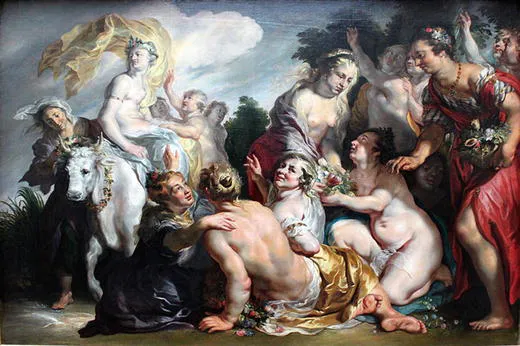
According to Greek mythology, Zeus , the Olympian chief god, became attracted to a Phoenician maiden called Europa. In order to trick Europa and to avoid the anger of his jealous wife Hera, Zeus turned into a white bull. Europa saw the bull while out in the fields and was so fascinated by it that she got onto its back. Zeus abducted Europa by swimming to the island of Crete and carrying her on his back. On the island Zeus revealed his true identity, raped and impregnated Europa. She gave birth to Minos, who would eventually become the king of Crete. The myth has been interpreted as a metaphorical passage, an account of the separation of Europe into the Greek Orient and Latin Occident, a representation of extreme nationalism, violence and oppression, and so on. In addition to these interpretations, we argue that the story of Europa is a story of memory and securitization. Zeus uses a disguise to make Europa feel safe; Europa experiences trauma two times, when she is abducted and when she is raped. From this repeated trauma memory is born, which is symbolized by Europa’s son Minos who, after his death, became a judge of the dead in the underworld. Like any other ancient myth, the myth of Europa supplies a symbolic framework for the interpretation of geographical, social, cultural and political realms such as Europe. How do myths, as a form of mnemonic knowledge, convey a sense of security? Do we construct security when we participate in narrating myths? Does memory help us overcome trauma and aspire to new forms of collaboration? How can we be sure that our future will not be overshadowed by the traumas of the past? How do we use art, film and media to re-align memories in order to securitize our experience? What are the economies of memorialization and securitization? In this book we aim to answer these questions by taking contemporary Europe as a geopolitical and temporal realm. We look at how memory has shaped securitization discourses in a range of fields stretching from political referenda to artistic practice. We also consider securitization as a form of mediation, or even memorialization, when we are compelled to forget but choose to remember.
Photograph 1.1
The Rape of Europa. Sculptural representation in the Spanish city of Torremolinos (Courtesy of Oilsisab, Wikimedia Commons)
Photograph 1.2
Jacob Jordaens 1615 baroque Rape of Europa anagoria (Courtesy of Wikimedia Commons)
Security is a term that generally defines a constellation of individual safety, public goods, transnational markets, ‘the European way of life’ and so forth. To maintain an adequate level of security in society is a prerequisite for establishing a sustainable and safe environment in which individual and collective economic, political and cultural players are able and are motivated to engage in activities leading to growth and social welfare. In the context of different agreements, such as the European Economic Union, the Schengen Zone, the Single Market and others, claims for personal and collective safety together with the rhetoric of commemoration influence decision-making processes and feature as securitization. Historically, security had been viewed in the context of military threats, and it had been the object of enquiry in disciplines such as political science and international relations (Balzacq 2005; Mattews 1989; Wæver 1995). For example, during the Cold War security was conceived as a ‘security dilemma’, or the spiral model of relations whereby one state could heighten its security by making strategic alliances, and other states could respond with similar measures, thus producing tensions which could lead to a conflict (see Jervis 1978). At the same time it was believed that nation-states were determined and had the capacity to advance international cooperation, limit the expansion of the arms race and seek peace. This traditional approach to security, which privileges the government and the state, was challenged in the 1990s with the emergence of Critical Security Studies. The nascent field of enquiry expanded the notion of security to include phenomena such as death, class, race, gender, individual perceptions and so on. It was an attempt to understand what power, knowledge and politics could be and what they could actually do. In the vein of the general ‘critical turn’ of the 1990s, Critical Security Studies aimed to query and disrupt the familiar presuppositions about security, especially about the role of the state, and to offer new perspectives on security and the world order (Vuori 2008; Walt 1991).
Photograph 1.3
Valentin Serov’s 1910 art nouveau interpretation of the myth (Courtesy of Wikimedia Commons)
Post-structuralist thought, especially the writing of Michel Foucault and Pierre Bourdieu, had informed the Paris School of Security Studies which views security as a social construct, not some existential threat. In this system the focus of our attention shifts from the need to understand the nature of the threat to the need to account for its evolution, use and spread. Therefore, (in)security acquires the shape and function of knowledge which, the scholars argue (Bigo 2008; Dillon 1996; Stritzel 2007), works according to the rules of language. Hence they introduce the notion of securitization as a speech act (Balzacq 2003; Buzan et al. 1998) wherein power is derived from the use of particular words, statements and signs, and in conformity with the existing rules of governing. This approach is grounded, too, in the centrality of the government and the state. These continue to be the chief institutions of security, and conversely, they utilize security as a means to maintain their political power. As a result, any move of the state must be viewed as a pragmatic act of security which depends on the linguistic manufacturing of threats (McDonald 2008; Williams 2003). In our volume, we extend this notion of security to include non-verbal, discursive, multi-platform and transmedial manifestations of securitization such as artistic, cinematic and performative enunciations. We consider these in different cultural and social contexts.
Critical Security Studies introduced the notion of securitization by considering threats as social constructs that evolve in time. The temporary dimension of (in)security was made evident in the work of Johan Erikkson (1999); however, this body of research approaches history and memory as a repository of previous threats, but not as a source of securitization. In this volume we propose to consider securitization as a system of mnemonic actions, or multi-modal enunciations involving symbolic exchanges and comprising of various types of iteration such as art, film and so on. Here, memory provides securitization agents with points and counterpoints in their securitization strategies. These transformations are at the core of individual and collective identities. Memory studies consider historical memory simultaneously as a source and outcome of collective identity. Memory studies are preoccupied with the issue of identity formation, both synchronically and diachronically, and the ways in which the subject constructs itself through opposition to other(s). Memory is used as a means to securitize identity whereby collective memory determines collective identities. In our case, the move towards a unified Europe queries the process of identity formation and simultaneously challenges our assumptions about collective memory. Complex processes such as regionalism and migration mobilize social resources to protect mnemonic values. We argue that, from ‘competitions of memory’ to ‘memory wars’ (Müller 2002), Europeans continue to re-formulate their identities and instigate the discourse of securitization at all levels, not only the government level.
Many scholars are critical of the concept of collective memory (see, for example, Enloe and Zalewski 1995; Wertsch and Roediger 2008; Reese and Fivush 2008). Sergio Della Sala is radical in his dismissal of the notion of collective memory in the European context. He believes that memory is always individual, and that in order to describe beliefs of specific social groups, for example, classes and nations, the term myth must be applied (Sala 2010: 4). However, we argue that, for example, the story of Europa’s rape has simultaneously a function of the myth and a function of memory: that is, in basic terms, we know the myth through remembering. In this volume we suggest that securitization is a relation between different forms of knowledge and memory, which often overlap and produce a sense of security, but which can also be manipulated to reveal zones of disassociation and separation, thus leading to insecurity.
Whilst we advocate a social constructivist approach to both memory and security, we remain cognizant of opposing theories such as Reinhart Kosellbeck’s notion of ‘historical conscience’ (2000: 19–20) and Kerwin Lee Klein’s belief in the primordial nature of memory which is similar to the concepts of ‘the national soul’ and ‘national spirit’ (2000: 135). Maurice Halbwachs (2005: 8) reminds us that social memory, or ‘memoire collective’, is a phenomenological category since the socio-cultural context always determines how and what we remember. Therefore, memory is a projection of our identity, and when memories are articulated they inform the broader social field of remembering, or being. Here Halbwachs departs from Henry Bergson’s understanding of memory as immanence (2004 (1896)); he also frees memory from the determinism of the previous era. In our work, we consider memory and securitization outside the binary system of individual, social, national and other signifiers. We propose a more fluid, poly-centric interpretation of these two terms, which in their turn, are not juxtaposed to one another but rather form a singular realm of symbolic action. To confirm, in our theorization, securitization is not a means to instrumentalize memory, and conversely memory is not a means to de-objectify threats and convert them into securitization acts. Rather memory and security are actualities of social iterations which are encoded in symbolic terms to convey a sense of purpose in the constantly evolving world. Our study of memory and securitization aims to reveal pragmatic interests of securitization agents, and equally it aims to produce an understanding of how knowledge is constructed in relation to the changing environment of our being.
Our focus on Europe provides yet another level of theorization for our study. Just like memory and security, we consider ‘Europe’ to be both a construct and a project that evolves in time. Whilst political borders of Europe are constantly shifting—we should remind the reader that in its original notion the term Europe meant a space that is not here, beyond the known world—its social, cultural and mnemonic connotations are even more ambiguous. Yet, ‘Europe’ and ‘European’ are common denominators used in colloquial speech and political statements to represent a specific set of values. In our volume we argue that in many ways ‘Europe’ is a form of memory, that is, our knowledge of the development of the European continent. Until recently Europe had an almost exclusive position of constructing its own image; it employed a centrifugal colonial gaze. Nowadays, as a notion, Europe is determined by numerous actors both within and outside its geopolitical boundaries. Just like memory, Europe is not a monolithic whole but a collage of individual recollections, ideas and experiences. In a way the notion of Europ...
Table of contents
Cover
Front Matter
1. Introduction
2. Memory as Security: Images of the Past in 2014 National Referenda in Europe
3. Securitization, Memory and the (Historic) Debate on Scottish Independence
4. Artistic Commemoration and Securitization: The WWI Centenary and the Creation of Collective Memory in the UK
5. Performing Memory and Securitization in Belfast
6. Europe on the Global Screen: Geopolitical Scotoma, Transnational Cinema of Memory and Hollywood’s Security Choices
7. Media Genre, Disrupted Memory and the European Securitization Chronotope: Transnationalizing the Lee Rigby Murder
8. Remembering and Securitizing Climate Change in Russian and British Media
9. #NoKievNazi: Social Media, Historical Memory and Securitization in the Ukraine Crisis
10. The Economy of Risks in the Eurasian Economic Union: From Common Memory Towards Economic Security
Back Matter
Trusted by 375,005 students
Access to over 1.5 million titles for a fair monthly price.
Study more efficiently using our study tools.
Frequently asked questions
Yes, you can cancel anytime from the Subscription tab in your account settings on the Perlego website. Your subscription will stay active until the end of your current billing period. Learn how to cancel your subscription
No, books cannot be downloaded as external files, such as PDFs, for use outside of Perlego. However, you can download books within the Perlego app for offline reading on mobile or tablet. Learn how to download books offline
Perlego offers two plans: Essential and Complete
Essential is ideal for learners and professionals who enjoy exploring a wide range of subjects. Access the Essential Library with 800,000+ trusted titles and best-sellers across business, personal growth, and the humanities. Includes unlimited reading time and Standard Read Aloud voice.
Complete: Perfect for advanced learners and researchers needing full, unrestricted access. Unlock 1.5M+ books across hundreds of subjects, including academic and specialized titles. The Complete Plan also includes advanced features like Premium Read Aloud and Research Assistant.
Both plans are available with monthly, semester, or annual billing cycles.
We are an online textbook subscription service, where you can get access to an entire online library for less than the price of a single book per month. With over 1.5 million books across 990+ topics, we’ve got you covered! Learn about our mission
Look out for the read-aloud symbol on your next book to see if you can listen to it. The read-aloud tool reads text aloud for you, highlighting the text as it is being read. You can pause it, speed it up and slow it down. Learn more about Read Aloud
Yes! You can use the Perlego app on both iOS and Android devices to read anytime, anywhere — even offline. Perfect for commutes or when you’re on the go. Please note we cannot support devices running on iOS 13 and Android 7 or earlier. Learn more about using the app
Yes, you can access Memory and Securitization in Contemporary Europe by Vlad Strukov, Victor Apryshchenko, Vlad Strukov,Victor Apryshchenko in PDF and/or ePUB format, as well as other popular books in Politics & International Relations & European Politics. We have over 1.5 million books available in our catalogue for you to explore.