eBook - ePub
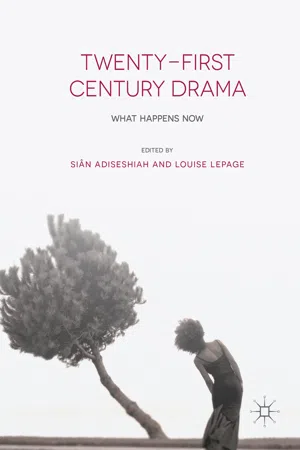
Twenty-First Century Drama
What Happens Now
- English
- ePUB (mobile friendly)
- Available on iOS & Android
eBook - ePub
Twenty-First Century Drama
What Happens Now
About this book
Within this landmark collection, original voices from the field of drama provide rich analysis of a selection of the most exciting and remarkable plays and productions of the twenty-first century. But what makes the drama of the new millenium so distinctive? Which events, themes, shifts, and paradigms are marking its stages? Kaleidoscopic in scope, Twenty-First Century Drama: What Happens Now creates a broad, rigorously critical framework for approaching the drama of this period, including its forms, playwrights, companies, institutions, collaborative projects, and directors. The collection has a deliberately British bent, examining established playwrights – such as Churchill, Brenton, and Hare – alongside a new generation of writers – including Stephens, Prebble, Kirkwood, Bartlett, and Kelly. Simultaneously international in scope, it engages with significant new work from the US, Japan, India, Australia, and the Netherlands, to reflect a twenty-first century context that is fundamentally globalized. The volume's central themes – the financial crisis, austerity, climate change, new forms of human being, migration, class, race and gender, cultural politics and issues of nationhood – are mediated through fresh, cutting-edge perspectives.
Information
Subtopic
Performing Arts© The Editor(s) (if applicable) and The Author(s) 2016
Siân Adiseshiah and Louise LePage (eds.)Twenty-First Century Drama10.1057/978-1-137-48403-1_11. Introduction: What Happens Now
Siân Adiseshiah1 and Louise LePage2
(1)
School of English and Journalism, University of Lincoln, Lincoln, UK
(2)
Department of Film, Theatre & Television, School of Arts and Communication Design, University of Reading, Reading, UK
Sixteen years into the new century seems a propitious moment to publish the first collection of essays on twenty-first-century drama. Although still adolescent, the new century has produced a generation: very soon undergraduates with dates of birth in the year 2000 will be enrolling onto university programmes and their lives will have been lived wholly in the new century. Close attention to the social, political and philosophical texture of this new century, and to the drama to which this period has given rise, is now needed. This volume of essays arises from the recognition that while there are several recent critical collections engaging with British and Irish drama in the ‘contemporary’ period (generally treated as stretching back to the 1980s and forward to the present day), 1 there is still no full-length study of specifically twenty-first-century drama. Within these pages, our contributors capture something of the range of plays that have populated and characterized this century’s stages, as they respond to recent historical events and to contingent qualities, shifts and paradigms. The volume offers a kaleidoscopic snapshot of critical perspectives arising from cutting-edge research on a prescient and provocative, but by no means comprehensive, sample of the new millennium’s drama.
The collection has a deliberately British bent to reflect the thriving nature of contemporary playwriting culture and its research in Britain, the interest British plays are met with in other parts of the world, and its popularity as a subject on Drama, Theatre and Literature courses in higher education. However, in contrast to so many recent critical collections on drama, ‘British’ is excluded from our volume’s title and rationale. 2 Experiences of engaging with plays today are shifting in a twenty-first-century context that is fundamentally globalized. Identifying ‘Britishness’ is an increasingly complex taxonomical exercise in a world in which national borders can be so easily crossed (though not for all). Is the national classification of a playwright’s work denoted by, for example, their place of birth? Or their place of abode? Or the theatre that produces their work? Or the tradition that orientates them? Or the director? Or the subject matter that they choose to focus on? And what about collaborative work that is international in scope? The increasingly global composition of theatre companies and their projects, enabled by the dominance of digital technologies and an international cultural market, is reflected in the drama under scrutiny. The scholars contributing to this volume are largely, although not exclusively, in alignment with what might be called a ‘British perspective’ (in the sense of being geographically located in the UK), but the plays under discussion are frequently international in range. More than this, the political and social issues so characteristic of the British dramatic tradition (in particular, New Writing) are today bound to, and conceived in, global terms that are often grander in scale than they have been heretofore (consider the reach of the financial crisis, climate change and migration). So when plays discussed in this volume are introduced in nationally specific terms (for example, as being Scottish or Japanese or Australian), the chapters reveal that their implications resonate with, or explicitly speak to, politics elsewhere.
Graham Saunders observes that ‘[w]hen attempting to assess a decade in British culture or politics, critics often grasp towards a received or truncated view’ (2008, p. 1). Writing about 1990s British political drama, Saunders recognizes ‘In-Yer-Face Theatre’ as that decade’s truncated view, but while acknowledging its influence, in Cool Britannia: British Political Drama in the 1990s (2008), he and his co-editor, Rebecca D’Monté, seek to complicate this narrative. In their collection of essays, they connect 1990s British drama to New Labour and Cool Britannia, and they also find a number of significant political threads and themes influencing the decade’s drama: Thatcherism, (post-)feminism, nation, devolution and globalization. These themes continue to press upon twenty-first-century history and its drama, and are to be found as subjects in the current volume. However, in an age that is still marked by 9/11, they do so in terms that move beyond the ‘smaller’ stories, which were perhaps characteristic of the 1990s: today’s thematic concerns are arguably more pervasively global and sincere in their political mediation.
Drawing on David Edgar’s ‘Provocative Acts’ (2011), the editors of The Methuen Drama Guide to Contemporary British Playwrights (Middeke et al. 2011) comment, in their Introduction, on the 2000s’ ‘fashion for verbatim theatre’ (2011, p. xv). Andrew Haydon in Dan Rebellato’s Modern British Playwriting, 2000–2009 also remarks upon the significance of verbatim drama, which, by 2007, had become ‘the prevalent form for dealing with the Big Topics’ (2013, p. 45). If there is a truncated view to be offered of the new millennium’s drama to date – in the UK, at any rate – perhaps it is here, with the story of verbatim drama, whose formal and theatrical possibilities have proliferated even into the realms of fiction and musicals, as it challenges us to consider the nature of truth, the politics of storytelling and our relation to the world. Indeed, both Siân Adiseshiah’s and Emma Cox’s chapters within this volume consider the materiality of the verbatim form and its relation to questions of political representation, aesthetics and spectatorship.
Yet, while the importance of verbatim drama must be registered in a volume on twenty-first-century drama, 3 the dramatic topography in the new century is more diverse, rich and complex than that of a single dramatic form (however fecund the form in question). This volume attempts to capture something of this complexity. Responding to some of the twenty-first century’s key geopolitical markers, its contributors explore the relation of these markers to drama, at the same time as identifying and interrogating important new dramatic trends, characteristics, paradigms and formal developments. This volume’s chapters reveal ways in which approaches to periodizing the twenty-first century continue to develop beyond 9/11, the Afghanistan and Iraq wars, and subsequent war on terror markers, to include the Arab Spring, the 2008 credit crunch, and the associated global financial crisis and austerity measures. More locally, particularly following the UK general election in May 2015, there has been increasing pressure on parliamentary democracy, its perceived efficacy and fairness, and the far-reaching implications of the tumultuous election results in Scotland. 4 These and related markers inform the chapters in Parts II and III, titled ‘Austerity and Class Returns’ and ‘Borders, Race, Nation’ respectively. Meanwhile Part IV – ‘New Humans, New Dramaturgies, New Worlds’ – responds to the ascendancy of digital technologies and scientific advances, which are shaping the twenty-first century and its drama in provocative ways that challenge us to consider the kinds of people, societies and worlds we are creating. This Part also responds to the threat of climate change, which although is a pre-twenty-first-century predicament, has apparently entered a new phase with extremes of weather conditions, global warming and the melting of the polar ice caps. This has informed a new kind of crisis, one that seems to be permanently, rather than temporarily or intermittently, with us.
This volume is also interested in concurrent shifts in theoretical trends and trajectories. We appear to be moving beyond the postmodernism that characterized the late twentieth century with some detectable markers including a revival of belief, a rehabilitation of agency and a (re)turn to realism. Certainly the huge abundance, popularity and success of verbatim theatre in the twenty-first century speak to a contemporary desire for ‘real life’ to permeate performance, for performance to be situated in the worlds audiences recognize. The opening Part of the book, ‘Beyond Postmodernism: Changing Perspectives on Drama’, brings together a range of perspectives about dramatic form which orientate us beyond a postmodernist moment bound to the later decades of the last century.
After 30 or so years of suspicion of realism’s apparent tendency to reproduce a conservatism of both form and content, Elaine Aston asks, in Chapter 2, if there is now room for realism, room for the potential of realism to engage critically with our contemporary moment, room for a ‘realism that informs on our neoliberal and “faux-feminist” condition as unacceptable and dehumanizing’. Through a reconsideration of Raymond Williams’s ‘A Lecture on Realism’ (1977), Aston uses as her case studies three women’s plays, all presented at the Royal Court Theatre: Fiona Evans’ Scarborough (2008), Lucy Kirkwood’s NSFW (2012) and Anupama Chandrasekhar’s Free Outgoing (2007). In each of these plays Aston identifies innovative, fluid forms of realism that serve to mediate critically the inhospitality (particularly for women) of our twenty-first-century neoliberal world. Aston’s claim is that realism has been revisited and reworked in these and other twenty-first-century plays: that realism has mutated beyond conservative aesthetic convention to something more heterogeneous, with radical potential. The chapter closes with consideration of realism as ‘viral’: ‘realism as infectious, contagious and spreading from a “host” of playwrights’.
Chris Megson’s chapter, ‘Beyond Belief: British Theatre and the “re-enchantment of the world” ’ (Chap. 3), posits belief or, more precisely, ‘the injunction to believe in belief’, as a compelling dramaturgical provocation to audiences. Belief, writes Megson, is to be found ‘across a range of apocryphal, historical and contemporary settings’ in a ‘significant constellation of twenty-first-century dramatic writing’. Analysing the plays of Bullet Catch (2009) by Rob Drummond, Enron (2009) by Lucy Prebble and 13 (2011) by Mike Bartlett, he shows how belief has the capacity at once to delude and to enchant and, crucially, to enable social transformation. Megson frames his analysis with reference to the early nineteenth-century philosopher and sociologist Max Weber’s notion of ‘disenchantment’ and Simon During’s contemporary theories about ‘secular magic’, both of which mark belief as historical categories of experience (the former arising with modernized Western society, the latter with the Enlightenment). For Megson, in the troubled twenty-first century, belief ‘reopens the telos’ that was closed by ‘disenchanted materialism’ by means of ‘stoking the conversation about the kind of society we want to live in and the values that might shape it’. Megson invites us, in short, to confront the implicit question raised in all of the plays he discusses in the chapter and which informs this volume: ‘What Happens Now?’
Megson’s interest in the spectator as a participant in new dramaturgies is carried over into ‘The Emancipated Shakespeare: or, What you Will’ (Chap. 4), but in Stephen Bottoms’s chapter, the spectator finds a different emphasis: s/he is positioned as a poet and a citizen. Exploring the one-man show by Tim Crouch, I, Cinna (the Poet) (2012) and Toneelgroep Amsterdam’s Roman Tragedies (2008), Bottoms shows how these two very different productions are bound by their politically complex treatments of Shakespeare’s Julius Caesar, and how they position observers as involved citizens. Critical of the way in which Shakespeare (‘who remains the dominant theatrical voice in the English-speaking world’) is foisted upon hapless schoolchildren for their edification, Bottoms calls upon Jacques Rancière’s The Ignorant Schoolmaster (1987) in order to challenge productions of Shakespeare that seek to teach their audiences how the plays should be appreciated. Instead, building on Rancière, Bottoms finds in Crouch’s and Toneelgroep Amsterdam’s performances a ‘“third thing”, a mediating bridge between the sensibilities of pupil/spectator and teacher/director’ that arises from a principle of ‘equality of intelligence’ and that ‘present[s] challenges that will fire our will to engage’.
The final chapter in Part I is ‘The Twenty-First-Century History Play’ by Paola Botham (Chap. 5). Responding to the striking rejuvenation of the history play in the 2000s, Botham examines the ways in which three very different plays from playwrights spanning three generations – Howard Brenton’s Anne Boleyn (2010), David Greig’s Dunsinane (2010) and James Graham’s The House (2012) – offer distinctively twenty-first-century engagements with history, historiography and the dramatic mediation of historical narrative. The chapter considers the post-postmodernism of the present historical moment as providing a fertile context for the revival of the history play. The post-1968 ‘radical’ approach to the history play is still in evidence in the twenty-first-century history play, argues Botham, ‘albeit with qualifications’. As such the chapter finds a continuing relevance of Brechtian historicization of using the past critically to reimagine the present (and the future) and it also reconsiders nostalgia – in particular formulations – as a potentially progressive strategy. But at the same time Botham detects a continuing ‘suspicion of ideological certainties and an intensification of the self-reflexive impulse’. Hence, the twenty-first-century history play is considered to forge a path between (or dialectic of) postmodern relativism and reflex...
Table of contents
- Cover
- Frontmatter
- 1. Introduction: What Happens Now
- 1. Beyond Postmodernism: Changing Perspectives on Drama
- 2. Austerity and Class Returns
- 3. Borders, Race, Nation
- 4. New Humans, New Dramaturgies, New Worlds
- Backmatter
Trusted by 375,005 students
Access to over 1.5 million titles for a fair monthly price.
Study more efficiently using our study tools.
Frequently asked questions
Yes, you can cancel anytime from the Subscription tab in your account settings on the Perlego website. Your subscription will stay active until the end of your current billing period. Learn how to cancel your subscription
No, books cannot be downloaded as external files, such as PDFs, for use outside of Perlego. However, you can download books within the Perlego app for offline reading on mobile or tablet. Learn how to download books offline
Perlego offers two plans: Essential and Complete
- Essential is ideal for learners and professionals who enjoy exploring a wide range of subjects. Access the Essential Library with 800,000+ trusted titles and best-sellers across business, personal growth, and the humanities. Includes unlimited reading time and Standard Read Aloud voice.
- Complete: Perfect for advanced learners and researchers needing full, unrestricted access. Unlock 1.5M+ books across hundreds of subjects, including academic and specialized titles. The Complete Plan also includes advanced features like Premium Read Aloud and Research Assistant.
We are an online textbook subscription service, where you can get access to an entire online library for less than the price of a single book per month. With over 1.5 million books across 990+ topics, we’ve got you covered! Learn about our mission
Look out for the read-aloud symbol on your next book to see if you can listen to it. The read-aloud tool reads text aloud for you, highlighting the text as it is being read. You can pause it, speed it up and slow it down. Learn more about Read Aloud
Yes! You can use the Perlego app on both iOS and Android devices to read anytime, anywhere — even offline. Perfect for commutes or when you’re on the go.
Please note we cannot support devices running on iOS 13 and Android 7 or earlier. Learn more about using the app
Please note we cannot support devices running on iOS 13 and Android 7 or earlier. Learn more about using the app
Yes, you can access Twenty-First Century Drama by Siân Adiseshiah, Louise LePage, Siân Adiseshiah,Louise LePage in PDF and/or ePUB format, as well as other popular books in Media & Performing Arts & Performing Arts. We have over 1.5 million books available in our catalogue for you to explore.