- English
- ePUB (mobile friendly)
- Available on iOS & Android
eBook - ePub
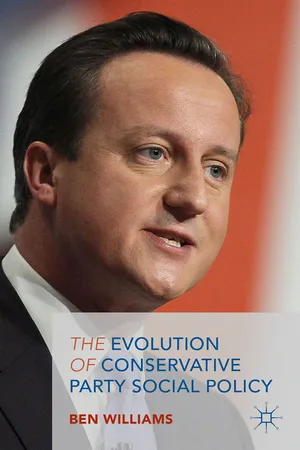
The Evolution of Conservative Party Social Policy
About this book
This book addresses how the Conservative Party has re-focused its interest in social policy. Analysing to what extent the Conservatives have changed within this particular policy sphere, the book explores various theoretical, social, political, and electoral dimensions of the subject matter.
Information
Introduction and background
The Conservative Party’s defeat at the 1997 General Election represented a political rejection on a historically unprecedented scale,1 and in subsequent years the party has faced a significant period of introspection regarding its future direction, its policy-making agenda, and on a broader dimension, its overall political identity. The confident aura of the Thatcher era of the 1980s, fuelled by a successful election-winning formula of free-market populism alongside the ideological certainty instilled by the thrusting capitalist agenda of the ‘New Right’, was shattered by a shifting public mood and a gradual erosion of popular support as the 1990s progressed. These socio-political changes culminated in the electoral outcome of 1997 when the 20th century’s ‘natural party of government’, which had generally acknowledged that ‘periods of opposition (were) the exception, and office the norm’,2 found its once-dominant position in a state of utter political disarray, ‘being reduced to a rump’ and experiencing its heaviest electoral defeat ‘since the birth of mass democratic politics in 1918’.3 This watershed election result was variously described by sections of the media as a New Labour ‘Triumph’ (The Guardian), a ‘Landslide’ (Daily Telegraph) and a ‘Massacre’ (Daily Mail), with the general consensus being that ‘it was all of these’.4
A long spell in national political opposition appeared inevitable given the scale of this ejection from office, and such an electoral annihilation at the hands of a revitalised and modernised ‘New Labour’ juggernaut represented the nadir of Conservative 20th-century political fortunes in terms of both parliamentary seats and wider public support. Fundamental reasons for such plummeting levels of popular appeal were rooted in the party’s faltering and uncertain ideological vision, a diminishing public reputation aligned with the unappealing nature of the party’s policy menu, with the image of contemporary Conservatism damaged in the eyes of significant sections of the electorate. This appeared to reflect a broader public disenchantment regarding its long-term political agenda: ultimately, the 1997 Conservative Party appeared too concerned with its own internal policy divisions and had grown out of touch with the views and interests of a rapidly changing and increasingly diverse British society. This dynamic social change evolved while the Conservatives were preoccupied with the political strains of governance, with a primary focus on the fundamental economic restructuring of the country. Consequently, the Conservative Party faced a scenario whereby:
After nearly two decades of Conservative rule, the needs, anxieties, priorities and aspirations of the electorate had become harder for the party to decipher and comprehend. Many simply failed to acknowledge how British society had changed in the 1990s’.5
Therefore, despite the constant hum of such ceaseless background social developments, the Conservative Party of the mid-1990s appeared to be instilled with a sense of socio-political myopia and detachment that struck at the heart of its identity as the decade progressed. Consequently, policy-making relating to key social and economic spheres appeared increasingly disjointed and lacking in terms of a coherent connected vision prior to 1997, with the party’s main focus from 1992 onwards appearing to be the short-term political survival of John Major’s fragile administration, with its slender parliamentary majority of just 21 (1992–97), which had disappeared by December 1996 due to a series of parliamentary deaths and subsequent by-election defeats. In this atavistic context of focusing on its own sheer political survival, the Conservative Party in office seemed to be detached from the basic concerns and priorities of contemporary external society. From late 1990 onwards, the Conservative political machine experienced a prolonged crisis triggered by the demise of Margaret Thatcher and her legacy of explicit ideological emphasis. The shattering electoral defeat of 1997 ultimately marked the culmination of almost seven years of a post-Thatcher hangover that blurred the party’s focus, confused its direction and blighted its fortunes. This limited its ability to navigate coherently any progression from its period of electoral and political hegemony. The electoral watershed ultimately brought such matters of identity and future policy direction to the forefront of the party’s political priorities, as it faced such challenges while firmly located in national political opposition on a long-term basis.
In this book I seek to analyse and interpret the nature of the response of British Conservatism to this somewhat bleak electoral and political scenario, observing the subsequent evolution of its key social policies and broader social attitudes in the process. I aim to address how and to what extent the Conservative Party has sought to adapt its position and attitudes in relation to various key social policy issues, and to what extent its comprehensive policy review has subsequently imparted elements of uncertainty and insecurity about the party’s long-term political prospects that complement existing socio-political vulnerabilities. My approach is based on the premise that the party’s established attitudes and alignment relating to broader contemporary social policy issues had created an associated negative image by the mid-1990s, and this was a clear contributing factor to the party’s recent relative political decline. This in turn provides additional context to the party’s image pertaining to social policy, as well as offering general enlightenment regarding the broader identity and image problems facing modern Conservatism, which has in turn created political and electoral difficulties that have been prolonged during the post-Thatcher era in particular.
A long-standing and dominant political role has been a hallmark of the Conservative Party’s image, an image derived from its longevity, durability, electoral success and political pragmatism: it held national office either alone or in coalition for approximately two-thirds of the 20th century. However despite this legacy of political dominance, its electoral record in the final years of the 20th century and the first years of the 21st has been far from impressive, with no outright general election victory achieved since 1992. This scenario has generated a perception that modern Conservatism appears to have plateaued in terms of generating wider electoral popularity, become primarily ‘economic’ as opposed to ‘social’ in its policy focus, and accordingly become somewhat dealigned with the prevailing social moods, aspirations and attitudes of contemporary Britain. This provides an important context for the book’s academic approach: a central element of its analysis is to assess the recent political assumption that the Conservative Party is inclined towards a primarily economic policy agenda, and to discover whether the assumption remains a valid and accurate one in the early years of the 21st century.
An inclination towards a predominantly economic agenda implies that by contrast, social policy has often been neglected, and the party’s past record in this sphere between 1979 and 1997 is therefore an important element to consider when assessing its electoral performance in the present era. In analysing the various elements that have shaped and influenced the Conservative Party’s political agenda from approximately 1997 onwards, the focus is therefore placed on a social policy agenda that has been the bedrock of the party’s ‘modernising’ socio-political strategy, aimed at refreshing its electoral brand and widening its overall political appeal. In reviving and reinvigorating an otherwise neglected policy dimension, social policy reformulation has been a challenge made more difficult by the pressing economic problems and austerity agenda that the post-2010 government has had to deal with. This book’s analytical framework ultimately seeks to compare the significance of social policy with that of economic policy-making, and specifically how the two dimensions interact and overlap in terms of both electoral potency and political relevance.
In adopting such an approach, key influences that have shaped the nature and rate of change within this sphere of social policy-making are addressed, with those which have been of most significance and connected to the party’s recent electoral misfortune particularly highlighted, notably issues such as health, education and the wider welfare state. In seeking to emphasise how the contemporary Conservative Party has revised and reformulated its focus on social policy the choice of 1997 as a starting point is crucial. It marked the beginning of 13 years in national political opposition following a remarkable 18-year period in office; such a significant exile from government represented an unprecedented length of national political opposition for the self-styled ‘natural party of government’, and this provides a distinct and original angle from which to examine and appraise policy development. In embarking on a process of significant introspective policy revision during its time outside government, the party sought to revise and reinvent both its image and core principles for the 21st century, with its modernising elements seeking to elaborate an innovative understanding of the key socially fused concepts of community, society and social justice. This formed part of a broader project to ‘detoxify’ the public image of Conservatism that had become polluted among parts of the electorate due to political events and policy developments between 1979 and 1997. It is, therefore, an important aspect of this book to consider whether such developments have resulted in the construction of a distinct and credible socio-political agenda for the British Conservative Party in the early years of the 21st century, or alternatively whether it has led to a reversion to more traditional forms of Conservatism and associated policy-making. In summary, the broad themes and influences that are identified as significant factors in this process of social policy evolution and reformulation are ideology, pragmatism, statecraft and (since 2010) the practical implications of an austerity agenda and coalition politics.
The period from 1997 onwards therefore represents a unique and significant phase in British politics (particularly from a Conservative perspective), due to the party’s unusually long exile from national office. The Conservative Party has enjoyed unprecedented electoral success as a party of government in the modern political era, although this record has been clouded somewhat by its relatively poor electoral performances from the mid-1990s. Such recent electoral difficulties are a development somewhat inconsistent with the party’s political hegemony for much of the 20th century. As a political movement, the Conservative Party has assumed a pivotal, integral position in the British political system over the course of the last century, and its prominent role in the UK’s broader political structure has been summarised by one academic as representing ‘one of the great certainties of British politics’,6 such has been its near-constant presence in the higher political echelons in the modern era.
There have been no other periods during the age of mass democracy where the Conservative Party have been out of national government for such a long period of time. This prolonged absence from national office as a consequence of successive general election defeats between 1997 and 2005 means that the historical period being focused on represents the Conservative Party’s most sustained period of opposition since 1832, a distinct period of modern history, an unprecedented era on which to focus.
This absence from government circles has appeared to some to have taken the Conservative Party to the brink of self-destruction, and indeed, following the party’s second successive landslide electoral defeat in 2001, one commentator has described the Conservative Party as being ‘shocked, frightened and hollowed out’,7 such was the extent of its identity crisis and sense of disarray and disorientation as a coherent political organisation. It is a reflection of the party’s powers of durability and recovery that it was in a competitive electoral position again by 2009–10,8 although this period of long-term opposition had motivated a root and branch review of Conservative ideology and policy in a number of key areas, on a scale not witnessed since the advent of Thatcherism from the mid-1970s onwards. In contemplating this concerted revision of post-Thatcher Conservative policy evolution, there has been contemporary good deal of conjecture in both media and academic circles as to just how extensive it has been in both a practical and theoretical sense.9 This monograph offers a thorough analysis of the theoretical basis and the practical implementation of Conservative social policy both before and after 2010, examining a policy sphere perceived to have been given less priority by the party during the post-1979 political era in particular.
This book addresses some core questions in relation to the Conservative Party’s deep internal policy review, and in particular offers a post-2010 perspective in assessing whether it has resulted in a fundamental revision of traditional Conservative ideology in order to embrace a more dynamic policy position in line with 21st century values and attitudes. An alternative view is that the Conservative leadership under David Cameron (from 2005 onwards) has, rather, gone no further than the implementation of a ‘re-packaged’, cosmetic and cautious image change, instead being more inclined to embrace ‘statecraft’10 and a heightened focus on delivering practical governance and competence in office; a mere modification rather than a radical overhaul of traditional policy positions, shrinking away from fundamental changes.
In apparently diluting (rhetorically at least) some of the overt and explicit ideological emphasis of the past (for example during the Thatcherite hegemony of the 1980s), Cameron’s Conservatism could be argued to have embraced a more pragmatic approach to its broader strategy for governance, merely moderating traditional values and attitudes with the aim of ultimately securing national office. However, once in power, some commentators such as Phillip Blond have argued that it has reverted to ‘Thatcherite’ type;11 and this dynamic debate about the true nature and approach of modern Conservatism to social policy matters and the extent they have changed since the mid-1990s lies at the heart of this study.
In exploring and analysing the extent of the apparent ‘change’ in contemporary Conservative social policy, David Cameron’s specific type of Conservatism has been the subject of much political conjecture and has been found to be difficult to specify, fuelled as it may be by his sustained rhetorical focus on changing the party’s social policy. His notable involvement in formulating the Conservative Party’s more right-wing 2005 general election manifesto12 has generated debate among commentators in relation to how great his influence over it actually was, with some observations that he was more ‘midwife’ than ‘creator’ of such a ‘core-vote’ policy agenda.13 Given how the party’s 2010 manifesto was comparatively modified and ‘modernised’ in both tone and substance,14 this has raised legitimate questions about how sincere Cameron’s later endorsement of more socially orientated ‘compassionate conservatism’ has been, and whether such a changed emphasis on policy and a new style of governance is due to pure pragmatism and political opportunism on his part, or is rather due to a healthily evolving ideological compass and a genuine desire to rebrand and ‘modernise’ the Conservative Party.
A further pertinent context for this book is evident in the fact that the 2010 electoral outcome resulted in the formation of Britain’s first post-war coalition government, a consequence of the first hung parliament since 1974,15 and the first peacetime coalition since the 1930s. The subsequent dynamics and tensions of coalition government are therefore also an important dimension to be taken into account when assessing how the coalition with the Liberal Democrats has influenced the evolution of Conservative Party social policy on returning to national office. Such unusual circumstances and original elements have been further sharpened by atmosphere climate of unprecedented economic austerity since 2010, and this has created a further distinct element to frame the development of the Conservative Party’s post-1997 social policies in practical terms. In this post-Thatcherite framework, and regardless of all of the warming words and changed rhetoric, the pivotal debate is whether the Conservative Party under David Cameron’s leadership has represented and reflected a genuinely new and reformed social policy agenda in practical terms, distinct and different from past policy experiments, and it is this that the book seeks to rigorously explore. In assessing to what extent the Conservative Party’s approach to social policy-making since 1997 has represented real change or has been merely a rhetorical emphasis on carefully-chosen words, some long-established and historical Conservative attitudes and beliefs regarding the role of government, social justice, the state and civil society have been rigorously reviewed, with the primary aim of determining to what extent they have either shifted or remained aligned to the party’s traditional, instinctive approaches.
1
Ideological influences on Conservative Party social policy
In understanding how ideology has shaped the formulation of the Conservative Party’s social and welfare policies over the course of the 20th century, particular attention must be paid to the contemporary political era, namely from the mid-1970s and the emergence of ‘Thatcherism’. This chapter, therefore, seeks to assess and analyse the major influences on Conservative Party policy development, and determine to what extent both ideological and pragmatic factors have driven and shaped the party’s policy-making agenda since 1997, particularly in the sphere of social and welfare policy.
Which aspect is the most influential over a government’s policy-making processes is clearly a key factor to consider in this debate, and will probably vary over time. The 1980s era of Conservative rule has been perceived as being more ideological in nature than the previous post-war era, leading to a phase of policy prioritisation within the governing Conservative Party that saw the economic domain generally given greater emphasis and precedence over the development of social policy. The primacy of economics, many observers have claimed, was primarily ...
Table of contents
- Cover
- Title
- Copyright
- Contents
- List of Tables and Figures
- Acknowledgements
- Introduction and background 1
- 1 Ideological influences on Conservative Party social policy
- 2 The ‘New Right’ and its impact on Conservative social policy
- 3 Conservatism and social justice in theory
- 4 Social policy case study 1: Modern Conservatism, practical social justice and welfare reform
- 5 Social policy case study 2: The ‘Big Society’ Policy Framework
- 6 Social policy case study 3: The Free Schools policy
- 7 Social policy case study 4: Reform of the NHS
- Conclusion: The nature and evolution of contemporary Conservative social policy
- Notes
- Bibliography
- Index
Trusted by 375,005 students
Access to over 1.5 million titles for a fair monthly price.
Study more efficiently using our study tools.
Frequently asked questions
Yes, you can cancel anytime from the Subscription tab in your account settings on the Perlego website. Your subscription will stay active until the end of your current billing period. Learn how to cancel your subscription
No, books cannot be downloaded as external files, such as PDFs, for use outside of Perlego. However, you can download books within the Perlego app for offline reading on mobile or tablet. Learn how to download books offline
Perlego offers two plans: Essential and Complete
- Essential is ideal for learners and professionals who enjoy exploring a wide range of subjects. Access the Essential Library with 800,000+ trusted titles and best-sellers across business, personal growth, and the humanities. Includes unlimited reading time and Standard Read Aloud voice.
- Complete: Perfect for advanced learners and researchers needing full, unrestricted access. Unlock 1.5M+ books across hundreds of subjects, including academic and specialized titles. The Complete Plan also includes advanced features like Premium Read Aloud and Research Assistant.
We are an online textbook subscription service, where you can get access to an entire online library for less than the price of a single book per month. With over 1.5 million books across 990+ topics, we’ve got you covered! Learn about our mission
Look out for the read-aloud symbol on your next book to see if you can listen to it. The read-aloud tool reads text aloud for you, highlighting the text as it is being read. You can pause it, speed it up and slow it down. Learn more about Read Aloud
Yes! You can use the Perlego app on both iOS and Android devices to read anytime, anywhere — even offline. Perfect for commutes or when you’re on the go.
Please note we cannot support devices running on iOS 13 and Android 7 or earlier. Learn more about using the app
Please note we cannot support devices running on iOS 13 and Android 7 or earlier. Learn more about using the app
Yes, you can access The Evolution of Conservative Party Social Policy by B. Williams in PDF and/or ePUB format, as well as other popular books in Politics & International Relations & European Politics. We have over 1.5 million books available in our catalogue for you to explore.