- English
- ePUB (mobile friendly)
- Available on iOS & Android
eBook - ePub
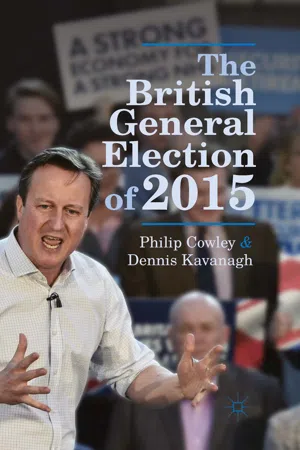
The British General Election of 2015
About this book
The British General Election of 2015 is a must-read for anyone wanting to know how the action unfolded in the most unpredictable election for a generation. Drawing on hundreds of confidential interviews with all the key players, it offers a compelling insider's guide to the election's background, campaign, and the results which led to the formation of the first majority Conservative government in eighteen years. Designed to appeal to everyone from Westminster insiders, politics students and the wider general public, this is the authoritative account of the 2015 election. Continuing a proud Palgrave Macmillan tradition, The British General Election of 2015 is the 19th edition and celebrates the 70th year of this prestigious series.
Information
1
I’m Afraid There is No Money: Five Years of Coalition
In the early hours of 8 May 2015, during his victory speech at Conservative Campaign Headquarters, David Cameron described the general election as one where ‘pundits got it wrong, the pollsters got it wrong, the commentators got it wrong’.
It was a fair complaint. A couple of months before, a collection of academic experts had met at the London School of Economics to forecast the result of the election. No matter what model they used or how they set about crunching the numbers, they all reached the same conclusion: no single party would win enough seats to command a majority in the House of Commons. A survey of over 500 academics, journalists and pollsters in early March came up with the same finding.1 You could add bookmakers to David Cameron’s list of the mistaken as well: just before the polls closed on 7 May, Paddy Power, for example, was offering odds of 1/25 for a hung parliament.
But you could add one other group too, a group who almost universally got the election wrong: the political parties. After the election was over, and with Cameron back in Number 10, there was an attempt by some of the participants in the election to rewrite history and to claim that they had known all along how it was going to play out. As we will show, whilst the parties’ private information was different from much of the public polling – Labour’s private polling had long been more pessimistic than the public polls and Conservative strategists had been more optimistic – these were differences of scale, not outcome. As the polls closed, even the most optimistic Conservative strategists were predicting a hung parliament, whilst Labour strategists all believed they had a real chance of entering government.
The apparent inevitability of a hung parliament – and one in which the Scottish National Party (SNP) would play a major role – had dominated discussion of the election. It became impossible to avoid conversations about the various post-election scenarios, with dozens of seminars and articles on the subject: what conditions the parties would have for a deal; what were their red lines; who would deal with whom. It even looked likely that a two-party deal would not be enough to produce a majority. Whereas in 2010 the Conservative and Liberal Democrat Coalition had produced a clear majority in the House of Commons, which, despite many difficulties, had lasted for five years, in 2015 it seemed as if the post-election negotiations might require a deal encompassing three or even four parties to secure a majority in the Commons.
Yet against almost all expectations, David Cameron pulled off one of the most unexpected election victories. The opinion polls – on which almost all of the pre-election analysis had been based – turned out to be fundamentally wrong, triggering a post-election crisis amongst pollsters to match that amongst opposition politicians. The election of 2015, then, was the surprise election – Cameron called it ‘the sweetest victory of all’. Speaking to celebrating Conservative staff the day after polling, his long-time friend and party vice-chair, Lord Feldman, described it more bluntly: as a big ‘fuck you’ to all those who said it could not be done.
It was true that it was achieved on only a very slight increase in the Conservative vote – up by 0.8 percentage points – and to levels that many previous Conservative leaders would have scoffed at.2 But much like Dr Johnson and his dancing dog, what is impressive is that it happened at all. Since 1945, there have only been three occasions in the UK when a party in government has increased both its vote and seat shares in consecutive elections; they had all involved either very short periods between election (as in 1964–6 and February–October 1974) or mid-term changes of Prime Minister (1951–5). None was comparable to what had happened in 2015. David Cameron was a rarity: an incumbent Prime Minister who had been in power for a full term and who had still managed to increase support in both his party’s votes and seats. There is no comparable modern example, at least dating back to the Great Reform Act of 1832.
For all these reasons, the Conservative victory of 2015 is noteworthy. But it is also noteworthy for the many sub-plots. The collapse of the Liberal Democrats, the Conservatives’ coalition partners for five years, who fell from 57 seats down to just eight, undoing at least a generation’s work building the third force in British politics; the rise, but ultimately still the failure, of the United Kingdom Independence Party (UKIP), who piled up almost four million votes, the best result for an ‘other’ party in modern British politics, but who achieved a paltry single seat as a reward; and, perhaps most spectacularly of all, the rise of the SNP, taking 56 of the 59 seats in Scotland, an increase of 50 seats on their 2010 performance, utterly destroying the Scottish Labour Party in the process, in what the former First Minister of Scotland described as an electoral tsunami – and which constitutes probably the most significant change in the British party system since the formation of the Labour Party.
The paradox of the last of these is that on election night itself, it was not all that surprising, but just a year before it would have seemed unimaginable. Whilst the polls may have been wrong about the overall outcome of the election, they were broadly right in Scotland and had been predicting a SNP landslide since shortly after the independence referendum of late 2014. Until then, Labour had assu...
Table of contents
- Cover Page
- Half Title Page
- Title Page
- Copyright
- Dedication
- Contents
- List of Tables
- List of Figures
- List of Illustrations
- List of Plates
- Preface
- 1 I’m Afraid There is No Money: Five Years of Coalition
- 2 How Hard Can it Be? The Conservatives
- 3 Brand Failure: Labour
- 4 Zugzwang: The Liberal Democrats and Others
- 5 The Long and the Short of the SNP Breakthrough
- 6 Roads and Car Crashes: The Election Approaches
- 7 Dead Cats and Bogy Men: The National Campaign
- 8 Different Scripts Required: Election Night
- 9 Margin of Error: The Polls
- 10 Where to Drop the Bombs: The Constituency Battle
- 11 The Battle for the Stage: Broadcasting
- 12 Still Life in the Old Attack Dogs: The Press
- 13 Variable Diversity: MPs and Candidates
- 14 Out of the Blue: The Campaign in Retrospect
- Appendix 1: The Results Analysed
- Appendix 2: The Voting Statistics
- Index
Trusted by 375,005 students
Access to over 1.5 million titles for a fair monthly price.
Study more efficiently using our study tools.
Frequently asked questions
Yes, you can cancel anytime from the Subscription tab in your account settings on the Perlego website. Your subscription will stay active until the end of your current billing period. Learn how to cancel your subscription
No, books cannot be downloaded as external files, such as PDFs, for use outside of Perlego. However, you can download books within the Perlego app for offline reading on mobile or tablet. Learn how to download books offline
Perlego offers two plans: Essential and Complete
- Essential is ideal for learners and professionals who enjoy exploring a wide range of subjects. Access the Essential Library with 800,000+ trusted titles and best-sellers across business, personal growth, and the humanities. Includes unlimited reading time and Standard Read Aloud voice.
- Complete: Perfect for advanced learners and researchers needing full, unrestricted access. Unlock 1.5M+ books across hundreds of subjects, including academic and specialized titles. The Complete Plan also includes advanced features like Premium Read Aloud and Research Assistant.
We are an online textbook subscription service, where you can get access to an entire online library for less than the price of a single book per month. With over 1.5 million books across 990+ topics, we’ve got you covered! Learn about our mission
Look out for the read-aloud symbol on your next book to see if you can listen to it. The read-aloud tool reads text aloud for you, highlighting the text as it is being read. You can pause it, speed it up and slow it down. Learn more about Read Aloud
Yes! You can use the Perlego app on both iOS and Android devices to read anytime, anywhere — even offline. Perfect for commutes or when you’re on the go.
Please note we cannot support devices running on iOS 13 and Android 7 or earlier. Learn more about using the app
Please note we cannot support devices running on iOS 13 and Android 7 or earlier. Learn more about using the app
Yes, you can access The British General Election of 2015 by Philip Cowley,Dennis Kavanagh in PDF and/or ePUB format, as well as other popular books in Politics & International Relations & British History. We have over 1.5 million books available in our catalogue for you to explore.