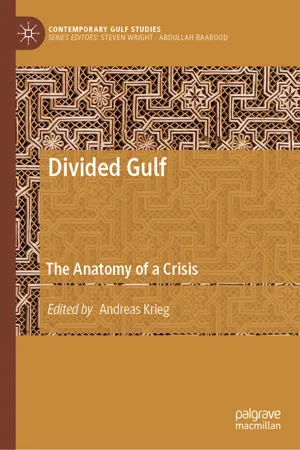
This book discusses the various critical dimensions of the Qatar Crisis as a development that has fundamentally reshaped the nature of regional integration for the near future. It represents the first academic attempt to challenge the commonly propagated binary view of this conflict. Further, the book explains the Gulf Crisis in the context of the transformation of the Gulf in the early 21st century, with new alliances and balances of power emerging. At the heart of the book lies the question of how the changing global and regional order facilitated or even fuelled the 2017 Crisis, which it argueswas only the most recent climax in an ongoing crisis in the Gulf, on that had been simmering since 2011 and is rooted in historical feuds that date back to the 1800s. While contextualizing the crisis historically, the book also seeks to look beyond historical events to identify underlying patterns of identity security in connection with state and nation building in the Gulf.
- English
- ePUB (mobile friendly)
- Available on iOS & Android
eBook - ePub
About this book
Information
© The Author(s) 2019
Andreas Krieg (ed.)Divided GulfContemporary Gulf Studieshttps://doi.org/10.1007/978-981-13-6314-6_11. Introduction
Andreas Krieg1
(1)
Defence Studies Department, King’s College London, London, UK
The idea of a divided Gulf takes me back to summer 2014. At that time, I was still seconded to the Qatari Armed Forces in Doha . My academic colleagues had departed already into their well-deserved summer holiday while I stayed behind to finish several projects. My students, all mid-ranking military officers from Qatar , were unable to leave the country as the entire military remained on high alert amid a diplomatic crisis that had begun several months earlier. In March 2014 Saudi Arabia , the United Arab Emirates (UAE) and Bahrain had withdrawn their ambassadors and severed diplomatic ties with Doha over Qatar’s support for opposition groups and dissidents during the Arab Spring —most notably groups linked to the Muslim Brotherhood.
What for many looked like a mere diplomatic dispute over interests to be settled within the parameters of the Gulf Cooperation Council (GCC) actually had taken a turn for the worse. Aside from the fact that the move to withdraw the ambassadors of three fellow GCC members was unprecedented in the thirty-year history of the GCC, withdrawn from the public eye, tensions particularly between the leadership in the UAE and Qatar had heightened over the spring going into the summer. The reason that my military students were unable to leave the country to go abroad for the holy month of Ramadan, was that Emirati fighter jets repeatedly probed the Qatari air force by penetrating Qatari air space without warning, just to turn around before being intercepted. In the Ministry of Defence in Doha there were serious concerns that the Emirates could take military action—something that contradicted everything I had read, learned and experienced in the Gulf. Conventional wisdom had been that Khalijis are a homogenous group of people, united by family, tribal, linguistic and religious ties—a group that would not go to war with one another despite empirical evidence to the contrary. The GCC had been hailed as an intergovernmental organization resting on a firm foundation of a united people where ambitions for economic, political and societal integration could not be undermined by any dispute or divergence between the ruling elites. Yet, as it turned out the debate about regional integration had been a mere façade in the years following the Arab Spring and leading up to the 2014 diplomatic crisis .
The 2014 diplomatic crisis was seemingly resolved with the signature of two consecutive Riyadh agreements between Qatar and its neighbours, brokered by the ‘old’ establishment of Saudi Arabia under the late King Abdullah. While relations were restored on the surface, strategic disagreements particularly between Abu Dhabi and Doha did not seem to fade. Although Qatar gradually withdrew their support for opposition groups in Libya , Egypt , Syria and Yemen , the strategic rift over how to manage socio-political relations in the region post-Arab Spring , remained in place. For many hidden behind joint GCC declarations and summits was a deeper ideological divide over beliefs, worldviews and values. At the heart of the rift between Qatar and its neighbours stands a value-based conflict, namely a clash of two diametrically opposed belief systems about how to organize socio-politics in the Middle East after the Arab Spring .1 At the heart of this conflict over narratives are two GCC countries, which have since the 1990s developed into two alternative poles of power to Saudi Arabia: Qatar and the UAE . Here, it is mostly the Qatari approach to the Arab Spring , promoting political pluralism with the help of non-state actors that clashes with the Emirati advocacy for a centralized strong state situated in the region of authoritarian stability . In this soft-power battle over narratives , which has spilled over to almost every post-Arab Spring conflict from Libya over Egypt to Yemen, Doha and Abu Dhabi appear on two ends of the spectrum.2
Meanwhile, social and political transformations ongoing in Saudi Arabia under the leadership of the new King Salman bin Abdulaziz and his son Mohammad bin Salman al Saud (MbS), had set the kingdom on a different path. Consensual decision making within the wider Al Saud family had given way to an increased centralization of power under the then deputy Crown Prince MbS.3 Against the backdrop of the ambition to fundamentally transform the kingdom, the king’s son proved to be an impulsive and impatient decision maker eager to use any means necessary to prepare the conservative monarchy for the twenty-first century. Plagued by internal sectarian, religious and socio-economic rifts, the kingdom was increasingly portrayed as the sick man on the Gulf whose failure to reform the almost century-old redistributive system would have detrimental consequences for the survival of the regime. Under immense pressure to reform the ultraconservative Saudi society, MbS turned to Abu Dhabi for inspiration of how to bring a society built around eighteenth-century values into the twenty-first century. The emerging personal relationship between MbS and the Crown Prince of Abu Dhabi and de facto ruler of the UAE Mohammad bin Zayed al Nahyan (MbZ) developed more and more into an alliance based on mutual interests, ideologies and values—a development that would bring Saudi Arabia and its evermore omnipotent then deputy Crown Prince closer to the Emirates.
Hence, when the Qatar News Agency (QNA) was hacked on 23 May 2017,4 releasing fabricated statements by Qatar’s Emir Tamim bin Hamad al Thani , Qatar had already been somewhat isolated from its peers in Riyadh and Abu Dhabi . The released statements of the Emir hailed Qatar’s relationships with Iran , expressed understanding for both Hezbollah and Hamas, and suggested that the new U.S. President Trump would not last long in office.5 Despite robust denials by the Qatari leadership, news outlets based in Saudi Arabia and the UAE were quick to disseminate the ostensible QNA press releases. To many Gulf observers, it dawned that the Gulf Crisis might go into its next round.6 More so, what commenced with the QNA hack quickly developed into the worst crisis since the inception of the GCC in the early 1980s. The coalition of four under the leadership of Saudi Arabia and the UAE were ready to escalate to previously inconceivable levels.
Less than two weeks after the cyberattack on the QNA , on 5 June, the coalition of Saudi Arabia , the UAE and Bahrain cut diplomatic ties with Qatar not only withdrawing their ambassadors but more importantly cutting off all transport links to the emirate. As a peninsula importing the majority of foodstuff, building material and other essentials via its only land border with Saudi Arabia or via the Emirati port of Jebel Ali near Dubai , Qatar suddenly appeared to be isolated not just diplomatically but more importantly logistically.
At first sight, the allegations made by the quartet suggested that this crisis was the result of an interest-based conflict, one between Doha and Abu Dhabi over market shares, one between Qatar and the Saudi kingdom over power and hegemony in the region, or allegedly one over the fight against terrorism and relations with Iran . While Saudi Arabia raised allegations that Doha had built too intimate relations with the Islamic Republic, the UAE claimed that Qatar had become a regional hub for terror financing and radicalization. Ignoring the fact that Saudi Arabia had long been the primary ideological and financial supporter of global jihadism and overlooking the statistics of the Emirates’ far greater trade volume with Iran , the blockading countries quickly got bogged down in a war of alternative facts.
At a second glimpse, commentators were quick to label the crisis a relationship conflict, namely a conflict over personalities and the individual interests of the ruling families.7 The rivalries between the Al Thanis of Qatar and the Al Nahyans of Abu Dhabi are as old as the disputes between the Al Thanis and the omnipotent Al Sauds in neighbouring Saudi Arabia . The decade-old game of thrones had more recently boiled down to a clash of personalities between Tamim bin Hamad , Qatar’s Emir, Mohammad bin Zayed, Crown Prince of Abu Dhabi and de facto ruler of the UAE , and Mohammad bin Salman , Crown Prince of Saud...
Table of contents
- Cover
- Front Matter
- 1. Introduction
- 2. Perceptions and Divisions in Security and Defense Structures in Arab Gulf States
- 3. Tribe and Tribalism: The Trojan Horse of GCC States?
- 4. Bitter Brethren: Freud’s Narcissism of Minor Differences and the Gulf Divide
- 5. The UAE, Qatar, and the Question of Political Islam
- 6. The Weaponization of Narratives Amid the Gulf Crisis
- 7. The Saudi Dimension: Understanding the Kingdom’s Position in the Gulf Crisis
- 8. The “Trump Factor” in the Gulf Divide
- 9. The Political Economy of the Gulf Divide
- 10. The Future of the GCC Amid the Gulf Divide
- 11. The Libyan Revolution Undone—The Conversation Will Not Be Televised
- 12. The Evolution of Turkey—Qatar Relations Amid a Growing Gulf Divide
- 13. Iran and Qatar: A Forced Rapprochement
- 14. Qatar’s Response to the Crisis: Public Diplomacy as a Means of Crisis Management
- 15. Making Sense of Europe’s Response to the Gulf Crisis
- 16. Conclusion
- Back Matter
Trusted by 375,005 students
Access to over 1.5 million titles for a fair monthly price.
Study more efficiently using our study tools.
Frequently asked questions
Yes, you can cancel anytime from the Subscription tab in your account settings on the Perlego website. Your subscription will stay active until the end of your current billing period. Learn how to cancel your subscription
No, books cannot be downloaded as external files, such as PDFs, for use outside of Perlego. However, you can download books within the Perlego app for offline reading on mobile or tablet. Learn how to download books offline
Perlego offers two plans: Essential and Complete
- Essential is ideal for learners and professionals who enjoy exploring a wide range of subjects. Access the Essential Library with 800,000+ trusted titles and best-sellers across business, personal growth, and the humanities. Includes unlimited reading time and Standard Read Aloud voice.
- Complete: Perfect for advanced learners and researchers needing full, unrestricted access. Unlock 1.5M+ books across hundreds of subjects, including academic and specialized titles. The Complete Plan also includes advanced features like Premium Read Aloud and Research Assistant.
We are an online textbook subscription service, where you can get access to an entire online library for less than the price of a single book per month. With over 1.5 million books across 990+ topics, we’ve got you covered! Learn about our mission
Look out for the read-aloud symbol on your next book to see if you can listen to it. The read-aloud tool reads text aloud for you, highlighting the text as it is being read. You can pause it, speed it up and slow it down. Learn more about Read Aloud
Yes! You can use the Perlego app on both iOS and Android devices to read anytime, anywhere — even offline. Perfect for commutes or when you’re on the go.
Please note we cannot support devices running on iOS 13 and Android 7 or earlier. Learn more about using the app
Please note we cannot support devices running on iOS 13 and Android 7 or earlier. Learn more about using the app
Yes, you can access Divided Gulf by Andreas Krieg in PDF and/or ePUB format, as well as other popular books in Politics & International Relations & Middle Eastern Politics. We have over 1.5 million books available in our catalogue for you to explore.