- English
- ePUB (mobile friendly)
- Available on iOS & Android
eBook - ePub
The Policy and Politics of Food Stamps and SNAP
About this book
Food Stamps, now known as the Supplemental Nutrition Assistance Program (SNAP), has endured and expanded in recent years. The program has been preserved and in some cases enhanced as a result of its inclusion in the Farm Bill, being characterized as a safety net of last resort and as a program for the deserving poor.
Information
1
Food Stamps and SNAP: History, Policy and Politics
Abstract: The program known as food stamps and SNAP serves over 45 million people. After a brief incarnation in the 1930s, the Food Stamp Program was revived in the 1960s and in 1973 was authorized under the Farm Bill, allowing it to continue in part due to logrolling between urban and rural lawmakers. In the past two decades, food stamps and SNAP has endured despite massive changes to the welfare system. Three factors have allowed the program to continue without major changes: authorizing the program within the Farm Bill, the characterization of the program as a safety net of last resort and the construction of the program as benefiting the deserving poor. Each of these factors has preserved food stamps and SNAP in an often difficult policy environment.
Gritter, Matthew. The Policy and Politics of Food Stamps and SNAP. New York: Palgrave Macmillan, 2015. DOI: 10.1057/9781137520920.0002.
Introduction
On November 20, 2014, an event was held at the US Department of Agriculture to commemorate the 50 years since the Food Stamp Act of 1964, the program known previously as Food Stamps and since 2008 as the Supplemental Nutrition Assistance Program or SNAP. As noted in a Food Resource and Action Center (FRAC) press release, “Audrey Rowe, USDA’s Administrator for the Food and Nutrition Service, welcomed the audience of nearly 100 advocates and spoke about the role SNAP plays in putting healthy food within [the] reach of millions of individuals and families.”1 Luminaries, including Secretary of Agriculture Tom Vilsack, saluted the program and its advocates. However, the story of food stamps and SNAP2 includes many lawmakers and policymakers who were not part of this celebration. While advocates against poverty and food insecurity have sought to support Food Stamps and SNAP, food stamps and SNAP owes its resilience in great part to other factors, including many corporate interests and conservative elected officials who were not among the advocates and officials gathered. In this book, the resilience of food stamps and SNAP over the past two decades is explored, showing the unusual and surprising ways in which the program continues to endure.
In recent years, increased attention has been devoted to food insecurity. With growing wage stagnation, enduring poverty and a threadbare safety net, policy responses to food insecurity and an increasing interest in the study of food in the United States, it is worth turning to the program traditionally known as food stamps to explore how these trends are playing out in a contentious and polarizing political atmosphere. After starting with fits and starts, persistent stigma and piecemeal initiatives, the program has become a key part of the American welfare state and has endured in some surprising and indeed, at first glance, perplexing ways.
After an early incarnation of the program in the 1930s, the contemporary Food Stamp Program (which was changed in the 2008 Farm Bill to SNAP, the Supplemental Nutrition Assistance Program)3 was restarted modestly by executive order during the Kennedy administration and was codified in the Food Stamp Act of 1964. The program expanded rapidly in the 1960s and 1970s and beginning in 1973 was included as part of the Farm Bill. Subject to spending caps and reductions throughout the many budget agreements4 negotiated during the 1980s and 1990s, food stamps remained intact. What protected a program that gained so much negative media attention? How did a means-tested program5 focused on the poor endure when other federal government programs were subject to severe cutbacks or converted to block grants? This book focuses on three factors to explain the durability of the Food Stamp/SNAP Program: institutional factors embedded in the authorization of the program, the construction of recipients as part of the deserving poor and the characterization of the program as a safety net of last resort.
After the dramatic increase in enrollment in the Food Stamps and SNAP Program beginning in 2001 reached a peak of approximately 47 million Americans in 2013, there has been an increased interest in reforming the program, particularly among conservative policymakers. The Food Stamps and SNAP Program has been authorized in a way that shielded it from some of the pressures of other social programs. Traditionally authorized under the Farm Bill, Food Stamps and SNAP policy was largely made alongside farm subsidies and agricultural support rather than traditional social programs, providing some insulation from efforts to reform federal social policy since the 1980s. While Food Stamp Programs hardly escaped scrutiny, they did not undergo large-scale changes as did the welfare program.
Growing in force and strength as the Tea Party movement rose to prominence around 2009, conservatives, including the vast majority of the Republican Party, worked to limit funding and reform the program. Proposals made over the past few years have gained increasing traction, despite the fact that the SNAP program was previously expanded by several Republican-elected officials including Bob Dole and George W. Bush. Two decades ago, the historic Personal Responsibility and Work Opportunity Reconciliation Act of 1996 converted the program commonly referred to as welfare from Aid to Families with Dependent Children (AFDC), an entitlement program based on a means test, to Temporary Assistance to Needy Families (TANF), a block grant6 program where states were given an amount of money with certain specifications but a great deal of room for experimentation and autonomy. Conservative policymakers are now seeking a similar outcome for SNAP, leaving many without access to any safety net programs at all.
This book is an exploration of how food stamps and SNAP has endured with a focus on three specific moments: the 104th Congress of 1995–1996 that passed the Personal Responsibility and Work Opportunity Reconciliation Act of 1996 that resulted in the end of welfare as an entitlement but passed little institutional change to the Food Stamp Program; the 2002 Farm Bill that expanded access to legal immigrants as President Bush supported the program as supporting the deserving poor; and the events leading up to the 2014 Farm Bill that despite attempts by conservative lawmakers did little to change the program. The three key factors mentioned previously—the institutional and structural factors regarding the placement of food stamps within the Farm Bill, the way food stamps and SNAP was reframed as helping the deserving poor and the characterization of food stamps and SNAP as the safety net of last resort—prevented significant change in the Food Stamp and SNAP Program. Food Stamps and SNAP was abolished and indeed, sometimes the program has expanded. The project concludes by noting how these factors may not endure in the future.
As Table 1.1 notes, three key points shape the argument of this book. The inclusion of food stamps with agricultural subsidies in the Farm Bill helped to shield the program against reform and block granting. Food stamps was reframed as a program for the working and thus deserving poor, leading to an expansion by politicians, most significantly President George W. Bush. The conversion of welfare from an entitlement to a block grant program left food stamps as a safety net of last resort, leading some Republicans to shield it from reform during debates over the Personal Responsibility and Work Opportunity Reconciliation Act of 1996 and also contributing to the large rise in enrollment between 2000 and 2013.
These developments have served as a counter to conservative policy ideas that continue to emerge. They were promoted during 1995 and 1996 and continue to appear in contemporary policy debates. They often correspond to the factors that have preserved food stamps and SNAP. As Table 1.2 shows, there are several correlations.
TABLE 1.1 Argument and Structure of the Book
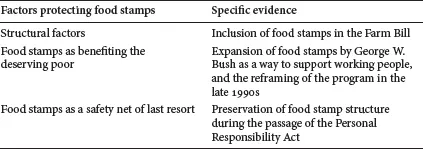
TABLE 1.2 Food stamps and SNAP and conservative policy ideas
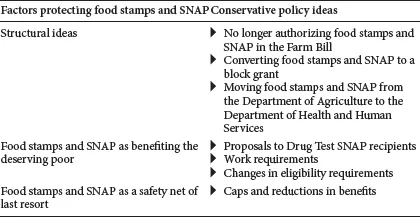
As Table 1.2 shows, conservative policy ideas can be arranged based on the same factors explored in this book. Conservatives want to remove the structural and institutional factors that have shielded food stamps and SNAP. They also want to increase eligibility requirements, including the somewhat punitive concepts of drug tests. Finally, capping and reducing benefits would make food stamps and SNAP less useful as a part of the safety net. Without SNAP assistance, many recipients would have only local food banks to turn to.
History of food stamps and SNAP
Food stamps and SNAP has a significant history that shows the piecemeal and decentralized nature of the American state. First begun during the last days of the Great Depression, the program began its modern incarnation during the 1960s and went through periods of expansion and attempts to reduce the enrollment and the scope of the program. Before proceeding to discussions of more recent actions, it is worth knowing the twist and turns in the program’s history. Logrolling, or the trading of votes and support for disparate programs and ideas, is a hallmark of the history of food stamps and SNAP particularly in terms of the Farm Bill where urban supporters of nutrition programs have worked with rural supporters of agricultural programs. Rather than the focus of a large-scale social movement, from the beginning, food stamps and SNAP has been the subject of limits and has lasted through strange bedfellows and unusual coalitions.
Tracy Roof chronicles the enduring influence of logrolling and of the agricultural community in developing the Food Stamp Program. She notes:
the first school lunch and Food Stamps programs were originally created to dispose of agricultural surpluses during the New Deal . . . In a classic example of logroll politics, congressional representatives of agricultural interests agreed to support a national food st...
Table of contents
- Cover
- Title
- 1 Food Stamps and SNAP: History, Policy and Politics
- 2 The Personal Responsibility and Work Opportunity Reconciliation Act of 1996 and the Saving of Food Stamps 19952000
- 3 Big Government Conservatism, Expanding and Reframing Food Stamps: George W. Bush, Welfare Reform and the 2002 Farm Bill
- 4 A New Right-Wing Consensus? Attacks on SNAP and the Preservation of the Program
- 5 Conclusion
- Bibliography
- Index
Trusted by 375,005 students
Access to over 1.5 million titles for a fair monthly price.
Study more efficiently using our study tools.
Frequently asked questions
Yes, you can cancel anytime from the Subscription tab in your account settings on the Perlego website. Your subscription will stay active until the end of your current billing period. Learn how to cancel your subscription
No, books cannot be downloaded as external files, such as PDFs, for use outside of Perlego. However, you can download books within the Perlego app for offline reading on mobile or tablet. Learn how to download books offline
Perlego offers two plans: Essential and Complete
- Essential is ideal for learners and professionals who enjoy exploring a wide range of subjects. Access the Essential Library with 800,000+ trusted titles and best-sellers across business, personal growth, and the humanities. Includes unlimited reading time and Standard Read Aloud voice.
- Complete: Perfect for advanced learners and researchers needing full, unrestricted access. Unlock 1.5M+ books across hundreds of subjects, including academic and specialized titles. The Complete Plan also includes advanced features like Premium Read Aloud and Research Assistant.
We are an online textbook subscription service, where you can get access to an entire online library for less than the price of a single book per month. With over 1.5 million books across 990+ topics, we’ve got you covered! Learn about our mission
Look out for the read-aloud symbol on your next book to see if you can listen to it. The read-aloud tool reads text aloud for you, highlighting the text as it is being read. You can pause it, speed it up and slow it down. Learn more about Read Aloud
Yes! You can use the Perlego app on both iOS and Android devices to read anytime, anywhere — even offline. Perfect for commutes or when you’re on the go.
Please note we cannot support devices running on iOS 13 and Android 7 or earlier. Learn more about using the app
Please note we cannot support devices running on iOS 13 and Android 7 or earlier. Learn more about using the app
Yes, you can access The Policy and Politics of Food Stamps and SNAP by Matthew Gritter in PDF and/or ePUB format, as well as other popular books in Politics & International Relations & European Politics. We have over 1.5 million books available in our catalogue for you to explore.