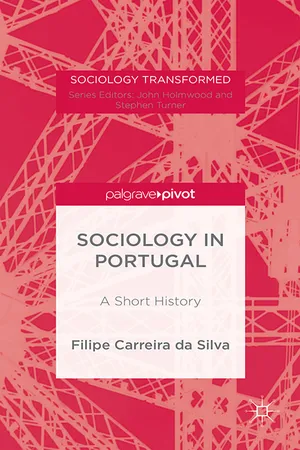
Sociology in Portugal provides the first English-language account of the history of sociology in Portugal from 1945 to the present day. Banned by the fascist regime until 1974, the institutionalization of sociology as an academic discipline came relatively late. Understanding academic disciplines as institutionalized struggles over meaning, Filipe Carreira da Silva gives a genealogy of sociology in Portugal from its origins in the political-administrative interstices of a dictatorship, through the 'cyclopean moment' of the political revolution of April 1974, which brought about its swift institutionalization and subsequent consolidation in the new democratic regime, to the challenges posed by internationalization since the 1990s. Attempts to define Portugal itself, he demonstrates, have been at the heart of these struggles. Analyzing agents, institutions, contexts, instruments and ideas, Carreira da Silva shows in fascinating detail how the sociological understanding of Portugal evolved from that of a developing society in the 1960s, to that of a modernizing European social formation in the 1980s, to the post-colonial or post-imperial Portugal of today.
- English
- ePUB (mobile friendly)
- Available on iOS & Android
eBook - ePub
About this book
Information
1
The Early Years, 1945–74
Abstract: This chapter covers the post-war period when, whilst still not formally recognized as an academic discipline, sociology began to enjoy independent scholarly production in Portugal. The right-wing dictatorship of Salazar and Caetano is analysed as the impeding factor. The strategies of social agents, namely the case of Adérito Sedas Nunes and the cluster of students around him, will illustrate my argument. Institutions, including the state, private foundations, and academic journals, will also be considered.
Carreira da Silva, Filipe. Sociology in Portugal: A Short History. Basingstoke: Palgrave Macmillan, 2016. DOI: 10.1057/9781137495518.0003.
Lisbon, January 1963. The first issue of a new social sciences journal is published, inaugurating an institutional trajectory that would lead, in little over a decade, to the creation of the first departments and undergraduate sociology degrees in Portugal. The new journal was entitled Análise Social (‘Social Analysis’), its title echoing an existing journal of economics entitled Análise Económica (‘Economic Analysis’).1 This journal provided a crucial institutional outlet around which A. Sedas Nunes was able to mobilize the intellectual efforts of a group of young scholars, mostly economists, all of them Catholic, to respond to the problem of the day, that is, to expose through social-scientific means the abhorrent social problems confronting one of the last fascist regimes in the world.
Portugal was, at the time, one of the most rural societies in Western Europe and also the poorest. Between 1954 and 1960, the annual growth rate (constant prices) of GDP was 4.3%, reaching 6.9% between 1960 and 1973 (Rocha 1984: 621). These robust economic growth rates, however, were partly a statistical illusion. The fact was that Salazar’s ‘Estado Novo’ calamitously failed to realize social justice. Until 1974, the state had been both unwilling and unable to take responsibility for redistribution and social welfare provision. Welfare services chronically lacked financial, human, and technical resources to implement even residual policies, and were expected to back up the status quo. Yet with very limited access to socio-economic indicators and very few publication outlets available to make these findings known, the gargantuan task facing the socially progressive group of social scientists around Sedas Nunes was to show this was indeed the case. It was, therefore, a matter of exposing social realities hitherto hidden from the population itself. Of course, to make social issues known was a delicate political matter in a repressive political regime such as Salazar’s. This was, in brief, the fine line the founders of sociology in Portugal had to negotiate in the 1960s. On the one hand, to create the institutional conditions so that sociological instruments could be employed to expose social problems typical of developing societies such as poverty, emigration, unemployment, labour conflicts, lack of sanitation, and so on. And on the other hand, to be politically astute enough to evade the censorship apparatus of the regime, which often meant exercising self-censorship in the dissemination of findings. This political gamble posed a wrenching moral dilemma, as later autobiographical statements make clear. To choose to remain in the country and pursue an academic career within the strict confines defined by the authorities, especially in face of a growing number of political exiles and political prisoners, risked being regarded in some quarters as ‘collaborationism’. Yet without it, the chances of the regime allowing sociology to be institutionalized, which Salazar himself considered to be ‘socialism under disguise’ (Nunes 1988: 37), were simply non-existent.
The situation in other Western countries at the time could have hardly been more different, which contributed to the perception many Portuguese shared that they were living in an ‘anomalous’ regime with no less ‘anomalous’ modes of governance of scientific activity. The 1960s marked the zenith of self-confidence and intellectual authority of the social sciences in the US and Western Europe. This modernist vision of the role of the social sciences fed upon: ‘the defeat of fascism, the disintegration of colonial empires, and the threat of communism’ (Ross 2015: 229). By contrast, in the 1960s Portugal fascism was yet to be defeated, the colonial empire still stretched from the Atlantic shores of Africa to Southeast Asia, and the threat of communism only reinforced the regime’s rhetoric of self-preservation. The US, benefiting from having emerged from World War II as the strongest world power and having evaded both fascism and communism, was busy promoting its products, science and technology among them. Important institutional outlets that sustained the projection of America’s cultural values and institutional forms included private foundations, disciplinary organizations, universities, and government agencies. In particular, the American model of the research university, under which teaching and research are pursued within the same institution, provided a powerful pole of attraction for modernizing countries. Likewise, the disciplinary form of American social science was being actively promoted by international organizations such as UNESCO. The ‘Americanization’ of the social sciences in Western Europe varied widely, of course. Swedish Social Democrats, for instance, emulated American paradigms as they found Parsons’ structural-functionalism compatible with their own vision of an integrated, harmonious egalitarian society. By contrast, with a university mode of governance with little or no disciplinary autonomy, Italy offered a far less welcoming context for the American model. Likewise, in Portugal, despite the best efforts of government agencies such as the CIA to provide discreet support to the nascent social sciences (Nunes 1988: 41), ‘Americanization’ has always been limited at best. As a result, sociology in Portugal first developed around a materialist problematic of structural constraints on practical action, leading sociologists to study such topics as structure, class relations, change, or power, but to downplay quintessential American concerns such as deviance and values.
A second important context to take into account when considering the formation of sociology as an academic discipline is the system of academic disciplines, i.e. how sociology fared vis-à-vis other human and social sciences in its dealings with the state. As in other colonial empires, anthropology and history in Portugal had long and distinguished academic records (Pinto 2004: 14–15). Alongside management and administration and tropical medicine, these human and social-scientific discourses provided precious knowledge of colonial territories, their populations and cultures under Portuguese rule. By contrast, critical knowledge of the social conditions of the metropolitan society was anything but helpful. Yet sociology needs not be critical. In France, the conservative sociological school founded by Frédéric Le Play had long competed for disciplinary dominance with the Durkheimian school (Bannister 2005: 346). Given that since the nineteenth century France acted like a cultural magnet for successive generations of Portuguese intellectual elites, it should come as no surprise that one of the very few sociological initiatives allowed under the fascist regime was a short-lived LePlaysian experiment whose protagonist was the Belgian Paul Descamps (see Cruz 1983; Ágoas 2013: 225–27; Neto 2013: 46). Despite the ideological proximity between Descamps’ LePlaysian sociology and Salazar’s corporative principles and social Catholic ideas, however, the application of this sociological approach to legitimize the regime’s own policies was not successful (Hespanha 1996: 5), and left virtually no trace in subsequent attempts to introduce sociology into the Portuguese academic curriculum.
This LePlaysian experiment, of course, may have been influenced by Sedas Nunes’ Catholic background and his own writings on the Social Doctrine of the Church (Nunes 1961). In fact, however, Sedas Nunes always maintained a careful distance between his writings and ideas on theological doctrine and his work as a social scientist. As a consequence, there is virtually no reference in Sedas Nunes’ sociological works to any of the LePlaysian antecedents that today’s internalist historians of sociology in Portugal are so keen to document. In general, in what constitutes a notable distinction from the Irish case, there was never a Catholic sociology in Portugal as such, in the sense of a long-standing, influential, and institutionally visible tradition of sociological thinking and research. The partial exception are the studies of Portuguese churchgoers promoted by the Catholic Church since the 1950s (Ferreira 2006; see also Silva 1996), but again these had virtually no impact upon the studies conducted by Sedas Nunes and the GIS in the 1960s and early 1970s and are, therefore, only of antiquarian interest.
The main problem driving this Portuguese cluster of early sociological precursors was that of development, namely of fostering development in a backward society through social scientific means. This motivation was at once moral-political and social-scientific. It had originally emerged in the 1950s out of a social progressive Catholic milieu genuinely concerned with the betterment of social conditions among the most vulnerable segments of society, and gradually became a social-scientific quest that would: ‘contribute to change and the betterment of conditions in society’ (Nunes 1988: 50–51). If there was a unifying interest mobilizing this group of young scholars it was that of studying social problems, in the general sense of problems of development. If there was an intellectual inclination, it was that of sheer intellectual curiosity about social realities (Nunes 1988: 19).
This is well illustrated by Sedas Nunes’ first ‘sociological adventure’ (1988: 28) on the dualist nature of Portuguese society (Nunes 1964; see also 2000). First published in a special issue of Análise Social on the ‘social aspects of economic development in Portugal’, this article mobilized an unprecedented range of statistical figures to characterize and interpret the process of socio-economic change in post-war Portugal. The essay’s main thesis may now seem trivial – that Portugal was better understood as a two-speed society, as it were, with a ‘traditional’ backward countryside and geographically circumscribed ‘modern’ poles around Lisbon and Oporto (1964: 420). However, in 1960s Portugal it was path-breaking. The mobilization of statistical figures to quantify social conditions was something virtually unheard of, let alone their usage to explain sociologically Portugal’s development problems and to suggest concrete solutions to pressing social issues such as the so-called ‘rural exodus’ from the ‘traditional’ countryside to the ‘modern’ capital (1964: 456). Indeed, the essay ‘Portugal, sociedade dualista’ proved pivotal in turning Sedas Nunes into a sociological authority almost overnight (1988: 39).
It would be a serious mistake, however, to depict the early sociological endeavours of Sedas Nunes (e.g. 1965) and his cluster as a well-intentioned, straightforward success. To begin with, today’s reader may react with incredulity to their focus upon the developmental problems of a country located in Western Europe, while that same country at the time headed a colonial empire composed of large territories with far more acute social problems. Did Connell not show that sociology was born in Western Europe out of a systematic comparison with its colonial possessions? At best, this may account for certain cases such as that of French sociology, but it certainly fails to capture the realities of non-democratic colonial powers such as Portugal. In fact, this sort of intra-imperial sociological inquiry was simply off-limits. Both the colonial empire and the nature of the political regime, as Sedas Nunes was keenly aware, were taboos whose violation meant political sanctioning eventually leading to institutional boycott, forced exile, or prison sentences (Nunes 1988: 25). This is how Sedas Nunes described the self-censorship he had been forced to impose upon himself and those around him in the late 1960s so that the first sociological works would pass the regime’s official censorship:
Some of the young scholars that came to work at GIS assumed that we, especially me, only said and published in the journal what we did because that was all we had to say and wanted to publish. They were not aware of the limitations imposed upon us from the exterior. As a result, they too wanted to say and publish everything they saw fit. That I could not allow. I had to ‘correct’ their texts with them as to make them ‘publishable’. The nefarious regime that is no more forced my hand. I think that they eventually understood that the intellectual tortures I imposed on them were the same I imposed on myself. But I cannot forget the role I had to perform, neither my face before them. Sometimes I wonder whether it would not have been preferable to tell them simply: ‘What you have written cannot be published’ and publish nothing of what they had written. But I have always wanted to go to the extreme limit of the tolerable, to explore all dimensions and frontiers of the possible and of the sayable. Maybe it was a mistake … even today I feel the need to excuse myself. (1988: 27)
These words suffice to illustrate the difficult political circumstances of ‘conditioned liberty’, as Sedas Nunes euphemistically put it elsewhere (2013: 9), in which his GIS developed its first sociological activities. Indeed, the relationship between the Portuguese government and the incipient sociological cluster around Sedas Nunes was far from straightforward and transparent. If, as we have seen, fascist authorities imposed strict limits upon what could be said and published, it is no less true that the transition from Salazar to Marcelo Caetano’s rule in 1969 brought with it a certain hope of political openness. Of course, this was no regime change, but only an attempt by certain forces within the regime to promote changes in order to keep the regime going in increasingly adverse international conditions. Among these changes was the new role of the social sciences. Taking its inspiration from the technocratic model of the post-war social sciences, disciplines such as sociology were now seen by certain segments of the regime as instruments of enlightened social change. The risk for social scientists, of course, was that of being instrumentalized, i.e. of assisting Caetano to extend his hold on power and thus preventing (or, at least, delaying) the transition to democratic rule. Again, Sedas Nunes was keenly aware of this risk.
This much is clear from his account of the historical origins of the research centre GIS and the journal Análise Social. Both institutional outlets were the product, he tells us, of an ‘improbable triangle’ (1988: 18) composed of one group, one man, and one politician. The ‘group’ was, of course, those young Catholic economists who revolved about him. Sedas Nunes depicts them as a group that became politically aware of the social issues confronting their society during their undergraduate years, and despite being disillusioned with Salazarism, were seen by the regime as: ‘intelligent, competent, and especially with “good manners”, i.e. well trained in the religious and moral principles of the Catholic, Apostolic and Roman Holy Mother Church’ (Nunes 1988: 17). The ‘man’ was an academic, José Pires Cardoso, perhaps the most systematic analyst of corporatist doctrine2 in Portugal and director of the ‘Gabinete de Estudos Corporativos’ (GEC, Centre for Corporatist Studies). Also disillusioned with the regime, which failed to implement his ideas, Cardoso turned his energies from the mid-1950s to the study of social problems. This established academic figure, with close ties to the upper echelons of the regime, acted as the patron of Sedas Nunes and the GIS, a body which originated as a sub-unit of the GEC. The ‘politician’ was the Minister of Corporations and Social Welfare, José João Gonçalves de Proença. After consulting with Pires Cardoso, Gonçalves de Proença eventually promulgated the decree creating the ‘Gabinete de Investigações Sociais’ and, with it, Análise Social.
As the intervention by the third element of the ‘improbable triangle’ makes clear, the risk of being manipulated by the regime was also present regarding funding for the professionalization of Sedas Nunes and the members of his cluster. In short, there were two clusters. The first GIS was created in 1963 and was composed of five members (Sedas Nunes, Raul da Silva Pereira, Mário Murteira, Mário Pinto, and Alfredo de Sousa, all of them economists, with Maria Manuela Silva and Mário Cardoso dos Santos joining the initial group later). The second GIS emerged in the late 1960s, adding to the first group a number of scholars trained in law, economics, engineering, agronomy, philosophy, history, colonial administration and so on. This was only possible owing to the financial support gathered by Sedas Nunes from private and state sources. Part of the funding came from the Calouste Gulbenkian Foundation, a charitable organization created in 1956 by a Portugal-based oil magnate of Armenian origin. In 1964 the Foundation awarded Sedas Nunes a research grant, enabling him to pursue an independent research career of sorts, and two years later the Foundation began to fund a number of junior research fellows to join Sedas Nunes. This is how the second GIS came about. Decisive support for the professionalization of this cluster came from the government, specifically following the political death of Salazar in 1968.3 With Caetano in power, the social and political generation to which Sedas Nunes belonged saw their standing reinforced. As a result, he applied to three governmental agencies for institutional support and swiftly received it. In 1969 GIS signed three protocols with each agency and was granted ten fully funded posts for its resear...
Table of contents
- Cover
- Title
- Introduction: Sociology in Portugal
- 1 The Early Years, 194574
- 2 Sociology Institutionalized, 197582
- 3 Consolidation, 1980s90s
- 4 Internationalization, 1995 to the Present Day
- 5 Sociologys Voices
- Conclusion: Sociology in Portugal in the Twenty-First Century
- References
- Index
Trusted by 375,005 students
Access to over 1.5 million titles for a fair monthly price.
Study more efficiently using our study tools.
Frequently asked questions
Yes, you can cancel anytime from the Subscription tab in your account settings on the Perlego website. Your subscription will stay active until the end of your current billing period. Learn how to cancel your subscription
No, books cannot be downloaded as external files, such as PDFs, for use outside of Perlego. However, you can download books within the Perlego app for offline reading on mobile or tablet. Learn how to download books offline
Perlego offers two plans: Essential and Complete
- Essential is ideal for learners and professionals who enjoy exploring a wide range of subjects. Access the Essential Library with 800,000+ trusted titles and best-sellers across business, personal growth, and the humanities. Includes unlimited reading time and Standard Read Aloud voice.
- Complete: Perfect for advanced learners and researchers needing full, unrestricted access. Unlock 1.5M+ books across hundreds of subjects, including academic and specialized titles. The Complete Plan also includes advanced features like Premium Read Aloud and Research Assistant.
We are an online textbook subscription service, where you can get access to an entire online library for less than the price of a single book per month. With over 1.5 million books across 990+ topics, we’ve got you covered! Learn about our mission
Look out for the read-aloud symbol on your next book to see if you can listen to it. The read-aloud tool reads text aloud for you, highlighting the text as it is being read. You can pause it, speed it up and slow it down. Learn more about Read Aloud
Yes! You can use the Perlego app on both iOS and Android devices to read anytime, anywhere — even offline. Perfect for commutes or when you’re on the go.
Please note we cannot support devices running on iOS 13 and Android 7 or earlier. Learn more about using the app
Please note we cannot support devices running on iOS 13 and Android 7 or earlier. Learn more about using the app
Yes, you can access Portuguese Sociology by Kenneth A. Loparo,Filipe Carreira da Silva in PDF and/or ePUB format, as well as other popular books in Social Sciences & Higher Education. We have over 1.5 million books available in our catalogue for you to explore.