
- English
- ePUB (mobile friendly)
- Available on iOS & Android
eBook - ePub
About this book
A new look at the strategic and managerial issues surrounding intellectual property (IP) and international commercialization in the international market. An updated version which provides practitioners and analysts with guidelines and an action framework on how to benefit from IP.
Information
1
Understanding and Profiting from Intellectual Property across Borders: A Beginning
Focus and structure
This book investigates intellectual property (IP) within the context of international business (IB), and presents IP fundamentals, IP environments, IP management and IP strategies in a way which is relevant to both business practice and research. It aims to provide practitioners and analysts with guidelines and an action framework on how to profit from IP across borders. The author has consulted the widest possible range of resources, including primary and secondary data and grey literature, to serve these research aims and objectives, and has structured the book thematically to guide readers towards a comprehensive understanding of IP in the IB world.
This chapter aims to set a clear picture of the book by addressing four topics. First, it clarifies the focus of the book, by addressing the aims and purposes. Second, the reasons behind writing this book and its intended readership are discussed. Third, the methodological approaches that have been followed in different areas of the subject are presented briefly. Finally, the contents of each chapter are outlined to provide the reader with a route map through the book.
1.1 Aims and purposes
The book aims to provide practitioners and analysts with guidelines on how to profit from IP, particularly in world business. Four major aspects of IP are addressed. First, IP fundamentals are outlined to establish an overall understanding of the subject, covering conceptual issues and different schools of thought, before narrowing the focus down to IP in the IB context. Second, the book discusses the question of IP environments , providing readers with critical insights into the factors that affect IP-related business activities in different countries. Third, the section on IP management emphasizes the importance of managing IP valuation, people and products. Finally, it examines IP strategies, focusing on business dissemination (that is, the process of gaining value from the spread and development of IP), including a systematic introduction to different possible business strategies for IP-related activities, specific explanations about various forms of IP licensing and diverse corporate strategies against piracy.
This book has a dual purpose in seeking to provide its audience with a critical understanding of the significance and implications of IP issues in world business.
• The first is to provide knowledge and understanding about IP in world business. The book offers a critical understanding of IP from the perspective of practitioners, demonstrating the strategic importance of IP to corporate success and presenting a comprehensive discussion of how the IP environment is analyzed and IP assets managed and strategized for onward dissemination.
• The second is to enhance the ability of readers to conduct cross-border IP analysis by understanding how to acquire and interpret data and evaluate the relevance and validity of the data. This understanding will assist them in planning appropriate responses and solutions to IP-related activities from corporate, industrial and international perspectives and in negotiating IP-related collaboration.
1.2 Rationale and intended readership
This book has been written to address two needs. First, it is to offer practitioners a ‘guidebook’ on how to profit from IP across borders. Although there has been much interdisciplinary research on IP, a book addressing the subject systematically from an IB angle is still lacking. Practitioners associated with IP businesses – such as creators, IP owners, business managers, research institutions and government organizations – need a comprehensive understanding of IP and IB to assist them in managing cross-border IP activities. While existing publications primarily emphasize the creation and protection of IP, this book steers in the direction of IP dissemination, that is, deriving value from IP. Second, there is a need for an educational and analytical guide for corporate researchers, academics and students – indeed, the idea of writing this book was driven initially by classroom demand. During the process of designing a course to teach students of MBA and MA business and management, the author found she had to prepare everything from scratch – writing cases, collecting statistical data for analysis and synthesizing existing theories and practice – a process which convinced her that a book on IP from the business angle would be of value to both practitioners and analysts.
There are also academic voids to fill as far as IP in the context of IB is concerned. As a business subject and practice, IP has gained in importance in recent decades. While it is still perceived mainly as a legal and economic subject, it is becoming more recognized as an interdisciplinary subject due to its importance in history, sociology, politics and natural sciences. With the signing of the agreement on the Trade-Related aspects of IP Rights (TRIPS) by the member states of the World Trade Organization (WTO), IP has become an integral part of business practice and an essential element of business transactions. However, there appears to be little research linking IP and IB that supports practice with a synthesis of contemporary theory: this book is written with the intention of achieving such a synthesis.
1.3 Methodological delineation
This book combines analyses of primary and secondary data and ‘grey literature’, and is organized thematically, that is, the data in each chapter has been collected and analyzed in various ways to provide evidence to demonstrate particular IP features. For primary data sources, two methods of collecting and analyzing data have been used. One involves survey data (e.g. data collected from corporate managers involved in IP-related businesses), which tends to reveal statistical facts about IP businesses. For example, for the discussion on measuring different IP systems (IPS) in the world (see IP Facts section of Chapter 4), the author has coded data based on government documentations and questionnaire surveys with government bodies and international organizations. The other primary data source is interview data and case analysis, such as is used in Chapter 11, where the strategy discussions are all related to cases based on interviews with corporate managers.
A rich array of secondary sources is also employed. All data sources, including journal papers, books, periodicals and magazines as well as Internet resources have their merits and demerits. Journal papers and books, such as scholarly books (research monographs), tend to target a particular specialist field and lay great emphasis on their thoroughness in relevant literature, soundness of methodology and interpretation of results. However, this type of work can take a long time to be published, particularly in leading journals, and thus the data can be dated. Such problems can be overcome by using professional resources, such as books, magazines and periodicals published by specialists in a particular field and oriented towards practitioners that place greater emphasis on the freshness of information. This type of data complements academic publications by addressing particular problems and offering pragmatic solutions, although it perhaps lacks methodological detail. Web data from a variety of sources are also used: while this shares the merits and demerits of professional data, it is up to date, and can add different angles of views from government sites, practitioners, journalists and IP owners, and can thus be grounded in practice to provide insights for IP businesses. The author has used Internet information selectively to avoid unreliable sources and ensure the trustworthiness of information. Many cases have been written from a synthesis of professional and Internet sources to bring them up to date and to allow a wide range of views to be taken into account (case and IP fact references are incorporated within endnotes, while most academic references can be found in the ‘References and further reading’ at the end of each chapter).
This book has also benefited from a wide range of ‘grey literature’, mostly in the form of reports from companies, government bodies, international organizations and so on that are not widely publicized. Such sources provided the author with quasi-primary data based on which she could conduct original analysis. For example, the World IP Organization (WIPO) compiles IP statistics on a yearly basis, presenting data by country of origin, types of IP applications and the granting of IP rights to domestic and foreign applicants. On their own, such data presents a broad-brush picture of the technological and other creative activities in a particular country. However, it may not indicate, for instance, whether different countries treat domestic and foreign IP applicants equally. The availability of such ‘grey’ data has allowed the author to subject it to further analysis to answer detailed questions, such as in Chapter 3, where raw WIPO data from the US and China – two countries perceived as being at the extremes of IP protection (IPP) – are compared to show where their processing of applications differs.
This integrated approach to consulting a wide range of information sources benefits the book, allowing its thematic discussions to take into account a wide range of views from professionals to academics, besides allowing the author to make her own contribution to the discussions. The approach is also methodologically beneficial: the breadth of methods used allows the research outcomes to take advantage of the merits of each method, while their individual demerits can be overcome by triangulation to achieve maximum validity and reliability.
1.4 Structure and thematic overview
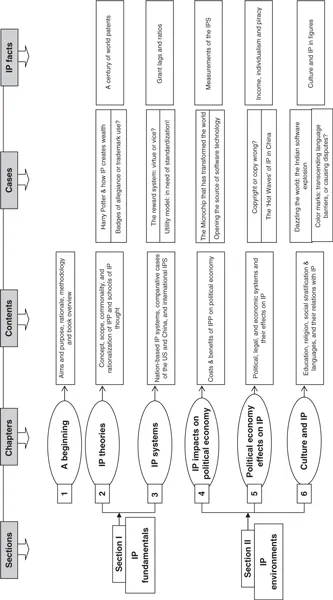
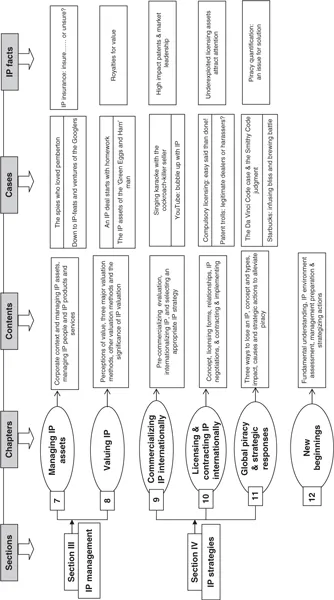
The book is structured thematically to address a range of IP topics within the framework of IB: its ‘route map’ is shown in Figure 1.1 . Each chapter follows the same structure to aid clarity. In addition to sections entitled ‘Focus and structure’, ‘Summary’ and ‘References and further reading’, the theme of each chapter is opened by a case discussion (the ‘Opener’). The main body of the chapter constitutes discussions of the main themes and relevant IP issues in relation to world business. The chapter closes with discussions on another thematically relevant real-life IP case (the ‘Closer’). Besides the case studies, each chapter contains an ‘IP Facts’ section, addressing the chapter’s theme from a statistical point of view. Thus, 20 opening and closing cases are outlined and ten ‘IP Facts’ sections presented to supplement chapter discussions.
The overall structure of this book is as follows:
Chapter 1 – Understanding and Profiting from Intellectual Property across Borders: A Beginning sets the route map for the book and outlines its aims and purposes, the rationale behind the book (for the benefit of both practitioners and analysts) and the methodology used to draw its conclusions.
Part I – Intellectual Property Fundamentals
Chapter 2 – Intellectual Property Theories addresses some fundamental issues to aid the reader’s overall understanding of the subject. It clarifies different types of IP concepts, discusses the ever-expanding scope of IP, the common characteristics of different types of IP and the motivations for countries to strengthen their IPP. Finally, this chapter sets the academic context by discussing the increasingly interdisciplinary schools of thought on IP.
Chapter 3 – Intellectual Property Systems shows how IPS across the world are still fundamentally country-based, despite the efforts to internationalize IPP, administration and enforcement. To illustrate such differences, the similarities and differences of the IPS operations in China and the US are considered.
Figure 1.1 A route map for the book. Created by the author.
Part II – Intellectual Property Environments
Chapter 4 – The Impacts of Intellectual Property on Political Economy highlights the costs and benefits of IPP to a country and also addresses questions like ‘Why is IPP beneficial for the political economy of a country?’, ‘What conditions are needed to allow countries to achieve optimal benefits from IP?’, ‘Is IP suited for all countries?’ and ‘What are the costs to a country of strengthening its IPP?’.
Chapter 5 – The Effects of Political Economy on Intellectual Property turns the previous chapter’s discussions around to consider how a country’s political economy systems impact on the development of IP. The nature of a country’s political economy environment – be it a democratic or a totalitarian political regime, a capitalist or a planned economy, operating within a common or civil law regime – can all have a bearing on the establishment and strengths and weaknesses of IP.
Chapter 6 – Culture and Intellectual Property discusses how national cultural elements can influence a country’s attitudes toward IP. Education, religion, social structure and language all have their role to play in influencing ways of thinking about IP, vice versa.
Part III – Intellectual Property Management
Chapter 7 – Managing Intellectual Property Assets focuses on the corporate management of IP assets (i.e. people and products). This includes outlining the corporate context, as it decides the focus of managing IP resources and categorizing IP firms according to their capabilities in dealing with IP and their tactics for managing IP assets.
Chapter 8 – Valuing Intellectual Property analyzes the different methods available for valuing IP assets. As background, the chapter first discusses various perceptions about value. Then the three major valuation methods – the cost, market and income approaches – are discussed in terms of their pros and cons, and how they are used. Other methods are also discussed briefly. Finally, the chapter emphasizes the importance of conducting IP valuation for different business purposes.
Part IV – Intellectual Property Strategies
Chapter 9 – Internationalizing Intellectual Property stresses the benefits, costs, risks and control of IP throughout the internationa...
Table of contents
- Cover
- Title Page
- Copyright
- Contents
- List of Illustrations
- List of Opener and Closer Cases
- List of Intellectual Property Facts
- List of Abbreviations and Acronyms
- Preface and Acknowledgements to the Second Edition
- 1. Understanding and Profiting from Intellectual Property across Borders: A Beginning
- Part I: Intellectual Property Fundamentals
- Part II: Intellectual Property Environments
- Part III: Intellectual Property Management
- Part IV: Intellectual Property Strategies
- Index
Trusted by 375,005 students
Access to over 1.5 million titles for a fair monthly price.
Study more efficiently using our study tools.
Frequently asked questions
Yes, you can cancel anytime from the Subscription tab in your account settings on the Perlego website. Your subscription will stay active until the end of your current billing period. Learn how to cancel your subscription
No, books cannot be downloaded as external files, such as PDFs, for use outside of Perlego. However, you can download books within the Perlego app for offline reading on mobile or tablet. Learn how to download books offline
Perlego offers two plans: Essential and Complete
- Essential is ideal for learners and professionals who enjoy exploring a wide range of subjects. Access the Essential Library with 800,000+ trusted titles and best-sellers across business, personal growth, and the humanities. Includes unlimited reading time and Standard Read Aloud voice.
- Complete: Perfect for advanced learners and researchers needing full, unrestricted access. Unlock 1.5M+ books across hundreds of subjects, including academic and specialized titles. The Complete Plan also includes advanced features like Premium Read Aloud and Research Assistant.
We are an online textbook subscription service, where you can get access to an entire online library for less than the price of a single book per month. With over 1.5 million books across 990+ topics, we’ve got you covered! Learn about our mission
Look out for the read-aloud symbol on your next book to see if you can listen to it. The read-aloud tool reads text aloud for you, highlighting the text as it is being read. You can pause it, speed it up and slow it down. Learn more about Read Aloud
Yes! You can use the Perlego app on both iOS and Android devices to read anytime, anywhere — even offline. Perfect for commutes or when you’re on the go.
Please note we cannot support devices running on iOS 13 and Android 7 or earlier. Learn more about using the app
Please note we cannot support devices running on iOS 13 and Android 7 or earlier. Learn more about using the app
Yes, you can access Understanding and Profiting from Intellectual Property by D. Yang in PDF and/or ePUB format, as well as other popular books in Business & Business Strategy. We have over 1.5 million books available in our catalogue for you to explore.