- English
- ePUB (mobile friendly)
- Available on iOS & Android
eBook - ePub
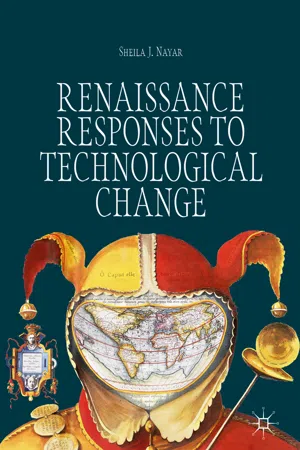
Renaissance Responses to Technological Change
About this book
This book foregrounds the pressures that three transformative technologies in the long sixteenth century—the printing press, gunpowder, and the magnetic compass—placed on long-held literary practices, as well as on cultural and social structures. Sheila J. Nayar disinters the clash between humanist drives and print culture; places the rise of gunpowder warfare beside the equivalent rise in chivalric romance; and illustrates fraught attempts by humanists to hold on to classicist traditions in the face of seismic changes in navigation. Lively and engaging, this study illuminates not only how literature responded to radical technological changes, but also how literature was sometimes forced, through unanticipated destabilizations, to reimagine itself. By tracing the early modern human's inter-animation with print, powder, and compass, Nayar exposes how these technologies assisted in producing new ways of seeing, knowing, and being in the world.
Information
Topic
StoriaSubtopic
Storia europea© The Author(s) 2019
Sheila J. NayarRenaissance Responses to Technological Changehttps://doi.org/10.1007/978-3-319-96899-5_11. From Petrarch to Bacon, Technécology Style: Introduction
Sheila J. Nayar1
(1)
Greensboro College, Greensboro, NC, USA
Sheila J. Nayar
Undoing the “Dark Ages”
I have always envisioned Petrarch rushing—whether furiously home to pen a familiar letter to Cicero or from some remote monastery to Boccaccio’s residence, in order to confer about his latest classical find. Wherever Petrarch is heading, it is always, in my mind’s eye, with an urgency spurred by his conviction in humanism and his eagerness to illuminate, through study of the ancients, the “Dark Ages” in which he envisaged himself living.
It was the past spurring Petrarch to look optimistically toward the future—or, so we might glean, based on his unfinished epic Africa (1338): “[A] more propitious age will come again: this Lethean stupor surely can’t endure forever. Our posterity, perchance, when the dark clouds are lifted, may enjoy more the radiance the ancients knew” (IX.637–641).1 One could argue his vision was eventually realized, given Marsilio Ficino’s capacity in 1492 to extol his own century, which “like a golden age, has restored to light the liberal arts, which were almost extinct.”2 In England, Robert Whittinton would contend that, by the early sixteenth century, “true knowledge of lernyng that long tym be hydde in profounde derknes by dylygence of men in this tyme is nowe brought to open lyght.”3
Of course, when Petrarch undertook his mission to cast off the shadow of those putatively dark ages, his Renaissance world (as distinct, say, from that of Michel de Montaigne or Miguel de Cervantes—or even Whittinton ) was, in many respects, more in keeping with that of the ancients. For, three technologies that were to transform the early modern western European world—the printing press, gunpowder , and the magnetic compass—were still in their infancy or not yet invented.4 It would not be until the long sixteenth century, the very period with which this project deals, that these technologies would lead to three revolutions: in communication, warfare , and navigation. While premature for me to posit any claims at this juncture, let me at least put forth an enticing question: Given the radical transformations facilitated by print, powder, and compass, how could the cultural movement of the Renaissance, and humanism more particularly, not be deeply affected and unavoidably “rewritten”?
By no means have I selected these technologies5 indiscriminately. The instruments comprising this triptych are the very ones Francis Bacon foregrounded for their radical leverage. While philosophers before Bacon had argued something similar,6 it is his proclamation in the New Organon (1620) that has, in the English context certainly, withstood the test of time: “For these three have changed the whole face and state of things throughout the world; … no empire, no sect, no star seems to have exerted greater power and influence in human affairs than these mechanical discoveries.”7 Bacon’s anti-humanist position regarding print , powder, and compass (not to mention, his deific aggrandizing of European man, with unsettling shades of the colonialism to come) pivots on the dissimilarity between the life of men “in the most civilized province of Europe, and [those] in the wildest and most barbarous districts of New India”; and it does so in order “to justify the saying that ‘man is a god to man,’ not only in regard to aid and benefit, but also by a comparison of condition. And this difference comes not from soil, not from climate, not from race, but from the arts.”8 For Bacon, possession of the mechanical arts of print , powder, and compass—conspicuously absent and unknown to the ancients—was also what set early modern man apart, and hierarchically above, his putatively superior antecedents.
But how to get from Petrarch’s enthusiasm for dispelling the darkness of his present via the classical past to this latter teleological emphasis on exceeding the past? Surely along the way these drives must have crashed, sometimes painfully, sometimes dynamically, into one another. Indeed, as Frank Lestringant describes with respect to Renaissance cosmography, it was from the oft-jarring dissonance between classical notions of a universally harmonious world and cracks that “were appearing all over the ancient representation of the cosmos” that cosmography gained its mobility and dynamism.9 Imagine thereby the difficulty—the potential confusion and responsibility—that went hand in hand with any attempt to reflect on the altering cosmos or to situate oneself within it. Did one attitudinally invent or abstain from inventing?10 Did one challenge or hide? Reject or embrace? And what when the interpreter was himself a humanist, who tended thereby to be attitudinally deferent toward persons of authority?11 Here, then, lies the purpose of this project: to place literary culture more firmly back into the context of these emergent technologies; to see how that culture adjusted, how it was adjudicated, and, even—borrowing here from the poetic lexicon of John Donne—how it inter-animated12 with these technologies to produce new ways of seeing, of knowing, and of being in the world.
Technécology as Methodological Approach
Quite before the advent of media theorists, modern philosophers were tracing technology’s sway on humankind. Karl Marx, for one, considered technology to be an extension of human forces,13 and Sigmund Freud more daringly asserted that all technologies, everything from writing to the car engine, removed limits that enabled man to make himself something of a prosthetic god.14 The jump to Marshall McLuhan’s contention that media technologies operate as extensions of man is not hard to spot. McLuhan maintained that, with each new communication invention, an entirely new environment was created—in fact, media were environments , he urged, emphasizing particularly the impact electronic media had on sensory perception and social conditions.15 The implication here—fully extendable to non-communication technologies, I would argue—is that the relationship of any subject to its object, including the possibility of separating the two, is hardly strict, stable, or even viable. Or, if we prefer the words of a more recent philosopher of technology, “Mediation does not simply take place between a subject and an object, but rather coshapes subjectivity and objectivity.”16 As the theoretical underpinning of what follows subscribes to this shift-shaping relationship between instruments and the humans who wield them, I have elected not to address until the final chapter the issue of technological determinism (always worrisomely attributable to any project foregrounding technologies). My preference is for readers to experience how I negotiate the inter-animation between thing and individual, or between thing and society, before adducing where, or whether, this project fits into a scheme of instrumental causation.
Like Peter-Paul Verbeek, the theorist whom I quoted above, I eschew a polemicist’s approach to technology, the sort woefully anchored in restricting binaries of “good” or “bad” and frequent in more mass publications on the subject. I am also similarly interested in making space for the more capaciously philosophical, phenomenological , and even metaphysical when it comes to relations to, and the ramifications of, technology—but always, cruciall...
Table of contents
- Cover
- Front Matter
- 1. From Petrarch to Bacon, Technécology Style: Introduction
- Part I
- Part II
- Part III
- Back Matter
Trusted by 375,005 students
Access to over 1.5 million titles for a fair monthly price.
Study more efficiently using our study tools.
Frequently asked questions
Yes, you can cancel anytime from the Subscription tab in your account settings on the Perlego website. Your subscription will stay active until the end of your current billing period. Learn how to cancel your subscription
No, books cannot be downloaded as external files, such as PDFs, for use outside of Perlego. However, you can download books within the Perlego app for offline reading on mobile or tablet. Learn how to download books offline
Perlego offers two plans: Essential and Complete
- Essential is ideal for learners and professionals who enjoy exploring a wide range of subjects. Access the Essential Library with 800,000+ trusted titles and best-sellers across business, personal growth, and the humanities. Includes unlimited reading time and Standard Read Aloud voice.
- Complete: Perfect for advanced learners and researchers needing full, unrestricted access. Unlock 1.5M+ books across hundreds of subjects, including academic and specialized titles. The Complete Plan also includes advanced features like Premium Read Aloud and Research Assistant.
We are an online textbook subscription service, where you can get access to an entire online library for less than the price of a single book per month. With over 1.5 million books across 990+ topics, we’ve got you covered! Learn about our mission
Look out for the read-aloud symbol on your next book to see if you can listen to it. The read-aloud tool reads text aloud for you, highlighting the text as it is being read. You can pause it, speed it up and slow it down. Learn more about Read Aloud
Yes! You can use the Perlego app on both iOS and Android devices to read anytime, anywhere — even offline. Perfect for commutes or when you’re on the go.
Please note we cannot support devices running on iOS 13 and Android 7 or earlier. Learn more about using the app
Please note we cannot support devices running on iOS 13 and Android 7 or earlier. Learn more about using the app
Yes, you can access Renaissance Responses to Technological Change by Sheila J. Nayar in PDF and/or ePUB format, as well as other popular books in Storia & Storia europea. We have over 1.5 million books available in our catalogue for you to explore.