eBook - ePub
Discourses of Ageing and Gender
The Impact of Public and Private Voices on the Identity of Ageing Women
- English
- ePUB (mobile friendly)
- Available on iOS & Android
eBook - ePub
Discourses of Ageing and Gender
The Impact of Public and Private Voices on the Identity of Ageing Women
About this book
This book presents in-depth investigation of the language used about women and ageing in public discourse, and compares this with the language used by women to express their personal, lived experience of ageing. It takes a linguistic approach to identify how messages contained in public discourse influence how individual women evaluate their own ageing, and particularly their ageing appearance. It begins by establishing the wider cultural context that produces prevailing attitudes to women, before turning to an analysis of representations of the ageing female body in beauty and cosmetic advertising and the lifestyle media. The focus then moves to a detailed investigation of women's own perceptions of the process of ageing and of their ageing appearance as revealed through their personal narratives. The final chapters challenge dominant attitudes to women and ageing by presenting two case studies of women who for different reasons and in different ways refuse to conform tocultural expectations. This work provides a platform for further academic research in the fields of linguistics, gerontology, gender and media studies; as well as offering meaningful applications in the wider domains of business and advertising.
Information
Subtopic
Linguistique© The Author(s) 2019
Clare AndersonDiscourses of Ageing and Genderhttps://doi.org/10.1007/978-3-319-96740-0_11. Introduction
Clare Anderson1
(1)
Department of English and Applied Linguistics, University of Birmingham, Birmingham, UK
Gender and Age in the Mirror
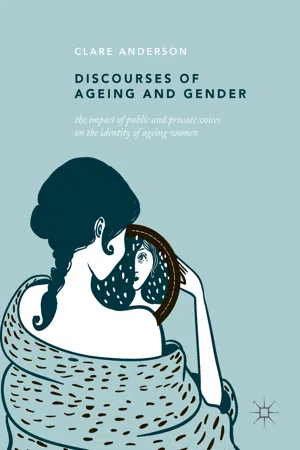
There is a moment, Frida Furman argues, when ‘the aging female body comes into deep conflict with cultural representations of feminine beauty’ (1997: 5), when as Kathleen Woodward comments, ‘all mirrors are potentially threatening’ (1991: 67). A consequence of the tension between the prevailing model of normative femininity (i.e. based on youth/beauty/sexual desirability) and the ageing female body is that there is no accepted linguistic or visual trajectory for accommodating age and ageing within the cultural rules governing the performance of femininity. By way of illustration, in a recent interview in The Sunday Times (31 December 2017), the classicist Mary Beard, whose struggles with visibility are well documented (and discussed more fully in Chapter 8) characterises the female experience as ‘either you’re ribbed for looking a mess or you’re attacked for being vain’. Indeed, what the cultural mirror reflects back to the collective gaze, often via the media as the lens of cultural attitudes, renders the ageing female body, paradoxically, ‘both invisible and hypervisible’ (Woodward 1999: xvi). I take the notion of the many-faceted mirror as a leitmotif for this book: my central focus is the investigation of the language used about and also by, ageing women, as it is reflected through the cultural ‘labyrinth of distorting mirrors’ (Hazan 1994: 19). In this introductory chapter I outline in broad terms the nature and scope of the book and the questions I will address. I begin by briefly describing the cultural context which gives the book—and the research on which it is based—its raison d’être, and which has shaped my thinking both as a researcher and as an older woman. I develop this discussion more fully in Chapter 2.
My study focuses on two discourse domains and the relationship between them. The first is discourse at a macro level—the public voices—exemplified by the following quotation which shows how ageing womanhood is reflected in the cultural mirror: the social commentator Rush Limbaugh’s public speculation about Hillary Clinton,
“Does America… want to watch a woman of Mrs Clinton’s age, age before their eyes in office?” (Rush Limbaugh, quoted in The Sunday Times, 15 February 2015)
The second is language used at an individual level—the private voices—illustrated by this comment from a mid-life female respondent in one of the interviews I collected for this study:
…. I feel they’re [sc. colleagues] all so much younger and I’m kind of irrelevant but I do find outside that I notice quite a lot of attractive older men with white hair and I think there didn’t used to be all these men with white hair… but I can see that you just didn’t even see those people…. you become quite invisible. (Female respondent, aged 56)
She expresses the complex action of the subjective gaze, simultaneously turning inwards in the evaluation of self and outwards in its judgements of others. Both quotations highlight the unease generated in public as well as private domains by ageing—and by the ageing female body in particular—and much of this collective unease is rooted in the notion of visibility.
A central argument I make in this book is that the greater visibility of older/ageing women reveals a fundamental paradox at the heart of cultural attitudes towards ageing women. Even as it gives greater prominence to older women, current culture struggles to accommodate the reality of the ageing female body, as illustrated in the quotation about Clinton; the comments of the 56 year-old woman shown above suggests that there is also a profound effect on individual experience of ageing. The ambivalent nature of the visibility conferred on older women comes at a time when there is arguably a greater platform for older women in professional and public life than ever before; a changing social context has reconceptualised the midlife period of the lifecourse, pushing back its chronological boundaries (see Chapter 2). As a consequence the trajectories of women’s lives may be changing; for example, a greater number of women may be working for longer so that more older women are remaining in the workplace, some of them occupying more senior/high status positions—although figures on representation of women at board level suggest that gender equality is still far from being achieved.1 Yet still, the issue of the visibility conferred on ageing women, particularly by the media, remains deeply problematic. At a macro level, the public voices of mass-mediated communication remain deeply ambivalent about the ‘cultural work the aging, gendered, body is expected to perform’ (Wearing 2007: 278).
Hurd Clarke and Griffin, in their study on beauty work as a response to ageing, observe that for the women in their study:
perceptions of invisibility were grounded in their acute visibility as old women. The possession of physical markers of ageing rendered the women more visible as objects of discrimination… (2008: 669)
There is a growing acknowledgement that this phenomenon affects many midlife women, as can be seen in the developing genre of autobiographical accounts of women’s midlife experiences e.g. Jane Shilling’s (2012) The Stranger in the Mirror , and India Knight’s (2014) In Your Prime . Furthermore, recent works such as Jeanette King’s (2013) Discourses of Ageing in Fiction and Feminism: The Invisible Woman and Helen Walmsley-Johnson’s (2015) personal account The Invisible Woman: Taking on the Vintage Years suggests an increasing determination to tackle the fraught issue of older women’s in/visibility. Despite this increased engagement with women’s ageing, as King also argues, historically there has been a lack of attention to these issues by feminist theorists—Germaine Greer’s (1991) classic text The Change being one of few exceptions. Whilst there may be greater representation of older women in news and media discourses, it is often ambivalent and contradictory, expressed through linguistic and visual strategies designed to encode covert negative evaluations, as I discuss in Chapter 5. Robin Lakoff wrote about the value to be gained from exploring ‘the language used by and about women’ (Lakoff 1975 [2004]: 37); equally important is the far less well-explored area of ‘the language used by and about ageing women’ (my italics).
Kathleen Woodward observes that ‘along with race, gender and age are the most salient markers of social difference’ (1999: x). However, theorisations of ageing as a socio-cultural (rather than a medical/biological) phenomenon have lagged significantly behind critical engagement with gender (see Woodward 1999, 2006; Twigg 2010). Consequently, the reciprocal impact of gender and age(ing) at a linguistic level remains under-investigated and under-theorised, so my work highlights a genuine gap in terms of academic enquiry. In the broader fields of gender and language/linguistics there is an absence of work which looks specifically at older women (as opposed to women in general), and most significantly, of studies which address (older) age as well as gender. Eckert’s (1997) work on how age intersects with individual language practice through the lifecourse does not factor in gender, and papers in the Journal of Women and Aging , one of very few journals focusing on women’s ageing, offer some perspectives on language but in the context of social/psychological/medical/attitudinal aspects of ageing, rather than being specifically linguistic in orientation.2 Furthermore, within the expanding field of embodiment theory there is also a call for a greater emphasis on empirical insights to counterbalance the priority given to theoretical perspectives, although there is little research that to date, focuses on ‘the voices that emanate from bodies themselves’ as Nettleton and Watson observe (1998: 2). Yet the interview data gathered for my study is a powerful testament to the importance of listening to how the real voices of lived experience construct the relationship between gender and age/ing—‘the often unexamined links’ (Wearing 2007: 284)—in order to understand the heterogeneous nature and complex personal impact of ageing in social, emotional and physical terms. This book, and the research on which it is based, fits into this gap by exploring two significant but under-researched intersections: the point where age and gender as identity categories collide ideologically, socially and linguistically; and equally importantly, the often problematic relationship between public discourses and private voices—the complex terrain where different power agendas, individual desires and cultural expectations come together. In focusing on the reciprocal mi...
Table of contents
- Cover
- Front Matter
- 1. Introduction
- 2. Cultural Context
- 3. Analytic Frameworks
- 4. Public Voices: Skincare Advertising and Discourses of “Beauty”
- 5. Public Voices: The Media Mirror
- 6. Private Voices: Talking About Ageing
- 7. Private Voices: Ageing in the Mirror
- 8. Transgressive Women: Celebration and Censure
- 9. Conclusions and Implications
- Back Matter
Trusted by 375,005 students
Access to over 1.5 million titles for a fair monthly price.
Study more efficiently using our study tools.
Frequently asked questions
Yes, you can cancel anytime from the Subscription tab in your account settings on the Perlego website. Your subscription will stay active until the end of your current billing period. Learn how to cancel your subscription
No, books cannot be downloaded as external files, such as PDFs, for use outside of Perlego. However, you can download books within the Perlego app for offline reading on mobile or tablet. Learn how to download books offline
Perlego offers two plans: Essential and Complete
- Essential is ideal for learners and professionals who enjoy exploring a wide range of subjects. Access the Essential Library with 800,000+ trusted titles and best-sellers across business, personal growth, and the humanities. Includes unlimited reading time and Standard Read Aloud voice.
- Complete: Perfect for advanced learners and researchers needing full, unrestricted access. Unlock 1.5M+ books across hundreds of subjects, including academic and specialized titles. The Complete Plan also includes advanced features like Premium Read Aloud and Research Assistant.
We are an online textbook subscription service, where you can get access to an entire online library for less than the price of a single book per month. With over 1.5 million books across 990+ topics, we’ve got you covered! Learn about our mission
Look out for the read-aloud symbol on your next book to see if you can listen to it. The read-aloud tool reads text aloud for you, highlighting the text as it is being read. You can pause it, speed it up and slow it down. Learn more about Read Aloud
Yes! You can use the Perlego app on both iOS and Android devices to read anytime, anywhere — even offline. Perfect for commutes or when you’re on the go.
Please note we cannot support devices running on iOS 13 and Android 7 or earlier. Learn more about using the app
Please note we cannot support devices running on iOS 13 and Android 7 or earlier. Learn more about using the app
Yes, you can access Discourses of Ageing and Gender by Clare Anderson in PDF and/or ePUB format, as well as other popular books in Langues et linguistique & Linguistique. We have over 1.5 million books available in our catalogue for you to explore.