The valuable context offered in this book for discussions about ethnicity in contemporary China will be of interest to China scholars, ethnologists, and political scientists.
- English
- ePUB (mobile friendly)
- Available on iOS & Android
eBook - ePub
About this book
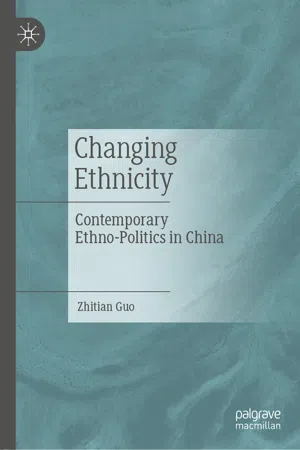
This book investigates the changes in ethnicity in contemporary China by examining the Yi in Liangshan. With a particular focus on cadres, a seemingly highly politicized group, this book tries to contribute to the discussion of ethnopolitics in China and the politicization of ethnicity. This study categorizes cadres into three generations and discovers that for the veteran echelon ethnicity is related to an emotional expression, for the second generation it is more about a political discourse and competitions, and for the third generation it takes the form of symbolic ethnicity that resonates in everyday life. Changing ethnicity of Yi is a miniature portrayal of the social development in China and demonstrates the interplay between ethnicity and ethnopolitics and how these interactions are expressed in people's everyday life.
Information
© The Author(s) 2020
Zhitian GuoChanging Ethnicityhttps://doi.org/10.1007/978-981-13-9491-1_11. Introduction: A Politicised Ethnicity?
Zhitian Guo1
(1)
School of Sociology, Central China Normal University, Wuhan, China
Zhitian Guo
China is a “multi-ethnic nation” (Fei 1989: 1), consisting of fifty-six ethnic groups. Although historical archives have shown that different ethnic groups have been living in China for over a thousand years, the official categorisation of fifty-five ethnic minority groups and other unidentified groups was only determined in 1985. Because of this official categorisation process led by the government, as well as other socialist campaigns experienced by all Chinese people, politics became an important variable in the investigations of Chinese ethnic groups.
Recent conflicts observed in ethnic minority regions and Han-dominated cities seemed to prove that Chinese ethnic issues are quite complicated. Zang (2015) listed several riots in Ethnicity in China, including the Kashgar attack in August 2008, the Hotan attack in July 2011 and the unrest in Bachu County in April 2013 which were not widely reported. People recently observed that some supermarkets in Beijing opened special checkout lanes for Hui Muslims, which caused overwhelming criticism. There were various stories about how Uyghurs selling nut cakes in the cities cheated local inhabitants and threatened and forced them into buying their cakes at exceptionally high prices. Some stories may be exaggerated and some were made up by netizens, but people’s reactions to these stories suggested a relatively intense relationship between the Uyghurs in the cities and other local inhabitants. It seemed that there was an increase in the terrorist risk in the Chinese borderlands, and there were growing criticisms of Chinese ethnic policies, especially the “less arrest or death penalty and more leniency”1 policy put forward in 1984.
The Yi in Liangshan in southwest China may not be as well-known as the Tibetans and the Uyghurs, who have their own religious beliefs and are frequently mentioned by many Western scholars when discussing separatist movements or political oppression, nor are they as frequently mentioned as the Mongolian and Manchu, who established dynasties that were not ruled by Han. However, as one of the largest ethnic minority groups, and with a population of over eighty million all over China, the Yi cannot be overlooked when discussing Chinese ethnic minorities. As early as 1882, the British orientalist and traveller Edward Colborne Baber described this group of people as being different from the Han people:
They are far taller race than the Chinese; taller probably than any European people…are almost without exception remarkably straight-built, with slim, but muscular limbs; many of them are robust but anything approaching the pork-fed obesity of an affluent sedentary Chinaman seems unknown. (Baber 1882: 60–61)
Later ethnologists and anthropologists showed great interest in traditional Yi society, which was defined as slave society according to the Marx’s theory of social development, and researched various aspects of the traditional Yi society.
However, people’s recent image of the Yi was predominantly related to poverty, drugs, and HIV/AIDS, especially those who live in Liangshan Yi Autonomous Prefecture, the largest area where Yi people live in compact communities. There are 17 counties (cities) in Liangshan Yi Autonomous Prefecture, among which 11 counties are listed in the key programmes of the nation’s poverty reduction efforts. In 1999, the Anti-Drug Committee of Liangshan Prefecture marked nine counties (cities) that were severely stricken by drugs; with the exception of Xichang, all the remaining eight counties were densely Yi populated (Ma 2000). HIV/AIDS also seemed to be associated with the Yi people. Some Yi migrant workers I met during my fieldwork in Liangshan mentioned that once the managers learnt they were Yi from Liangshan, they turned down their job applications immediately. Another respondent who worked in the blood collection station in Xichang said that she refused to collect the blood from people who were from the “east five counties2” of Liangshan.
Because of these negative impressions, many seem to have forgotten that the Yi were among one of the earliest minority groups that collaborated with the Chinese Communist Party. In May 1935, the vanguard of the Red Army reached Mianning County during the Long March, attempting to go through the Yi region peacefully and, at the same time, promoting the CPC’s ethnic policies. Upon hearing the calls from the Red Army and simultaneously being petrified by the noise and power of machine guns and submachine guns, Guoji Xiaoyedan, the headman of the Guoji clan, came to meet Liu Bocheng and wanted to form an alliance with the Red Army. In order to secure the deal with General Liu that the Red Army would not attack the Guoji Clan, and that the Guoji Clan would in turn help the Red Army pass through their territory safely, he proposed that General Liu drink a cup of wine containing cock’s blood with him, which was the traditional Yi way of building trust. Liu Bocheng did as he requested, sent him a red flag with “the Guji3 Detachment of Chinese Yi Red Army” emblazoned on it, and Xiaoyedan fulfilled his commitment. The Yi people in Liangshan Prefecture quietly celebrated the 80th anniversary of “Yihai Alliance (Yihai jiemeng)” in 2015. In commemoration of this event, which symbolised the unification of the Han and the Yi, the prefectural government organised a series of activities including revisiting places that the Red Army had passed during the Long March,4 holding art and calligraphy exhibitions,5 and performing the opera that was created to pay tribute to the alliance.6
Xichang is the capital city of Liangshan Prefecture and, in the city centre, there is a statue of General Liu Bocheng and the Yi headman Guoji Xiaoyedan standing side by side with each holding a wine cup, to record the moment when the Red Army and the Guoji clan formed an alliance. Even if the celebration had not taken place, people would still remember this significant event. When I took a taxi to meet one of my respondents, I chatted with the taxi driver who was born in Xichang about thirty years ago. He was Han, and did not have much knowledge about the Yi even though he had lived in the city for nearly thirty years and ethnic cultural traits could be observed almost everywhere. When we passed the statue, he said: “This statue has always been here. Nobody dares to tear it down even if it is causing problems for the traffic. It is a symbol of ethnic unification. It is written in the school textbook, that the headman of Yi collaborated with General Liu which contributed to the final victory of the Red Army’s Long March”. I noticed that he took Guoji Xiaoyedan to be the headman of Yi as an entire group instead of being the headman of one specific clan, and I therefore asked him if he knew this. He paused for a few seconds and replied: “No, I don’t. But is that important? Guoji represents the Yi, Liu Bocheng represents the Party and the Han, and that’s all”.
It seems that politics go hand in hand with the discussion of ethnic issues, and there have been heated debates about politicised ethnicity in China. Ma Rong is one of the leading scholars who suggested that, instead of following a politicising orientation of ethnic policies, the government should carry out culturalising policies (Ma 2007a). He argued that ancient Chinese dynasties had always performed culturalisation policies, and that it was only after 1949 that China started to adopt the model of the USSR (Ma 2007a). Ma stressed the importance and necessity of distinguishing between “nation” (“minzu” in the phrase “zhonghua minzu”) and “ethnic groups” (“minzu” in “shaoshu minzu”), because “nation” is a political entity with a territorial boundary that human groups identify with, while “ethnic groups” are groups of people that exist within the nation, and have their own cultural, physical and other non-political features (Ma 2007b). Based on this distinction, he further suggested that there should be unification at state level, which includes the unification of economic, social, political and cultural fields, and pluralism at ethnic group level that also covers different fields (Ma 2012).
Many other social scientists shared similar views. Hu and Hu (2011) claimed that the current ethnic policy is still the legacy of the former Soviet Union and seeks to solve problems by politicising ethnic issues, which might lead to the collapse of the Chinese nation state. By comparing the Soviet Union’s model and the American model of nation states, they argued that thorough changes of policies at political, economic, cultural and societal levels are required in order to build a nation without ethnic minorities; all ethnic groups, including the Han, ought to be integrated into a sole ethnic group and form a national Chinese identity. Xie further developed Ma’s theory, and suggested that it would be necessary to build a “Chinese culture” that would include identification with the “Chinese nation”, as well as moral principles, values, beliefs and so on that are shared by all the people (Xie 2014: xxvii).
Ma’s theory was also criticised by his academic colleagues. Wang Xien stressed that it was difficult in practice to distinguish strictly between “nation” and “ethnic groups”, because these terms were so ingrained in people’s minds that “they are not just widely used as policy terms and social language, but also have been accepted among scholars” (Wang 2014: 132). Hao Shiyuan criticised Ma’s proposition of depoliticising ethnicity because he believed that ethnic issues were so multifaceted that it was difficult to identify if they were “politicisation” or “acculturation” (Hao 2014: 40). He also suggested that politicising ethnic policies might not be the main reason for the disintegration of the former Soviet Union; he proposed that the promotion of great-Russian nationalist chauvinism and the failure to implement policies promoting ethnic equality were both important factors. Chen Jianyue further emphasised that all ethnic issues were essentially political, and without political platforms problems could not be solved (Chen 2014).
The purpose of this study is not to evaluate different orientations of Chinese ethnic policies, but it will take the state as the most important shaping power of the changes to ethnic groups. Because different ethnic groups in China each have their uniqueness, this study will only examine the Yi in the Liangshan Prefecture. The study will shed light on the ethnic cadres who are normally regarded as the intermediaries between the st...
Table of contents
- Cover
- Front Matter
- 1. Introduction: A Politicised Ethnicity?
- 2. Changing Ethnicity: Ethnicity, Everyday Life and Social Change
- 3. “Vat jjy vat” and “kat shax shax”: Socialist Campaigns, Han Neighbours and Yi Ethnicity
- 4. The Rise of Competition and a Politicised Ethnicity: Ethnicity and the Demarcation of the Prefecture
- 5. Pride and Prejudice?—The Stories of Third-Generation Cadres
- 6. Changing Ethnicity
- Back Matter
Trusted by 375,005 students
Access to over 1.5 million titles for a fair monthly price.
Study more efficiently using our study tools.
Frequently asked questions
Yes, you can cancel anytime from the Subscription tab in your account settings on the Perlego website. Your subscription will stay active until the end of your current billing period. Learn how to cancel your subscription
No, books cannot be downloaded as external files, such as PDFs, for use outside of Perlego. However, you can download books within the Perlego app for offline reading on mobile or tablet. Learn how to download books offline
Perlego offers two plans: Essential and Complete
- Essential is ideal for learners and professionals who enjoy exploring a wide range of subjects. Access the Essential Library with 800,000+ trusted titles and best-sellers across business, personal growth, and the humanities. Includes unlimited reading time and Standard Read Aloud voice.
- Complete: Perfect for advanced learners and researchers needing full, unrestricted access. Unlock 1.5M+ books across hundreds of subjects, including academic and specialized titles. The Complete Plan also includes advanced features like Premium Read Aloud and Research Assistant.
We are an online textbook subscription service, where you can get access to an entire online library for less than the price of a single book per month. With over 1.5 million books across 990+ topics, we’ve got you covered! Learn about our mission
Look out for the read-aloud symbol on your next book to see if you can listen to it. The read-aloud tool reads text aloud for you, highlighting the text as it is being read. You can pause it, speed it up and slow it down. Learn more about Read Aloud
Yes! You can use the Perlego app on both iOS and Android devices to read anytime, anywhere — even offline. Perfect for commutes or when you’re on the go.
Please note we cannot support devices running on iOS 13 and Android 7 or earlier. Learn more about using the app
Please note we cannot support devices running on iOS 13 and Android 7 or earlier. Learn more about using the app
Yes, you can access Changing Ethnicity by Zhitian Guo in PDF and/or ePUB format, as well as other popular books in Política y relaciones internacionales & Negocios internacionales. We have over 1.5 million books available in our catalogue for you to explore.