On 15th February 2003, two million people marched in the streets of London to call on the British government not to go to war with Iraq. Though Britain did enter war, the movement did not rest in defeat. This book tells the story of what happened behind the scenes of this extraordinary mass movement, looking specifically at the political relationship between Muslim and leftist activists.
Crisis narratives about Muslims assume that they are only engaged with sectarian communalist forms of identity politics or that their supposed religious and social conservatism is incompatible with progressive values. Through telling this story, Massoumi looks closely at the role of identity politics within social movements, considering what this means in practice and whether we can meaningfully speak of identity politics. Arguing that identity politics can only be understood within the context of a wider social and political structure, this book analyses the conditions through which Muslim and leftist engagement emerges within this movement, and highlights the decisive leadership of Muslim women.
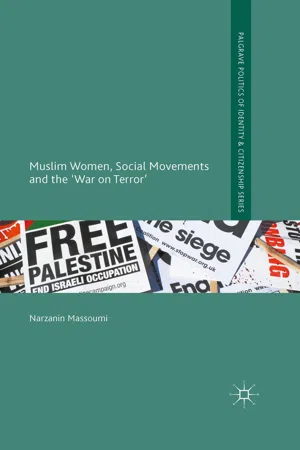
- English
- ePUB (mobile friendly)
- Available on iOS & Android
eBook - ePub
Muslim Women, Social Movements and the 'War on Terror'
About this book
Information
1
Introduction
The British anti-war movement made its place in history. On 15 February 2003, 2 million people marched in the streets of London to call on the British government not to go to war with Iraq. Though Britain did enter war, the movement did not rest in defeat. As Ziauddin Sardar commented at the time: ‘[T]his march against war on Iraq means much more. It is the coming of age of a younger, more assertive and politically aware generation of Muslims’ (Ziauddin Sardar, The Observer, 16 February 2003).
This book tells the story of what happened behind the scenes of this extraordinary mass movement. I look specifically at one aspect that emerged from this movement: the formation of a political relationship between some Muslim groups and leftists. I felt a powerful analogy of this relationship occurred when I saw Salma Yaqoob, a hijab-wearing Muslim woman, address a room packed with well over a thousand activists. She ended her speech with two quotes: one from the Qur’an and the other from the leader of the Russian revolution, Vladimir Lenin. It felt like the face of the British left was about to change for the good.
Ever since Salman Rushdie published the controversial Satanic Verses, which angered Muslims across the world, British Muslims had mostly mobilized separately from the established left. The post September 11th British anti-war movement marked the beginning of something new. Muslim organizations joined far left groups in creating a new movement that opposed the US and UK led wars in Afghanistan and Iraq. The movement grew rapidly, challenging a wider narrative that formed part of the ‘War on Terror’ agenda by incorporating campaigns against anti-terror legislation and Islamophobia. Yet it was the Israeli bombardment of a Palestinian refugee camp in 2002 that cemented the relationship between Muslims and the left, sparking the beginning of a political formation that would mobilize millions of people on to the streets.
While many leftist movement leaders celebrated the involvement of Muslims in the movement (German and Murray, 2005: 57) others suggested the alliance betrayed leftist values, claiming that certain Islamic practices and values were incompatible with cornerstone leftwing values of socialism, gender equality, secularism, and the rights of sexual minorities (Glynn, 2012). When Salma Yaqoob, a Muslim woman, was elected as the chair of Birmingham Stop the War Coalition, some members of far left groups raised objections, claiming that her Islamic beliefs would undermine leftists’ commitment to women’s and sexual minority rights.
This book examines the political relationship created between Muslim and leftist activists. Crisis narratives about Muslims assume that they are only engaged with sectarian communalist forms of ‘identity politics’ (Malik, 2007) or that their supposedly religious and social conservatism is incompatible with progressive values. It is within the context of such debates that I look closely at the role of so-called ‘identity politics’ within social movements – considering what this actually means in practice. Can we even meaningfully speak of ‘identity politics’?
Aims of the book
I contribute to two areas of political sociology: social movement theory and critical theories of multiculturalism. Analytical perspectives on social movements have remained separate to normative perspectives in theories of multiculturalism, or what has more broadly been referred to as ‘identity politics’. This is despite the fact that there is much overlap in their empirical focus. The women’s movement, black power and gay and lesbian movements, among others which developed in the late 1960s and 1970s, challenged the universal conceptions of citizenship in liberal democracies. These movements were among others of an era – like the peace and environmental movements – that no longer fit with the class-based identification of previous popular movements. Yet the social movement academic literature, which seeks to explain the nature and development of these movements (McAdam, 1982; Melucci, 1989; Tilly, 1978), is quite set apart from the normative perspectives that argue that these challenges are necessary (Fraser, 1997; Modood, 2007; Young, 1990).
A distinction can be drawn between European and American traditions of social movement theory. European social movement theory, Introduction partly influenced by a Marxist/Hegelian philosophy of history are typically concerned with the structure and types of society in which social movements emerge (Crossley, 2002: 10). In the European tradition, there is an assumption that societies centre on particular social conflicts that generate particular movements (Melucci, 1989; Touraine, 1981). Social movement theories in this tradition focus on questions related to the historical role particular movements played within a particular society. New social movement theorists (Melucci, 1989; Touraine, 1981) examine clusters of movements in the 1960s within wider structural changes in society (namely post-industrialism). The problem with the new social movement approach, however, was that they assumed a simplistic relationship between the structure of society and the formation of particular types of social movements. Bold claims about the ‘newness’ of these movements have not stood up to empirical enquiry.
In contrast, the American tradition of social movement theory, despite also being indebted to Marx (Crossley, 2002: 10; for example Gamson, 1990; McAdam, 1982; Tilly, 1978), developed in a far more empirical direction. These social movement theorists were far more concerned with the dynamics of movement organization (Crossley, 2002: 167). This meant focusing on the ‘how’ of social movement activity: investigating the role of the political environment in which the movement takes place (McAdam, 1982); processes of social movement organization and networks (Evans, 1979; McCarthy and Zald, 1977) and the ways in which meaning is constructed (Gamson, 1992; Snow and Benford, 1988). This work developed some important empirical studies of social movements. However, there is a tendency for a bias towards process, which can neglect the longstanding social relations and systems of domination that can also shape the development of social movement activity (Morris and Braine, 2001: 24). These studies fail to offer a satisfactory theory of the grievances that give rise to social movements. They neglect important links between forms of domination in society and the nature and development of political struggle.
Identity claims need to be contextualized within a wider social and political structure. Nancy Fraser (2013) in her analysis of second-wave feminism, illustrates how the claims made by feminist movements vary according context. Within state-managed capitalism – the claims of second-wave feminism were anti-systemic; they challenged the paternalist authority of the time. However, within a context of neoliberalism, feminist claims lost some of this oppositional value. The rise of neoliberalism changed the terrain on which second-wave feminism operated: ‘Aspirations that had a clear emancipatory thrust within the context of state-organized capitalism assumed a far more ambiguous meaning in a neoliberal era’ (Fraser, 2013: location 4951). Feminist critiques of economism, androcentrism, and the paternalist logic of state-managed capitalism, took on a different meaning when welfare states were under attack from the free-market (Fraser, 2013).
An understanding of the relationship between forms of domination and forms of social movement need to be integrated more clearly into social movement analysis (Hetland and Goodwin, 2013; Morris and Braine, 2001). Yet, rather than assuming the emergence of particular ‘grievances’, a political analysis is needed.
The movement against the ‘War on Terror’ went beyond single issue campaigning to take an anti-imperialist orientation. I offer an analysis of the political conditions that give rise to particular forms of Muslim activism within this movement. I focus on the specific features of social movement organizations, types of opposition, and concrete interactions with the state, that inform the creation of political relationships between leftist and Muslim activists and organisations.
British Muslim activism developed a distinctly religious character in the late 1980s. Some scholars interpret the emergence of a religious Muslim leadership as the result of growing Muslim agency, which challenged the dominant basis of the race equality framework at the time (Meer, 2010; Modood, 1990, 2005, 2009). Others perceived it as a state-sponsored attempt to co-opt sections of ethnic minority leadership, fragmenting a more critical anti-racist politics, and resulting in a more conservative generation of political leadership amongst ethnic minorities (Kundnani, 2007; Sivanadan, 1990). In any case, this distinctly religious character led to tensions with the existing anti-racist movement, feminist political mobilizations, and the left in general. Long-standing frictions between anti-racism and feminism did not simplify these tensions, which mounted during the Rushdie Affair and the formation of Women Against Fundamentalism.
The ‘War on Terror’ had an important influence on these existing dynamics. Muslim opposition to the Iraq War broke down the relationship between the political establishment and key sections of the existing Muslim leadership. Following the 7 July 2005 London bombings, the government began to seek out a range of new Muslim interlocutors. This was pursued through highly selective and disciplinary mechanisms, which marginalised certain sections of Muslim civil society. At the same time, tensions between the state and some Muslim organizations, groups and individuals opened up political possibilities for new formations – including alliances between leftists and Muslims in the anti-war movement.
As I will discuss throughout the book, gender is an important dynamic in this movement. Feminist scholars of social movements have argued that all social movements are gendered (Einwohner, 1999; Kuumba, 2001; Taylor, 1992). Gender is a key organizing principle in social life; gender guides social interactions and is the basis of stratification and structural inequalities. This means that gender operates in social movements at a number of stages and levels. Gender can shape movements in the initial stages of emergence or in processes of mobilization and recruitment (Rodriguez, 1994). Gender can also shape organizational structures and movement roles (Neuhouser, 1995; Robnett, 1997).
The movement against the ‘War on Terror’ is a gendered-integrated movement – a social movement that engages both men and women in a single objective that is not gender-related (West and Blumberg, 1990). Research on such movements has highlighted a complex pattern of social movement organization and leadership divisions in gendered terms (Kuumba, 2001; Robnett, 1997). In this book, I consider the role of gender in two ways. I look at the leadership of Muslim women within the anti-‘War on Terror’ movement as well as the formation of political consciousness of grassroots Muslim women activists in the movement.
As feminist scholars of social movements argue, social movements can be sites for ‘gendering consciousness’ (Craske, 1993). These scholars argue that social resistance often fosters an awareness of gender roles and relations even when the targets or movement objectives are not focused on gendered related issues. For example, both Rodriguez (1994)’s study on Barrio women and Neuhouser (1995)’s study on Brazilian urban activist women noted the development of a gender identity that transformed further into a feminist identity. They highlighted how gender ideologies and relations changed during the course of the movement; women were politicized and came to see their interests as women (Kuumba, 2001).
I argue that exploring political consciousness can give insight into wider structures of domination. Piven and Cloward (1977) highlight how subordinated groups:
[E]xperience deprivation and oppression within a concrete setting, not as the end result of large and abstract processes and it is the concrete setting that molds their discontent into specific grievances against specific targets. Workers experience the factory, the assembly line, the spies and the guards, the owner and the paycheck. They do not experience monopoly capitalism. People on relief experience the shabby waiting rooms, the overseer or the casework, and the dole. They do not experience American social welfare policy … . In other words, it is the daily experience of people that shapes grievances, establishes the measure of their demands, and points out the targets of their anger.
(1977: 20–21)
In examining political consciousness, it is not simply a matter of seeking to understand ‘isolated instances of wrongdoing or frustration’ (Nilsen and Cox, 2013: 73). Political consciousness gives ‘clues to underlying structures and relationships which are not observable other than through the particular phenomena or events they produce’ (Wainwright, 1994: 4 cited by Nilsen and Cox, 2013: 73). And so, as Nilsen and Cox suggest:
These structures and relationships can be made explicit when movement participants combine and extend their ‘fragmented knowledge’ in ways that enable them to develop ‘a better understanding of the social mechanisms at work, so as to direct their efforts in order that their intentions might be more efficiently fulfilled’.
(Wainwright, 1994: 108 cited by Nilsen and Cox, 2013: 74)
Methodology
I came to this study though my own personal involvement in this movement. There is no doubt that this insider status gave me a number of advantages. Not only was I able to utilize a number of contacts to help secure interviews but participants trusted me.
Yet there were some disadvantages too. My loyalty and affiliation to the movement, made it hard to keep a distance; knowing some participants personally made criticism feel like a betrayal. Scholars have theorized extensively about how to contend with the unease of power relations emerging between the researcher and those being researched (Harding, 1987; Smith, 1986; Stanley and Wise, 1983).
Alain Touraine (1981) deals with this directly by developing the method of ‘Sociological intervention’. By making his intentions explicit, he deals with the difficulty of reconciling the power inequality in an almost Leninist war. Taking a position of leadership towards the movement, Touraine’s methodology seeks to help activists within social movements understand their role as social agents in history, in order to further the development of the social movement (Touraine, 1981: 150–183).
I had more humble intentions with this project. It did not feel appropriate to tell experienced activists how they should be organizing politically. I adopted an approach that sits closer to the methodological practices of Alberto Melucci (1989). Instead, he seeks to examine the interplay between competing standpoints, without valorizing one position over others (237). I wanted participants to feel confident to express themselves in the ways they desired. The movement was diverse, involving different factions and ideological perspectives; I wanted to be open to hearing stories from these different perspectives.
To achieve this, I recognize the myriad levels of leadership and roles of participants (Morris and Staggenborg, 2004), and examine the social and symbiotic relationship between ‘leaders’ and ‘followers’. Within various contexts, I explore the different levels of participation in the movement, and the relationship between different elements of the movement.
Participants and research context
Feminist social movement scholars have highlighted how the difference between ‘leaders’ and ‘followers’ is often said to reflect the dichotomistic logic of a gendered-division of labour. Leaders roles are viewed as the most important in generating support for the movement and drawing in new participants. ‘Followers’ and ‘grassroots activists’ of the movement are in contrast viewed as the ‘workers’ who operate under the dictates of the leaders (Kuumba, 2001: 79).
In gender-integrated movements, patriarchal assumptions and organisation within society means that men are more often than women in formal leadership positions within social movements. Yet, social movement scholars have shown that even when that is the case, women play important leadership roles in many ways that often goes unacknowledged in historical and social analysis of social movements. Instead of privileging the official leaders, and relegating the rest, Robnett (1997)’s study of the civil rights movement highlighted how a reconsideration of leadership can help understand the myriad ways in which women play leadership roles within social movements.
Recognizing such diversity in movement leadership, I examined the variety of forms of movement participation. I interview both self-identified Muslim leaders as well as non-Muslim leftists activists who represented a broad range of organizations within the movement: Stop the War Coalition (StWC), Muslim Association of Britain, the British Muslim Initiative, Just Peace, Respect, Red Pepper, Helping Households Under Great Stress, Cage, Act Together, Women for an Independent Iraq, Inquest, Newham Monitoring Project, City Circle, Friends of Al Aqsa and Palestine Solidarity Campaign (See Appendix 1). Where possible I have used the names of participants. However, some of the discussions were contentious in their reflections on internal political divisions within the movement. For this reason, in such instances, I have maintained requests for anonymity for participants who did not want to be mentioned by name.
How social movements represent their messages publicly can be vital to their success. I analyzed how movement spokespeople represent the movement within the Guardian ‘Comment is free’ blog. I argue that this does not happen in isolation but in interaction with a range of other social actors. The Guardian is a British left-leaning newspaper, and ‘Comment is free’ is a key feature of the newspaper’s website, an online blog that hosts a series of editorial commentaries from journalists, academics and a range of civil society actors. Yet, the Guardian ‘Comment is free’ blog was also a space of political contention – an arena in which the movement’s key opponents mobilized claims that challenged anti-war activists.
Finally, I carried out focus groups (Gamson, 1992; Melucci, 1989) with Muslim women activists on British university campuses (see Appendix 2). In contrast to the generally elite section of the movement, writing in the Guardian, th...
Table of contents
- Cover
- Title Page
- Copyright
- Contents
- Acknowledgements
- 1. Introduction
- 2. Identity Politics and Social Movements
- 3. Background: Muslim Political Mobilizations in Britain
- 4. The Anti-War Movement: New Alliances, Old Challenges?
- 5. Opposing Movements and Islamophobia in The Guardian Comment Is Free
- 6. ‘Talking Back’ to the Gendered ‘War on Terror’
- 7. Towards an Oppositional Consciousness?
- 8. Conclusion
- Appendices
- Notes
- Bibliography
- Index
Trusted by 375,005 students
Access to over 1.5 million titles for a fair monthly price.
Study more efficiently using our study tools.
Frequently asked questions
Yes, you can cancel anytime from the Subscription tab in your account settings on the Perlego website. Your subscription will stay active until the end of your current billing period. Learn how to cancel your subscription
No, books cannot be downloaded as external files, such as PDFs, for use outside of Perlego. However, you can download books within the Perlego app for offline reading on mobile or tablet. Learn how to download books offline
Perlego offers two plans: Essential and Complete
- Essential is ideal for learners and professionals who enjoy exploring a wide range of subjects. Access the Essential Library with 800,000+ trusted titles and best-sellers across business, personal growth, and the humanities. Includes unlimited reading time and Standard Read Aloud voice.
- Complete: Perfect for advanced learners and researchers needing full, unrestricted access. Unlock 1.5M+ books across hundreds of subjects, including academic and specialized titles. The Complete Plan also includes advanced features like Premium Read Aloud and Research Assistant.
We are an online textbook subscription service, where you can get access to an entire online library for less than the price of a single book per month. With over 1.5 million books across 990+ topics, we’ve got you covered! Learn about our mission
Look out for the read-aloud symbol on your next book to see if you can listen to it. The read-aloud tool reads text aloud for you, highlighting the text as it is being read. You can pause it, speed it up and slow it down. Learn more about Read Aloud
Yes! You can use the Perlego app on both iOS and Android devices to read anytime, anywhere — even offline. Perfect for commutes or when you’re on the go.
Please note we cannot support devices running on iOS 13 and Android 7 or earlier. Learn more about using the app
Please note we cannot support devices running on iOS 13 and Android 7 or earlier. Learn more about using the app
Yes, you can access Muslim Women, Social Movements and the 'War on Terror' by Narzanin Massoumi in PDF and/or ePUB format, as well as other popular books in Social Sciences & Politics. We have over 1.5 million books available in our catalogue for you to explore.