eBook - ePub
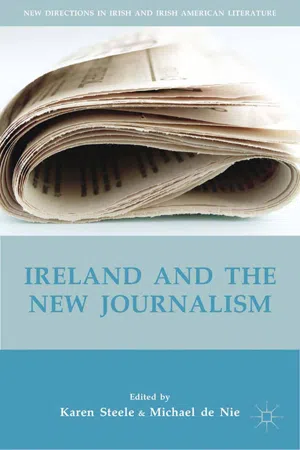
Ireland and the New Journalism
- English
- ePUB (mobile friendly)
- Available on iOS & Android
eBook - ePub
Ireland and the New Journalism
About this book
This volume explores the ways in which the complicated revolution in British newspapers, the New Journalism, influenced Irish politics, culture, and newspaper practices. The essays here further illuminate the central role of the press in the evolution of Irish nationalism and modernism in the late nineteenth and early twentieth centuries.
Information
Part I
Irish Trauma and the Roots of New Journalism
Chapter One
Ghosts and Wires: The Telegraph and Irish Space
Christopher Morash
I do not think it possible for an English reader, however powerful his imagination, to conceive the state of Ireland during the past winter, or its present condition. Famines and plagues will suggest themselves with their ghastly and repulsive incidents—the dead mother—the dying infant—the feast of cannibals—Athens—Jerusalem—Marseilles. But these awful facts stand forth as dark spots on the illuminated chronicles of time; episodes, it may be, of some magnificent epoch in a nation’s history—tragedies acted in remote times, or in distant regions—the actors, the inhabitants of beleaguered cities, or the citizens of a narrow territory. But here the tragedy is enacted with no narrower limits than the boundaries of a Kingdom, the victims—an entire people within our own days, at our own thresholds.1
This account, from Shafto Adair’s pamphlet The Winter of 1846–7 in Antrim, strikes a note that can be found in accounts of the Irish Famine of the 1840s, cutting across genres. In the reports of relief organizations, in the eyewitness accounts of landlords and agents, in the fact-finding travel narratives of writers such as Thomas Carlyle, and in editorial commentaries in newspapers such as The Nation, we find images of almost unimaginable horror produce a disturbing sense of temporal and spatial dislocation. Reports of bodies rotting by the roadsides, cannibalism, and abandoned villages conjure up, as Adair puts it, “tragedies acted in remote times, or in distant regions”; but these events are neither remote in time nor space. Instead, they are taking place “within our own days, on our own thresholds.”
This spatiotemporal disorientation experienced in Ireland in the 1840s was not purely the product of the almost unimaginable scale and sheer horror of the deaths by disease, starvation, and the emigration of the Famine. It can also be understood as an acute moment in a longer crisis, a tear in the fabric as the Irish experience of space and time underwent a prolonged and radical transformation born of a culture that was, in some respects, premodern colliding with modernity. Among the most significant drivers of that modernity were new technologies of transportation and communication—steam and the telegraph. To put this in perspective, in 1834—a decade before images began filtering in from the west of Ireland of a famine that seemed to belong to the Middle Ages or the Book of Job—the first Irish railroad opened along a stretch of commuter line from the port of Kingstown (what is now Dun Laoghaire) to central Dublin. By the eve of the Famine, in 1845, there was enough activity in railway-building in Ireland to warrant a periodical, the Irish Railway Gazette. Over the following decade—coinciding with the years of famine—a total of 840 miles of railway were built, with the concluding major piece of infrastructure, the Boyne Viaduct, opened in 1855. “Hail, Mighty Steam!,” declared the poet Robert Young on the opening of the Enniskillen Railway in 1847, “That every place/ Can time outstrip, and shorten space.”2 Only a few short miles away from the gleaming modernity of the Enniskillen line, Shafto Adair was looking out at a landscape of desolation in which vast expanses of historical time seemed to merge, and the metropolitan center seemed almost impossibly distant. Where the railway introduced a new experience of space in which distances once measured in days were now measured in hours, the disparity between Famine Ireland and London (or even Dublin or Belfast) seemed more aptly measured in centuries.
If the rapid laying of rails in the Famine years in Ireland produced a traumatic eruption of modernity in a premodern landscape, the almost simultaneous unfurling of telegraph lines multiplied the effect. Again, the development of the telegraph maps with uncanny precision the years of the Irish Famine. The iconic moment in which the telegraph went from being a scientific curiosity to becoming part of the fabric of the mediated world—the first public demonstration of Morse code—took place in 1844; that same year, the first Irish telegraph line was laid beside the Dalkey Atmospheric Railway, not far from the first Irish rail line in Kingstown. A year later, the stalks of the potato turned black in the first year of the Famine. Over the next few years, as Irish newspapers filled with reports of typhus and cholera, and as there was an exodus of the sick and the starving from the countryside, telegraph lines were laid across Ireland, often alongside the rail lines. By 1852, with workhouses still filled in parts of the western seaboard, the first undersea cable linked Howth and Holyhead, connecting Ireland and Wales, and onward to England and the rest of Europe. Only six years later, the first transatlantic line was laid, leaving from Valentia, in County Kerry; although it only operated successfully for a few months (the first permanent cable was laid in 1866), it meant that in precisely the same years that the west of Ireland seemed most remote from modernity, it was in fact more intimately connected to the rest of the world than ever before. “Thought swift flashes through the wire as the nerve, over mountain, through main,” wrote the Irish poet Thomas Caulfield Irwin, “And the Telegraph narrows the round of our World to the size of the Brain!”3 In a pamphlet published in 1856, Thomas Knox Fortescue proposed that, in the new geography of the telegraph and steamship, “Ireland will become the centre of a collection of radii, whose extremities shall be connected with every country in the Earth.”4 By 1874 (after which Ireland had experienced yet another failed harvest in 1871–1872), the submarine cables to North America in the west, and to Britain in the east, would link to a network of cable around the world spanning 650,000 miles, making it possible for a message from almost anywhere in the world to reach even remote corners of Ireland almost instantly.
Journalism was at the nexus of this collision, for in the day-to-day work of the Irish journalist the global spaces of the new telecommunications order met the challenge of an atavistic poverty just beyond the edge of vision; it was in this context that the New Journalism took shape in Ireland. This argument takes a more concrete shape when contrasting, briefly, the work of two Irish journalists of the second half of the nineteenth century: Andrew Dunlop and William O’Brien. While not exact contemporaries (O’Brien was slightly younger), the careers of the two men overlapped and, indeed, intersected for a brief period when they both worked on the same newspaper, the Freeman’s Journal. O’Brien wrote for the paper from 1877 until 1881, when he left for the Parnellite United Ireland. Dunlop started working for the Freeman’s Journal in 1880, leaving in 1885 when, as he explained, he “resigned in consequence of the repeated attacks made by [O’Brien’s] United Ireland upon myself and on the Freeman’s Journal for retaining me on the staff.”5 As colleagues and adversaries, Dunlop and O’Brien make a useful case study for considering the New Journalism as a response to Ireland’s disjunctive modernity.
Dunlop’s Fifty Years of Irish Journalism, published in 1911, is one of the most vivid accounts of the working life of an Irish journalist from the period. Dunlop’s politics were conservative. He was opposed to Home Rule and wary of land reform, but this did not prevent him from writing for a paper with very different political views (such as the Freeman’s Journal), while simultaneously acting as a correspondent for a number of London papers, including the Times and the Daily News. “Mr William O’Brien,” he later wrote, “paid me the compliment, as I regarded it, of complaining that I had, in my capacity of correspondent for the Daily News, done more to prevent Home Rule being granted than any other man in Ireland.”6 Dunlop’s work as a correspondent grew out of his work as a subeditor on the Dublin Daily Express, where he started work in 1866. Working through the night (he reports that his working hours were approximately 8:00 p.m. to 4:00 a.m.), he would sift through the previous day’s London and provincial papers (much as Irish editors had done, with varying timelags, for the previous century and a half), selecting items either to summarize or to print verbatim, and then writing a leader to provide commentary for Irish readers (on news that had been current the previous day in London). At that point, he later wrote, “the telegraphing of news was in the hands of the Magnetic Telegraph Company (by agreement with the Electric Telegraph Company), who gathered the news as well as telegraphed it to the subscribing newspapers. The total telegraphic matter did not average two columns a night.”7 Dunlop began to supplement this work by writing daily letters on Irish affairs, part summary and part editorial, which he posted to the London newspapers (where, once again, his Irish news arrived a day late for English readers).
Dunlop’s work as an Iris...
Table of contents
- Cover
- Title
- Introduction
- Part I Irish Trauma and the Roots of New Journalism
- Part II Democratizing Journalism
- Part III Transnational New Journalism
- Part IV New Journalism and Modernism
- List of Contributors
- Index
Trusted by 375,005 students
Access to over 1.5 million titles for a fair monthly price.
Study more efficiently using our study tools.
Frequently asked questions
Yes, you can cancel anytime from the Subscription tab in your account settings on the Perlego website. Your subscription will stay active until the end of your current billing period. Learn how to cancel your subscription
No, books cannot be downloaded as external files, such as PDFs, for use outside of Perlego. However, you can download books within the Perlego app for offline reading on mobile or tablet. Learn how to download books offline
Perlego offers two plans: Essential and Complete
- Essential is ideal for learners and professionals who enjoy exploring a wide range of subjects. Access the Essential Library with 800,000+ trusted titles and best-sellers across business, personal growth, and the humanities. Includes unlimited reading time and Standard Read Aloud voice.
- Complete: Perfect for advanced learners and researchers needing full, unrestricted access. Unlock 1.5M+ books across hundreds of subjects, including academic and specialized titles. The Complete Plan also includes advanced features like Premium Read Aloud and Research Assistant.
We are an online textbook subscription service, where you can get access to an entire online library for less than the price of a single book per month. With over 1.5 million books across 990+ topics, we’ve got you covered! Learn about our mission
Look out for the read-aloud symbol on your next book to see if you can listen to it. The read-aloud tool reads text aloud for you, highlighting the text as it is being read. You can pause it, speed it up and slow it down. Learn more about Read Aloud
Yes! You can use the Perlego app on both iOS and Android devices to read anytime, anywhere — even offline. Perfect for commutes or when you’re on the go.
Please note we cannot support devices running on iOS 13 and Android 7 or earlier. Learn more about using the app
Please note we cannot support devices running on iOS 13 and Android 7 or earlier. Learn more about using the app
Yes, you can access Ireland and the New Journalism by K. Steele, M. de Nie, K. Steele,M. de Nie,Kenneth A. Loparo,Michael de Nie in PDF and/or ePUB format, as well as other popular books in Languages & Linguistics & Social History. We have over 1.5 million books available in our catalogue for you to explore.