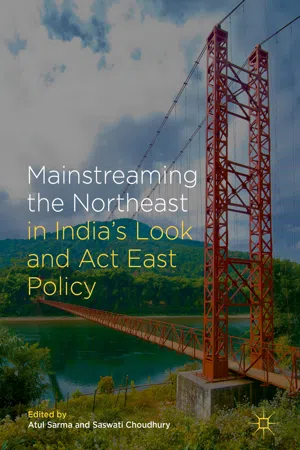
This book provides a detailed account of the evolution of India's Look and Act East Policy, addressing the nuances of the policy and its efficacy for the Northeast Region. The Northeastern India as a region is landlocked, sharing most of its boundary with neighbouring countries of South and South East Asia. It empirically explores the progress in and prospects for trade, investment and connectivity between Northeast India and Southeast Asian countries. Further, it discusses a range of regional and sub-regional multilateral initiatives – e.g. the Bay of Bengal Initiative for Multi-Sectoral Technical and Economic Cooperation (BIMSTEC), Bangladesh-China-India-Myanmar (BCIM), and Mekong-Ganga Cooperation (MGC) – that could potentially strengthen the cooperation between Northeast India and neighboring regions in the social, cultural and economic spheres.
eBook - ePub
Mainstreaming the Northeast in India's Look and Act East Policy
- English
- ePUB (mobile friendly)
- Available on iOS & Android
eBook - ePub
Mainstreaming the Northeast in India's Look and Act East Policy
About this book
Information
© The Author(s) 2018
Atul Sarma and Saswati Choudhury (eds.)Mainstreaming the Northeast in India’s Look and Act East Policyhttps://doi.org/10.1007/978-981-10-5320-7_11. Towards a Perspective on the Look (Act) East Policy and Northeast India
Atul Sarma1 and Saswati Choudhury2
(1)
Institute for Human Development, New Delhi, India
(2)
OKD Institute of Social Change and Development, Guwahati, Assam, India
Atul Sarma (Corresponding author)
Saswati Choudhury
Keywords
MainstreamingNortheast IndiaFragmented marketLEPAEPASEANAtul Sarma
is Chairman of the Omeo Kumar Das Institute of Social Change and Development, Guwahati, and also Visiting Professor at the Institute for Human Development, New Delhi. He was Head and Professor of Economics at the Indian Statistical Institute, New Delhi, and also Vice Chancellor of Rajiv Gandhi University. He was ICSSR National Fellow. Professor Sarma was Member of the Thirteenth Finance Commission (2007–2009).
Saswati Choudhury
is an Associate Professor at Omeo Kumar Das Institute of Social Change and Development, an ICSSR Institute, at Guwahati.
1.1 Introduction
During the late 1980s at the behest of the then Prime Minister, Rajiv Gandhi, India began reviving its relations with South East and East Asia. The Annual Report of the Ministry of External Affairs ( MEA) for 1995–96 noted that there were hardly any high level contacts between India and the Association of South East Asian Nations ( ASEAN) prior to 1985; however, a definite trend emerged since then which indicated that ASEAN was interested in recuperating old relations with India with the restoration of political dialogue . During the next five years, the Indian Prime Minister visited Indonesia, Thailand, Myanmar (then known as Burma), Vietnam and also China in December 1988. India also hosted leaders from South East Asian countries like Suharto of Indonesia, Lee Kuan Yew of Singapore, Mahathir Mohammad of Malaysia, Nguyen Van Linh of Vietnam and Hun Sen of Kampuchea, as well as other ministers. The political exchanges between India and South East Asian countries during the eighties also focused on issues of trade and commerce, energy sharing and cooperation in the field of science and technology. Global political development at the end of the Cold War called for a pragmatic approach in India’s foreign policy. The economic exigency following the balance of payment crisis forced India to shelve its protective economic policies and liberalize. Its eastern neighbours offered a promising area of engagement. ASEAN, together with Japan, Korea and China, was economically the fastest growing region not only in Asia but globally as well. Business delegations led by the Federation of the Indian Chamber of Commerce and Industry (FICCI) visited ASEAN countries. Singapore became the focal point in India’s overseas investment promotion tours undertaken by the Indian Finance Minister and the Minister of State for Commerce in 1991. Singapore reciprocated and also actively supported India’s effort to join ASEAN as a dialogue partner. India became a Sectoral Dialogue Partner of ASEAN in 1992, a full ASEAN Dialogue Partner in 1995, and a member of the ASEAN Regional Forum (ARF ) in 1996.
India’s engagement with East and South East Asian countries since the 1980s has largely been termed as Look East Policy although there is no official policy document which lays down the guidelines and principles. During his September 1994 visit to Singapore, the Indian Prime Minister, Narasimha Rao delivered a lecture entitled “India and the Asia–Pacific: Forging a New Relationship” at the Institute of South East Asian Studies (ISEAS) in which he emphasized India’s eagerness to join the future development path in the Asia–Pacific region in the post-Cold War period. The term “Look East Policy” appeared in official records of India for the first time in the Annual Report of the Ministry of External Affairs (MEA) in 1995–96 and referred to India’s engagement in the ASEAN region with emphasis on economic and institutional relations. Delivering the 14th Singapore lecture in April 2002, Prime Minister A. B. Vajpayee said, “I speak today on ASEAN and the Asia–Pacific … This region is one of the focal points of India’s foreign policy, strategic concerns and economic interests … It is a fundamental fact of geography that India is in the immediate neighbourhood of ASEAN” (ASEAN 2002). In December 2005 in his keynote address at the Special Leader’s Dialogue of ASEAN Business Advisory Council in Kuala Lumpur, Malaysia, India’s Prime Minister, Manmohan Singh stated that, since 1992, the Government of India had launched a “Look East Polic y” which was not merely an external economic policy but also marked a strategic shift in India’s envisioned role in the changing global economic scenario. It was an attempt to reach out to India’s civilizational neighbours in South East and East Asia. At the Ninth India–ASEAN summit in Bali, Prime Minister Manmohan Singh stated that India’s partnership with ASEAN was a key feature of the country’s foreign policy and the foundation of its Look East Policy (LEP). India’s engagement with its eastern neighbours has also been acknowledged by ASEAN. At the fourth India–ASEAN summit held at Kuala Lumpur in December 2005, India’s support to the CLMV countries (Cambodia, Laos, Myanmar, Vietnam) in service sector, especially in English language training, satellite based networking , telemedicine services and super speciality health care facilities, was appreciated. LEP goes beyond economic cooperation today and includes defence and strategic partnership building as also regional cooperation for human resource development.
India’s eastward move is perceived as recognition of its physical contiguity and cultural and social proximity with South East Asia. At the 12th ASEAN–India Summit, Prime Minister of India, Narendra Modi declared that, externally, India’s LEP had become the Act East Policy (AEP ). The thrust areas for the redefined regional engagement for India with the countries in this region would primarily be (1) markets (liberalization of foreign trade, direct investment, capital accounts and financial systems); (2) policy (intergovernmental cooperation and development of common institutions); (3) geopolitics (relationships between political power and geographic space). Regional engagement is expected to expand not only to the limits of production possibilities but also to facilitate the flow of academic and scientific collaboration, technology sharing, service growth and institutional cooperation . For the new government, renewing cultural and spiritual connectivity with Asia is as important as physical connectivity (Raja Mohan, 2015).
India’s renewed engagement with ASEAN since the nineties improved economic relations and ASEAN became the fourth largest trading partner of India. Annual trade had grown at an average rate of 22 per cent per annum during the decade of 2000–11and stood at US$76.53 billion in 2014–15. Investment flows have been substantial both ways, with ASEAN accounting for 12.5 per cent of investment flows into India since 2000. Foreign direct investment (FDI) inflows into India from ASEAN between April 2007 and March 2015 was US$32.44 billion, while FDI outflows from India to ASEAN countries, from April 2007 to March 2015, as per data maintained by the Department of Economic Affairs (DEA) , was US$38.672 billion.
1.2 Northeast India and India’s Look East Policy
The articulation of LEP since the early 1990s raised the hope of a new development perspective for the Northeast Region of India by placing it as a gateway to the dynamic East and South East Asian economies. The scholars and development experts working on Northeast India had argued for a resurgence of the region by establishing trade links with the fast growing South East Asian countries under the aegis of LEP. There were apprehensions as well: the opening of the Northeast Region to South East Asian countries would add to the insecurity in the region which had been affected by cross-border conflicts and insurgency. While the Northeast continued to be trapped in the debate of security issues versus economic gains , India’s relations with ASEAN improved not only trade and business but also cultural and strategic security issues.1 However, Northeast India was left out of such engagements, even though it continentally connects to the region through Myanmar and shares certain commonalities in the economic and social spheres . Recognizing these shared commonalities and the physical contiguity, Government of India built the “Friendship Road” to Myanmar in 1996 and, following its inauguration, hosted the ASEAN car rally . Nothing much happened beyond the opening of designated border trade points and the carrying on of a bare minimum trade.
Though the potential for developing the resource rich Northeast Region through economic complementarities with South East Asia and Bangladesh is immense, the underdeveloped transport and communications network within the region contribute to high transportation costs and a fragmented market. Within the region Assam serves as the main connecting node through which others states of the region can be accessed. The railways, which provide the cheapest mode of transport, has a total route length of 2743 km, with Assam alone accounting for 89 per cent of the route length.2 The air connectivity within the region is networked through 22 airports of which 12 are currently operational. The region has only one international flight operation.3 To overcome the remoteness in connectivity within the region, the Special Accelerated Road Development Programme–North East (SARDP–NE) was adopted in 2005 for developing the road length to 6418 km so as to improve the connectivity of 88 district headquarters in the region by at least two lane roads and improve road connectivity in border areas and access points to neighbouring countries. Regional connectivity for developing a unified region became particularly essential.
Besides connectivity, the economies of the states of the region are also disparate. Except Assam, all other states are small in population size and thus have a small market, each beset with their own rigidities. Such rigidities can be overcome through the development of an integrated market that could enable the states of the region to develop their economies according to their comparative advantage and thus enjoy the gains from economies of scale and specialization. The hill economies of the region and their subsistence nature are incompatible with the market-driven economy, and the result has been underdeveloped product and labour markets in the region. In order to break through the challenges in region’s development, the Northeast perspective of the Look (Act) East Policy was developed by the NEC in October 2007 under the aegis of the Ministry of Development Of North Eastern Region (DONER ) and was incorporated within “Vision NER: 2020” with the basic objective “to break the fetters of the geo-political isolation .”
The economic rationale behind this new vision was that the landlocked Northeast would find wider market access with some of the fastest growing countries in South East Asia and this in turn would induce growth and development of the region. Three aspects of this policy have emerged over the years with respect to Northeast India:
- Connectivity and physical infrastructure to facilitate trade;
- Trade and investment protocols;
- Bilateral/multilateral relationships, such as in tourism, and enhanced people-to-people interaction through sports, culture, academia and medical research.
The economic relation between Northeast India and South East Asia at present centres around trade through borders with Myanmar (much of which is not officially recorded) and the annual trade fairs in some of the countries and the states in the region. Such engagements provide little scope for accessing market benefits. There is a need for a systemic understanding of the basic agrarian and production relations in the region which would facilitate a policy direction for developing economic complementarities within the region and with the economies of South East Asia in a shared market framework.
With more than 45 million people, the Northeast Region has a fairly large market and holds the potential to develop into India’s powerhouse with large reserves of energy resources, that is oil, natural gas , coal, limestone as well as India’s largest perennial water system (Sarma 2011). The region’s agro-climatic conditions have endowed it with the strong potential to develop horticultural products, plantation crops, vegetables, spices, rare herbs and medicinal herbs. The region also holds the potential for developing into an export hub for the agro-processed industrial sector. With its rich cultural and natural bounties, unique performing arts and varied cuisine and handicrafts, the region offers unlimited tourism potential. The NER has been the hub of niche products in handicrafts and handloom. To promote the local products in NER, “One Village One Product” movement that was initiated in Japan in the late 1970s or the One Tambon One Product (OTOP) promoted by Thailand in the recent past can be emulated. Under this programme village/rural comm...
Table of contents
- Cover
- Frontmatter
- 1. Towards a Perspective on the Look (Act) East Policy and Northeast India
- 1. Part I
- 2. Part II
- 3. Part III
- 4. Part IV
- Backmatter
Trusted by 375,005 students
Access to over 1.5 million titles for a fair monthly price.
Study more efficiently using our study tools.
Frequently asked questions
Yes, you can cancel anytime from the Subscription tab in your account settings on the Perlego website. Your subscription will stay active until the end of your current billing period. Learn how to cancel your subscription
No, books cannot be downloaded as external files, such as PDFs, for use outside of Perlego. However, you can download books within the Perlego app for offline reading on mobile or tablet. Learn how to download books offline
Perlego offers two plans: Essential and Complete
- Essential is ideal for learners and professionals who enjoy exploring a wide range of subjects. Access the Essential Library with 800,000+ trusted titles and best-sellers across business, personal growth, and the humanities. Includes unlimited reading time and Standard Read Aloud voice.
- Complete: Perfect for advanced learners and researchers needing full, unrestricted access. Unlock 1.5M+ books across hundreds of subjects, including academic and specialized titles. The Complete Plan also includes advanced features like Premium Read Aloud and Research Assistant.
We are an online textbook subscription service, where you can get access to an entire online library for less than the price of a single book per month. With over 1.5 million books across 990+ topics, we’ve got you covered! Learn about our mission
Look out for the read-aloud symbol on your next book to see if you can listen to it. The read-aloud tool reads text aloud for you, highlighting the text as it is being read. You can pause it, speed it up and slow it down. Learn more about Read Aloud
Yes! You can use the Perlego app on both iOS and Android devices to read anytime, anywhere — even offline. Perfect for commutes or when you’re on the go.
Please note we cannot support devices running on iOS 13 and Android 7 or earlier. Learn more about using the app
Please note we cannot support devices running on iOS 13 and Android 7 or earlier. Learn more about using the app
Yes, you can access Mainstreaming the Northeast in India's Look and Act East Policy by Atul Sarma, Saswati Choudhury, Atul Sarma,Saswati Choudhury in PDF and/or ePUB format, as well as other popular books in Commerce & Finance. We have over 1.5 million books available in our catalogue for you to explore.