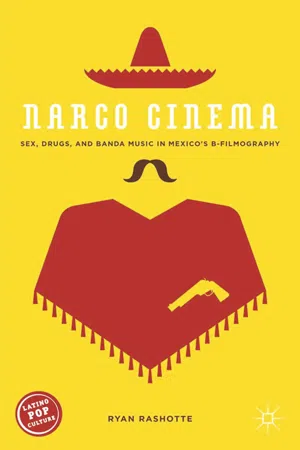
This book provides the first comprehensive study of narco cinema, a cross-border exploitation cinema that, for over forty years, has been instrumental in shaping narco-culture in Mexico and the US borderlands. Identifying classics in its mammoth catalogue and analyzing select films at length, Rashotte outlines the genre's history and aesthetic criteria. He approaches its history as an alternative to mainstream representation of the drug war and considers how its vernacular aesthetic speaks to the anxieties and desires of Latina/o audiences by celebrating regional cultures while exploring the dynamics of global transition. Despite recent federal prohibitions, narco cinema endures as a popular folk art because it reflects distinctively the experiences of those uprooted by the forces of globalization and critiques those forces in ways mainstream cinema has failed.
- English
- ePUB (mobile friendly)
- Available on iOS & Android
eBook - ePub
About this book
Information
Print ISBN
9781349505517
9781137501479
Subtopic
Film & Video1
What Is Narco Cinema?

Figure 1.1 The blood- and coke-smeared mirror
Narco cinema is a low-budget direct-to-video cinema produced by Mexican and Mexican-American studios, predominantly for US Latina1 markets. It’s a remarkably lucrative industry and in over 40 years of production has furnished a catalogue of thousands of films about narco culture in Mexico and the borderlands.
Beyond these preliminaries is where explanation goes off by itself to die. This is difficult cinema to describe to viewers unfamiliar with Latin American melodrama. Try to picture what The Young and the Restless might look like with Steven Seagal as head writer and you may get something like the Anglo equivalent in mind: shootouts, explosions, French kisses, roundhouse kicks, more explosions, boobage, hysterical sobbing, punch-outs, and finally, explosions; at center, the steel-eyed hero violently resisting (or maximizing a stake in) the hematic vortex all has become. Imagine a Harlequin Romance sponsored by the NRA. Imagine a décima to the Lone Man crooned by a group of lonely men strumming their AK-47s under a corrugated yellow moon. Add to this (whatever the hell “this” is) the tortoise-and-hare narrative pace at which scenes of extended exposition rival quick shoot-’em-ups, and the Bollywoodesque regularity of musical interludes (in this case by celebrity corridistas) and it’s easy to appreciate why the first-time viewer may feel a bit disoriented.
Before I get to the films, some distinctions will be useful. Though they share subject matter and stereotypes, you wouldn’t consider American blockbusters like Traffic and Savages narco films. Nor would you those critically acclaimed Nuevo Cine offerings like Miss Bala and El Infierno (even if it’s these major-studio releases that journalists tend to cover in the few editorials our genre receives). And while other Latin American countries, Colombia in particular, produce correlative narco films and novelas (which tend to be better funded and more widely embraced by the mainstream); and while films about narcotics thrive in just about every modern culture for which drugs and cinema are both prevalent social diversions and climbable economies, those aren’t what I mean. For its fecundity and longevity, its superlative violence and kitsch, there is nothing quite like Mexican narco cinema.
Having said this, there’s no cause to fret if this is your first encounter with the genre. Narco films don’t often show up on Blockbuster shelves or in Netflix queues. They aren’t playing in a theater near you unless you happen to live in a Mexican metropolis with a perennial schlock fest or campus “irony night,” in which case you might find an old Almada brothers caper sandwiched between a sexy-comedy and a Santo flick in some late-night celebration of blecch. But root through the bargain bin in an El Paso Wal-Mart or a San Diego 7–11 and you’ll find what I’m talking about. Look for the DVD six-pack with the bashful sex bomb on the cover, the ranchero bruisers charging alongside her in their military-fitted Range Rover. Make the five-dollar investment, go home, insert disc one, press play, and zing off to an entertainment landscape that will, I guarantee, trouble your understanding of the power of film.
Or, if it happens that you don’t live in Aztlán, simply pay a visit to a flea market in any major city in the Americas where Latinas commune and you’ll find pirated copies of the same films (five pesos in Tepito; five bucks in Toronto); or subscribe to Cine Latino where these movies loop day and night between the regular melodramas and the unfunny comedies like malicious needs in a recovery ward; or go online and find a narco-film blog that hasn’t yet been taken down, or just head straight over to YouTube where you can stream some of the latest dec- and viginti-annual shoestring releases from Imperial or Raza Mex or JS Films, those studios that have come to perpetuate the trade and ensure the luminosity of a unique and decidedly anti-Hollywood star system in the popular Latina astronomy.
Two things you’ll observe early: narco cinema is devotedly regional, with Baja, Michoacán, and, most frequently, Sinaloa providing the backdrops, even for films shot in Texas and California; and, while from picture to picture the cops and narcos rotate as heroes and villains and the endings shift from tragic to comic (sometimes leaving us with a smoky question mark: a sequel looming on the horizon), there’s a staunch moral lesson about being true to yourself and your roots.
You may appreciate the moral lesson. You may also find it hard to disagree with critics and even those filmmakers themselves who’ll happily admit that this is not high art. But it’s impossible to deny that in the past decade narco cinema has become one of the most successful b-movie cultures in the world, a truly populist cinema with a diverse fan base overwhelming regional and linguistic barriers.
Like a very finicky species of lice, outside word of the genre tends to travel on raised eyebrows. On controversial reports about clandestine sources of funding. Some journalists suspect that the industry is little more than a money- laundering vehicle for cartels,2 while others see the films as PR campaigns designed to lionize questionable reputations with bio-prop. And for every ten industry names who hurriedly dismiss such rumors, there’s one just as quick to substantiate them.3 José Luis Urquieta, director of such classics as Tres veces mojado (Three Times a Wetback, 1988) and La camioneta gris (The Gray Truck, 1989) estimates that at least half of all narco videohomes are financed by the cartels.4 And whether this is true, or was once true, there’s an undeniable intimacy between the studios and the narcos whose stories they tell. Actor, director, and industry grandee Jorge Reynoso explains:
“The scripts are written in such a way that everybody can participate . . . [The] strippers . . . the security guards, the cops, the drunk guys, the hit men, and all the people who are in that kind of environment always work with us. What you see is what you get. The prostitute is a prostitute, the cop is a cop, and the drug dealer is a drug dealer.”5
And here’s another curious fact: narco cinema makes for a rare success story in the piratical age of film, generating annual revenues of up to 30 million dollars,6 a figure even more remarkable for the fact that 89 percent of narco DVDs sold in Mexico are bootlegs.7 El Bazukazo (2010), a popular film, but by no means exceptionally so, sold 20 thousand DVDs on its first release,8 has, at the time of writing, received 1.5 million hits on YouTube, as well as spawned an unknowable amount of bootlegs up and down the Americas’ black markets, and yet still stands, fiscally speaking, as a hit for its studio. The reason being? It was cheap to make. I mean, like, über cheap, and fast. An average narco film costs between 20 to 50 thousand dollars to produce, takes a month to film (including pre- and post-production; writers get a three- or four-day crack at a script), and a single director can put out ten films annually.9 (Jorge Reynoso claims to have made 26 in a single year.)10 The business model is trial-and-error economics. Studios write off the duds, recoup with modest sales and cash out on the few hits that push them each year from solvency to success.
To combat bootlegging, the films retail cheaply in US chain stores (producers say their target market is Mexicans in the United States),11 and some studios have begun selling screening rights to TV stations in states with sizeable Latina populations (Texas, California, and Illinois).12 Baja Films Internacional—one of the studio titans and, based out of Tijuana and San Diego, literally a cine fronterizo enterprise—licenses its 400+ film catalogue to Los Angeles’s TV MEX, and MCM Studios (La Raza Mex Films in its latest iteration) now deals only in distribution.13 It’s partly the industry’s financial acumen that has allowed it to create more jobs and turn greater profits than Mexico’s better-established, state-subsidized, internationally feted studios.14
All of which begs the question: given its financial success and mass appeal, why is information on the genre so scant? There are no complete archives for narco cinema that I’ve been able to find.15 IMDB is shot through with rankling lacunae (about a quarter of the films I’ve watched aren’t listed). And while you could speculate about a lack of blog interest or Internet access among its dependable fan base, I like to imagine that this absence has more to do with the cinema’s aesthetic. There’s something essentially anti-archival about narco cinema. If the task of the narco novelist is to create a “discourse of memory” that “restore[s] humanity to the dead people in the street” (as Gabriela Polit Dueñas argues in a recent study of Sinaloan literature),16 the job of the narco auteur is much more mundane, his discourse of memory hewing to the short-term. And unlike the narcocorridos, the ballads of drug trafficking that have lately garnered highbrow and academic attention (thanks in no small part to Elijah Wald’s excellent book on the subject), narco cinema has no readily apparent authenticity to trade on. Its kitsch at times appears absolute that you wonder if it’s a purposeful affront to authenticity-mongering audiences trying to look past the flash for deep meaning. Put it this way: if the narcocorrido has become a rare Robert Johnson 45, the narco film remains a George Thorogood music video: a folk art pumped and distorted into a combustible monster.
This is not meant to be an insult and I don’t mean to imply that films are roundly . . . bad (there are some brilliant gems in the catalogue, as we shall see in the pages ahead). It’s just to say that the filmmakers are aware of their product’s shelf life. The films spill into the market in scads to be watched, discarded, but rarely celebrated. The nature of the business is such that the cinema persists over the films themselves and the stories and tropes are less flashes of inspiration than worn industrial machines with which to repurpose the latest song or headline from the drug war into a popular ephemera. Of course, for scholars and fans, this is a problem, and what prompted this study was partly the desire for a substantial survey of a cinema that seems aesthetically devoted to its own obsolescence.
But two years of research and thousands of death scenes later, at a point where my interest is no longer just that but seems more like a full-blown addiction, I have to be honest: I do question whether it’s wise to promote anything that celebrates narco culture. Maybe it was just after I’d watched a squadron of cinematic Zetas brutalize a group of migrants (a Narco News report on the San Fernando Massacre fresh in my mind) that the ethics of this project began to worry me. Because even if the films aren’t always glorifying narco violence, at least they’re participating in what political scientists call the “banalization of atrocity,” that is, normalizing a culture of large-scale and indiscriminate murder, feminicide, and torture.17 And when I consider that this project indirectly deals with an industry that employs child soldiers and directly with an industry that glamorizes a sexy, well-remunerative narco lifestyle in such a way that may seem attractive to impoverished youth, I admit that I am conflicted.
And I suspect that you will be too. Whether it’s the schlock, the violence, or the machismo, there are elements of narco cinema that you won’t enjoy. And so before reading any further, I ask that you take seriously a few discretionary points:
Warning: The Following Pages Contain Scenes with Coarse Language . . .
¡Órale, carnal, pásame la pinche merca!
Narco cinema is a Rosetta Stone of borderlands jargon, but I don’t mean only slang when I say “coarse language.” Slang is just part of the vernacular of narco culture at large, a system of signs that is regional in its expressions (its fashion and music) and motivations (its faith in codes of honor and local allegiance), but cosmopolitan in how it articulates the anxieties and occasional joys which its endangerment can inspire. It’s the language of campesinos and migrant workers and seasonal gomeros harvesting poppies for the cartels; of obscenely wealthy second-gen narco juniors debauching their weekends in Guadalajara and Las Vegas; of awkward Chicana teens battling suburban malaise in the great American mall. The language that passes borders unchecked and with which our cinema’s diverse viewership may make claims, or defy fixed positions, on the torn and messy roadmap that globalization unfolds. But it’s also a language that has powerful enemies and what particularly riles them is its coarseness.
In 2011, the heads of Mexico’s media conglomerates signed the controversial “Agreement on Informative Coverage of Violence,” an editorial manifesto on crime reporting that offered much-needed den...
Table of contents
- Cover
- Title
- 1 What Is Narco Cinema?
- 2 Hecho de coca: A Sentimental Education
- 3 Two Foul Score of the Brothers Almada
- 4 Narcas y Narcos
- 5 . . . and Narco Gays?
- Postscript: From Culiacán to Cannes
- Notes
- Works Cited
- Index
Trusted by 375,005 students
Access to over 1.5 million titles for a fair monthly price.
Study more efficiently using our study tools.
Frequently asked questions
Yes, you can cancel anytime from the Subscription tab in your account settings on the Perlego website. Your subscription will stay active until the end of your current billing period. Learn how to cancel your subscription
No, books cannot be downloaded as external files, such as PDFs, for use outside of Perlego. However, you can download books within the Perlego app for offline reading on mobile or tablet. Learn how to download books offline
Perlego offers two plans: Essential and Complete
- Essential is ideal for learners and professionals who enjoy exploring a wide range of subjects. Access the Essential Library with 800,000+ trusted titles and best-sellers across business, personal growth, and the humanities. Includes unlimited reading time and Standard Read Aloud voice.
- Complete: Perfect for advanced learners and researchers needing full, unrestricted access. Unlock 1.5M+ books across hundreds of subjects, including academic and specialized titles. The Complete Plan also includes advanced features like Premium Read Aloud and Research Assistant.
We are an online textbook subscription service, where you can get access to an entire online library for less than the price of a single book per month. With over 1.5 million books across 990+ topics, we’ve got you covered! Learn about our mission
Look out for the read-aloud symbol on your next book to see if you can listen to it. The read-aloud tool reads text aloud for you, highlighting the text as it is being read. You can pause it, speed it up and slow it down. Learn more about Read Aloud
Yes! You can use the Perlego app on both iOS and Android devices to read anytime, anywhere — even offline. Perfect for commutes or when you’re on the go.
Please note we cannot support devices running on iOS 13 and Android 7 or earlier. Learn more about using the app
Please note we cannot support devices running on iOS 13 and Android 7 or earlier. Learn more about using the app
Yes, you can access Narco Cinema by Ryan Rashotte in PDF and/or ePUB format. We have over 1.5 million books available in our catalogue for you to explore.