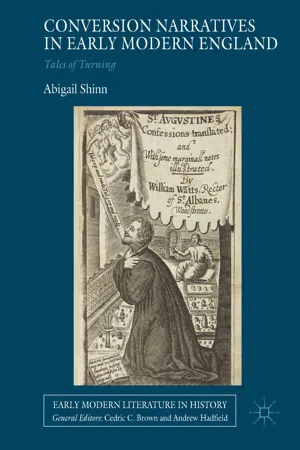
This book is a study of English conversion narratives between 1580 and 1660. Focusing on the formal, stylistic properties of these texts, it argues that there is a direct correspondence between the spiritual and rhetorical turn. Furthermore, by focusing on a comparatively early period in the history of the conversion narrative the book charts for the first time writers' experimentation and engagement with rhetorical theory before the genre's relative stabilization in the 1650s. A cross confessional study analyzing work by both Protestant and Catholic writers, this book explores conversion's relationship with reading; the links between conversion, eloquence, translation and trope; the conflation of spiritual movement with literal travel; and the use of the body as a site for spiritual knowledge and proof.
- English
- ePUB (mobile friendly)
- Available on iOS & Android
eBook - ePub
About this book
Information
© The Author(s) 2018
Abigail ShinnConversion Narratives in Early Modern EnglandEarly Modern Literature in Historyhttps://doi.org/10.1007/978-3-319-96577-2_11. Introduction: Tales of Turning
Abigail Shinn1
(1)
Goldsmiths, University of London, London, UK
The Protestant writer and clergyman Thomas Wilson provides a two-part definition of conversion in his Christian Dictionarie (1612), one of the earliest concordances of the Bible in English. Using the language of motion and labour, conversion is described as both a passive and active process:
The turning, or totall change of an elect Sinner from sinne to God: and in this signification is comprehended, both faith and Repentance, euen the whole worke of grace. Psal. 51, 14. And sinners shalbe Conuerted to thee. This is Passiue Conuersion, wherein we suffer God to worke vpon vs, but our selues by our Naturall power, worke nothing, vnlesse it be to hinder the worke of Grace, what wee may.A turning from some perticuler sinne or sinnes, whereby we haue offended God or man. Luke 22, 32. When thou art conuerted. Ier. 31, 18. Conuert thou me, and I shall be Conuerted. This is an Actiue Conuersion, performed by men already regenerate, who being already renewed by grace, doo work together with his Grace; Conuerting grace being accompanied with assisting and supporting grace. 1
A passive conversion involves the elect believer ‘turning…from sinne to God’ in a movement provoked exclusively by the ‘worke’ of grace upon the soul. In contrast, active conversion is experienced by the ‘regenerate’ soul who has already received grace but has committed a sin that they must work alongside God to resolve. Election theology demands that conversion be restricted to the saved so Wilson’s definition leaves no space for the conversion of the unregenerate. Conversion in both forms, active and passive, is here explicitly connected to the motion of ‘turning’—a kinetic process which combines metamorphosis with the action of moving towards or away from a particular position. Wilson is working from conversion’s etymological root in the Latin convertĕre which means ‘to turn about, turn in character or nature, transform or translate’. 2 This movement can be imagined metaphorically as the convert turning so that their field of vision incorporates a new vista inhabited by God, leaving a sinful perspective behind. Turning is therefore necessarily a process of (re)orientation as the convert turns towards God and away from error and superstition, situating himself or herself within spiritual space. The language of labour or travail further links the motion of turning to an understanding of the convert as an object onto which has been exerted force, whether a purely external pressure (‘worke upon’) or a combination of external and internal influences (‘work together’). Wilson’s turning convert thereby testifies to the forceful work of God upon the soul of the elect believer. This is work which recalls the labour of parturition, the archetypal metaphor for the pain of spiritual transformation, so that conversion’s turning becomes linked to a bodily, and feminised, understanding of renewal and rebirth. 3
Wilson’s definition also emphasises that conversion is often an ongoing process, rather than a singular event, as the convert may sin and therefore need to once again turn to God for further assistance and support. What emerges is an image of the convert as a receptive entity subject to the push and pull of divine forces, an object which turns, but which may well need to turn again. A turn does not necessarily result in enduring stasis or stability, and if a turn becomes a revolution, then the convert may find himself or herself back where they started. In an age when the sins of the nicodemite, equivocator and church papist were joined by the perceived hypocrisy of the serial convert, the kinetic qualities of conversion could thus signal a dangerous ambivalence. In the words of John Heywood’s epigram Of turnyng (1562): ‘Halfe turne or whole turne, where turners be turning / Turnying keepes turners from hangyng and burning’. 4 The paradox which lies at the heart of conversion is that its affinity with the language of movement results in fears of instability.
The central concern of this book is the representation of these different tales of turning in conversion narratives, texts that incorporate a story of a change in religious affiliation or a moment of spiritual transformation. My argument is that by studying their formal and stylistic properties we can excavate the ways writers both mirror, and attempt to contain, the kinetic qualities of conversion. In the act of turning, the convert asks ‘where am I?’ and ‘where is God?’ In order to orientate himself or herself spiritually, the turning convert positions themselves textually, making visible important correspondences between the motions and effects of conversion, and the understanding of rhetoric’s power to move and persuade. The first book-length study to pay sustained attention to the literary composition of conversion narratives, Conversion Narratives in Early Modern England will reveal an often-symbiotic relationship between turned words and turned souls, and reappraise our understanding of the interconnectedness of early modern literary and religious cultures more generally.
The motivations that lie behind the composition of a conversion account are closely related to the kinetic qualities of religious change. The act of writing about conversion is ostensibly designed in some way to fix, or stabilise, a religious turn and prevent it from being perceived as a presage to further movement, but this is a difficult effect to achieve. For example, the tension between two religious positions—on the cusp of turning and on the straight course which follows a successful turn—is one of the primary compositional pressures faced by the writers of conversion accounts. The finality of the eventual turn to faith is always precarious, and the potential for it to appear inconclusive has to be carefully negotiated. In looking to provide a textual stopping place or point of termination, writers also have to go through a process of literary movement and metamorphosis, comparable to the motions experienced by the changed believer, which serve to create and animate the convert within the text. The impulse to stabilise through an act of literary construction (a process counter-intuitively predicated upon movement and transformation) is accompanied by the urge to articulate. Converts and their witnesses see the broadcasting of their experiences as an act of charity or an opportunity for evangelism which can provide comfort and assurance for those who are already saved, and may prompt change in the reader who is not. In the process, they have to wrestle with how to portray the unseen and silent transformation that has taken place in the soul. Immense pressure is consequently placed upon descriptive language as the numinous and indescribable have to be given concrete and recognisable form. As Brian Cummings argues, ‘conversio defies the ordinary usages of language to express it, for it is a movement without preparation, even without syntax’. 5 Labouring to express the inexpressible, conversion writers thus engage in a careful, and often startlingly inventive, exploration of the limits and possibilities afforded by language and rhetoric.
However difficult to satisfy, the primary motivations which lie behind the composition of a conversion narrative, i.e. a desire to substantiate or prove that a religious turn has taken place and an urge to proclaim in order to inspire stability or further movement in others, give rise to a series of resourceful compositional strategies. Many of these strategies self-consciously harness the kinetic nature of conversion by conflating literal and figurative movements in order to add symbolic weight to the recollection of religious experience. For example, the route traversed by the travelling convert becomes a spiritual journey and the action of hunting parallels the pursuit of souls. 6 This book is focused on unravelling conjoined religious and literary movements such as these, and by paying serious attention to the compositional choices made by conversion writers between 1580 and 1660, I highlight an intricate network of conjoined rhetorical and spiritual turnings. This network is activated by an affective reading culture which sees interactions with the codex, scriptural or otherwise, as a possible catalyst for spiritual change, and the first chapter places conversion at the heart of the phenomenology of reading by examining in detail the intimate relationship between the convert and the book.
This research is indebted to a rich body of literary and historical enquiry, loosely understood as a part of the ‘turn’ to religion in early modern studies, which has transformed our understanding of religious culture and its relationship to literature. 7 Historians charting the persistence of pre-Reformation beliefs and practices in Tudor and Stuart England have redrawn the parameters of religious culture and questioned a teleological reading of Protestantism’s dominance. 8 In literary studies, critics have researched the impact of the Reformation upon literature, placed language at the heart of arguments about doctrinal difference and religious identity, and recovered a Catholic literary culture which has all too often been obscured by a focus upon Protestantism’s relationship to the book. 9 Coupled with a greater understanding of the interactions between East and West during the period and the phenomenon of ‘turning Turk’, early modern England’s religious landscape is now recognised as crowded and diverse. 10 Correspondingly, there has emerged a particular focus upon the connections between conversion and writing practices. Within this critical milieu, the conversion narrative has been explored principally as a mode of life-writing, with a particular focus upon the development of a Protestant identity and the religious literature of writers such as John Bunyan. 11 In recent years, a growing understanding of autobiography’s complexity in the early modern period has led scholars to look for the traces of a life in a range of often far from obvious sources, including almanacs and account books, and to emphasise the form’s improvisatory nature and experimentalism. 12 In tandem, Brooke Conti and Kathleen Lynch have complicated our understanding of the multifarious pressures placed upon the construction of a religious life, situating Protestant autobiography within the context of religious controversy, the print trade, and networks of congregation and community. 13
My approach to the conversion narrative is one which shifts the focus from the concerns of life-writing and autobiography toward the formal and structural qualities of the conversion experience as a literary phenomenon. I am less interested in the ‘self’ behind the text, or the status of conversion narratives as ‘acts of self-interpretation’, in D. Bruce Hindmarsh’s words, than the compositional choices which go into creating or performing that ‘self’ as a persuasive entity. 14 As Karl F. Morrison points out, the experience of conversion cannot be recovered through texts, ‘what we can study is a document, a written composition, and whatever kinds of understanding it may manifest’. 15 Reading Morrison, Ryan Szpiech describes the resulting gap between experience and text as the difference between the ‘thing felt’ and the ‘thing made’. 16 In focusing upon the written documents of conversion, the ‘thing made’ in Szpiech’s terms, I make no claims for the truth of what is described. Rather, I outline the narrative typologies and rhetorical forms that are harnessed by conversion writers in order to construct a persuasive, and sometimes moving, narrative. 17 In short, I am looking to their style (elocutio) and organisation (dipositio). 18 At first glance, this may appear to be a reading of religious discourse as wholly pragmatic rather than spiritually or morally inflected. On the contrary, in looking to the ways in which conversion narratives seek to persuade their readers, rhetoric and narrative are revealed as instrumental participants in the shaping of early modern religious identity. This is in contrast to readings of conversion accounts as religious and political works whose literary construction is little more than ‘word-games’ and ‘sleight of hand’. 19 An attendance to the literary and rhetorical complexity of conversion accounts thereby provides a (historicised) formalist lens into a body of work more commonly examined as documentary evidence and biography. Molly Murray has compellingly argued that conversion profoundly influenced poetic style in the...
Table of contents
- Cover
- Front Matter
- 1. Introduction: Tales of Turning
- 2. Take Up and Read: The Convert and the Book
- 3. Converting Souls and Words: Tropes, Eloquence and Translation
- 4. Narrative Topographies and the Geographies of Conversion
- 5. Witnessing the Body: Corporeal Conversions
- 6. Conclusion: Bunyan’s Turn
- Back Matter
Trusted by 375,005 students
Access to over 1.5 million titles for a fair monthly price.
Study more efficiently using our study tools.
Frequently asked questions
Yes, you can cancel anytime from the Subscription tab in your account settings on the Perlego website. Your subscription will stay active until the end of your current billing period. Learn how to cancel your subscription
No, books cannot be downloaded as external files, such as PDFs, for use outside of Perlego. However, you can download books within the Perlego app for offline reading on mobile or tablet. Learn how to download books offline
Perlego offers two plans: Essential and Complete
- Essential is ideal for learners and professionals who enjoy exploring a wide range of subjects. Access the Essential Library with 800,000+ trusted titles and best-sellers across business, personal growth, and the humanities. Includes unlimited reading time and Standard Read Aloud voice.
- Complete: Perfect for advanced learners and researchers needing full, unrestricted access. Unlock 1.5M+ books across hundreds of subjects, including academic and specialized titles. The Complete Plan also includes advanced features like Premium Read Aloud and Research Assistant.
We are an online textbook subscription service, where you can get access to an entire online library for less than the price of a single book per month. With over 1.5 million books across 990+ topics, we’ve got you covered! Learn about our mission
Look out for the read-aloud symbol on your next book to see if you can listen to it. The read-aloud tool reads text aloud for you, highlighting the text as it is being read. You can pause it, speed it up and slow it down. Learn more about Read Aloud
Yes! You can use the Perlego app on both iOS and Android devices to read anytime, anywhere — even offline. Perfect for commutes or when you’re on the go.
Please note we cannot support devices running on iOS 13 and Android 7 or earlier. Learn more about using the app
Please note we cannot support devices running on iOS 13 and Android 7 or earlier. Learn more about using the app
Yes, you can access Conversion Narratives in Early Modern England by Abigail Shinn in PDF and/or ePUB format, as well as other popular books in Literature & European Literary Criticism. We have over 1.5 million books available in our catalogue for you to explore.