- English
- ePUB (mobile friendly)
- Available on iOS & Android
eBook - ePub
About this book
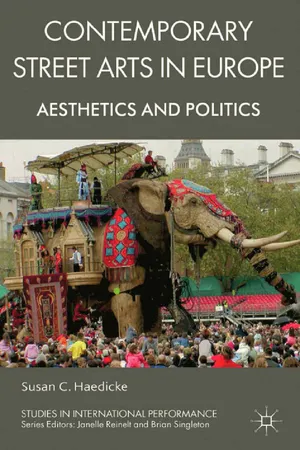
Street theatre invades a public space, shakes it up and disappears, but the memory of the disruption haunts the site for audiences who experience it. This book looks at how the dynamic interrelationship of performance, participant and place creates a politicized aesthetic of public space that enables the public to rehearse democratic practices.
Information
Subtopic
Literary Criticism1
Looking Back: A Socio-Historical and Intellectual Context for Contemporary Street Arts in Europe
Legacy of 1968
Performances have taken over the streets and squares of European cities for centuries: ancient mimes, jugglers, acrobats, and bards; the medieval cycles, miracles and morality plays; royal entries of the Renaissance; itinerant commedia dell’arte troupes; tableaux vivants; showmen exhibiting anything out of the ordinary from religious relics to freaks of nature throughout the centuries; and the popular entertainments of the great fairs, like Bartholomew Fair and Southwark Fair in London and Foire Saint-Germain, Foire Saint-Laurent, and Foire Saint-Ovide in Paris (some of which lasted into the 19th century).1 All these street performances and many others used art to shift the focus of their audiences from ordinary day-to-day activities to special events of religious celebration, entertainment, or displays of power and transformed the function of the public space in which they took place. The long and vivid history of outdoor performance clearly contributed to what is called street arts today, but contemporary street theatre in Europe is not simply a continuation, an elaboration, or a modernization of the traditions of the past. Although adapting centuries-old outdoor performance techniques, the current form of street arts was deeply influenced by and developed as an artistic response to the same anti-establishment impulses and seeds of rebellion that initiated social unrest in the 1960s and led to the vivid, and often violent, demonstrations and riots around the world in 1968.
The earliest radical theatre companies2 in this tumultuous period, in many ways anticipating the events of 1968, devised militant performances to challenge dominant discourses and traditional values through performance practices linking theatre to social issues, political struggles, and democratic initiatives. They sought to politicize the public by encouraging them to make cultural choices and to restore the participatory role of active citizenship. The elite art establishment often dismissed their communally devised pieces as amateurish, misguided, and even a degeneration of culture into a form of socio-political activism. These condemnations did not stop the young artists, and their experiments often motivated them to abandon traditional theatrical venues, texts, rehearsal procedures, and company structures. International tours and newly established festivals in Europe in the 1960s and 1970s enabled the activist artists (notably Living Theatre and Bread and Puppet Theatre) to share their innovative and oppositional theatrical languages, practices and techniques. The radical artists also shared a utopian confidence in the power of art to affect social change.
In the early 1980s, Michel Crespin (a pioneer in street arts as co-founder of an early street theatre company, Théâtracide; co-founder and director of Lieux Publics;3 and founder of one of the earliest street theatre festivals in Aurillac, France) completed a study that cited the goals of street arts as both preserving old traditions of outdoor entertainment, carnivals, and other festivities and encouraging experimentation with new forms and practices.4 This dual goal was echoed in ‘Dossier Spécial 01’, the report of a Street Arts Working Group, established by HorsLesMurs in 1998 and charged with identifying key aspects and practices of contemporary street theatre. Michel Simonot, writer and director who led the Street Arts Working Group, acknowledged the importance and influence of the ancient outdoor art forms, but at the same time he insisted that current street theatre artistic practices originated in ideological values and political goals unique to the 1960s and 1970s (1999: 5).5 In the 2007 study entitled Street Artists in Europe, commissioned by the European Parliament’s Committee on Culture and Education, Yohann Floch (consultant on international relations, education and cultural arts and coordinator of Circostrada Network at HorsLesMurs) claims that looking for these links to the past arises from an imagined need for historical legitimacy. He argues that outdoor performers from earlier centuries performed outside out of necessity and sought to create the conditions of an indoor theatre with its physical distance between actor and audience as evidenced by the use of make-shift stages. Artists who in the 1960s and 1970s chose to go outdoors, did so to oppose traditional cultural institutions, to re-appropriate public space, to mingle with a new audience, and to establish porosity between art and non-art. ‘The object of the street theatre is the street’ noted French sociologist Sylvia Ostrowetsky, one of the first scholars to look at street theatre as an art form worthy of critical analysis (1997: 141; my translation). Crossing the theatre building’s threshold represented a metaphoric border crossing that required finding a new home, learning new languages and codes, putting down new roots, and establishing new relationships with the native populations (the public that avoided art institutions). This notion of border crossings formed the foundation of street arts’ aesthetics and politics. Thus their practices, while seemingly similar to earlier outdoor performance, were developed consciously in response to the vibrant socio-political moment. To understand this shift to theatre ‘outside the walls’ (hors les murs), it is important to have a sense of the unique context in which it began to flourish.
For political scientist Sheldon Wolin, the 1960s began as a ‘quest to expand the meaning and practice of freedom. It was a time for seeing the world and themselves with fresh eyes, for believing that it was possible to begin things anew’ (1997: 132). It came to represent a decade in which populations became politicized: ‘The sixties converted democracy from a rhetorical to a working proposition, not just about equal rights but about new models of action and access to power in workplaces, schools, neighbourhoods, and local communities’ (1997: 144). And it was a time when ‘acts of civil disobedience, communal experiments, aesthetic innovations…did not spring from a desire to ‘participate,’ but from a newly discovered passion for significant action’ (1997: 143). In western democracies, the conflicts of the 1960s were flamed by the sons and daughters of the middle class, the students at universities, who were disillusioned by the world around them and believed that they were on the brink of revolutionary changes. Paul Potter, president of the radical group Students for a Democratic Society in the United States, claimed that the young people ‘had everything their society could give them, found that gift hollow and rejected it’ (quoted in Cavallo, 1999: 2). They were motivated by a distrust of those in authority and a moral outrage against the injustices and inequalities in their supposedly democratic societies.
The summative year of 1968 was, in the words of one popular history writer, ‘the year that rocked the world’ (Kurlansky, 2005). The events of 1968, however, were the explosion of ideas that had been in the air certainly throughout the 1960s and most likely since the end of World War II, ideas that crossed national borders to create global unrest and citizen activism.6 Carole Fink, Philipp Gassert, and Detlef Junker, in the ‘Introduction’ to their interdisciplinary and international anthology on the 1960s, write: ‘The events of 1968 happened within national contexts yet took place across the globe—from Berkeley to Berlin, Bangkok to Buenos Aires, Cairo to Cape Town, Paris to Tokyo’ (1998: 1). Local groups, emboldened by the mass media coverage of protests elsewhere, felt a part of a larger and more powerful socio-political movement that could possibly find an alternative to both communism and capitalism: a ‘third way’ beyond state or party politics. Paul Berman calls this period a time of ‘utopian exhilaration’ when many believed that a ‘superior new society was already coming into existence’ (1996: 9). Images and reports of demonstrations and the often aggressive response of the police or the brutal suppression of democratic initiatives appeared daily on television, on radio, and in newspapers around the world. In countries without a free press, underground broadcasts, posters and leaflets, and even word-of-mouth kept the population informed of successful and unsuccessful protests and provided a network of information on issues and strategies (Fink et al., 1998: 1–27). While the social revolt in each country was in response to national issues, the global unrest represented a world-wide discontent with the cultural, economic and political status quo; a rejection of authority, Western imperialism, dictatorships, and rampant consumerism; and a longing for ‘freedom, justice, and self-determination’ (ibid., 1998: 21) on personal levels in some countries and on a state level in others as citizens fought against totalitarian governments.
While demonstrations, marches, and unrest occurred in cities around the world, the events of May 1968 in France were arguably the most dramatic and transmissible. Fink et al. write:
The ‘export’ of the Paris May, which proved to be particularly contagious, is perhaps the most striking example of the global nature of 1968….The gains made in Paris convinced protesters in other countries that it was possible to make similar demands elsewhere, leading to the exchange of ideas and methods of revolution across national borders….Paris provided both the model for dissent and a cautionary lesson for the authorities. (1998: 18)
Daniel Singer, Paris-based correspondent for The Nation during these years who wrote about the events soon after they happened, concurs: ‘The lessons of the May crisis are not only true for France, but extend well beyond French frontiers’ (2000: x).
It was only in France that the student protesters were joined by workers nationwide who went on strike with similar, although sometimes more practical, sometimes more ambiguous, demands. In Italy, workers also responded to student protests, but not until a year later and not on a national level. And in Germany and the United States, student and worker movements sometimes intersected, but not to the extent of the coordination in France. The uprising caused the largest strike in French history that put the power of the ruling party into question and paralyzed the economy. Georges Pompidou, prime minister at the time, worried that ‘the only historical precedent [of the May events] is the fifteenth century when the structures of the Middle Ages were collapsing and when students were revolting at the Sorbonne. Right now, it is not the government which is being attacked, not the institutions, nor even France. It is our own civilization’ (quoted in Seidman, 2004: 1–2). While the words may seem hyperbolic, there is no question that the protests of May 1968 challenged the societal and intellectual status quo in French society profoundly.
In spite of this apparent upheaval, the ‘third way’ of the May 1968 protesters failed to achieve radical political change. Historian Peter Starr, in his analysis of what he calls the ‘failed revolution’, argues that the ‘third way’ rejected ‘direct political action’, organizing and coordination and instead relied on iconic gestures, proclamations and street interventions, often inspired by artistic practices, to spread the idea of revolution (1995: 8). But, while that approach did not result in actual revolution, it did achieve a radical socio-cultural shift that located the site of opposition and subversion in art. Social historian, Michael Seidman writes that:
The events [of May ‘68] are still viewed as a rupture with the past and the beginning not of a proletarian revolution (as many radicals thought at the time), but rather of a cultural rebellion that led to a more emancipated society. Almost all agree that the crisis of the spring of 1968 changed France profoundly. (2004: 1)
And, Ingrid Gilcher-Holtey, who describes this revolt as a ‘new social movement’ (or a mobilization of a group of people over a sustained period of time who seek to affect social change through protests and demonstrations), argues that this movement opposed the ‘total structure of society’ and was guided by ideas of the New Left, one of which insisted ‘that changes in the cultural sphere must precede social and political transformation’ (1998: 257).
In October following May 1968, Michel de Certeau wrote The Capture of Speech, in which he tried to make sense of the events of a few months earlier and assess their impact in the cultural sphere. He calls the crisis a:
symbolic revolution… because it signifies more than it effectuates, or because of the fact that it contests given social and historical relations in order to create authentic ones. After all, the ‘symbol’ is the indication that affects the entire movement, in practice as well as in theory. From the beginning to the end, speech is what played the decisive role. (1998: 5–6)
He explains quite passionately:
Last May, speech was taken the way, in 1789, the Bastille was taken. The stronghold that was assailed is a knowledge held by the dispensers of culture, a knowledge meant to integrate or enclose student workers and wage earners in a system of assigned duties. From the taking of the Bastille to the taking of the Sorbonne, between these two symbols, an essential difference characterizes the event of May 13, 1968: today it is imprisoned speech that was freed. (1998: 11)
For de Certeau, the protests succeeded in hijacking cultural knowledge and social language by inverting the meaning of their signs and thus stating or depicting the seemingly impossible, representing the unrepresentable. It is this creation of ‘symbolic sites’ with their contradictory signs that constituted the ‘exemplary action’ of the revolt. The exemplary action:
‘opens a breach,’ not because of its own efficacity [sic.], but because it displaces a law that was the more powerful in that it had not been brought to mind; it unveils what was latent and makes it contestable….The exemplary action changes nothing; it creates possibilities relative to impossibilities that had until then been admitted but not clarified. (1998: 8)
These symbolic sites and exemplary actions are forms of shock, discussed earlier, and they acquired an aesthetic form in the oppositional street interventions of the 1970s and 1980s.7
Henri Lefebvre, also writing in 1968, gave the revolt more than the symbolic success claimed by de Certeau, insisting that it was:
profoundly political from the outset….The extraordinary fact is that, following a relatively minor confrontation, a substantial number of the superstructures and institutions of a great country should have been severely shaken and in certain cases even made to collapse. For such were the results of the movement as it spread. (1969: 112–13)
The protests shifted from student demands for reforms in housing and classrooms to societal issues of hierarchy, freedom, personal agency and ‘autogestion’ or self-management. As Lefebvre warned, ‘the crisis of authority is but the outward appearance of a much deeper crisis which extends, beyond everyday existence, to the institutions and the state which holds them together’ (1969: 107). Celebration and struggle characterized this cultural revolution for Lefebvre as the students, in particular, reclaimed the streets and re-appropriated public spaces in their quest to refashion society. And like de Certeau, Lefebvre applauded ‘the explosion of unfettered speech….Speech manifested itself as a primary freedom, now reconquered and re-appropriated’ (1969: 119). And Jean-Jacques Lebel, artist and activist who played a significant role in the student street activities, passionately claimed that the ‘May Revolution dynamited the limits of ‘art’ and ‘culture’ as it did all other social or political limits. The old avant-gardist dream of turning ‘life’ into ‘art,’ into a collective creative experience, finally came true’ (1998: 180).
It is difficult to deny the significant impact of the vivid events of 1968 on a generation of French thinkers whose work has crossed national and disciplinary borders: de Certeau and Lefebvre certainly, but also Deleuze, Guattari, Derrida, Foucault, Debord, Lefort, and Rancière to mention just a few. For them, May 1968 represented an irreversible rupture in the socio-political and intellectual foundations of French society that required a ‘third way’ of oppositional thought retaining the revolutionary impulses but avoiding inevitable consequences and compromises that would result from actual revolutionary action. ‘The solution’, explains Grant Kester in his analysis of art theory and history of this period:
was a tactical withdrawal into the protected field of the text. The novel, the poem, the film, the work of art, and theory itself would become the site for a process of ‘subtle’ or ‘discrete’ subversion. The revolutionary would decamp to the institutional margins of political life—the university, the gallery, and the publishing house—to create a heterotopic space of experimentation. (2011: 45–6)
Thus, for these French thinkers, the arts had a crucial role to play in the new society.8 The enormous impact of their ideas on both intellectual thought and art practices is impossible to measure since, as Kester argues, ‘What would have been identified twenty years ago as a distinct ‘post-structural’ strand within the larger field of critical theory has been so successfully assimilated that it’s now largely synonymous with critical theory per se’ (2011: 54).
It is easy to see the impact of these ideas and the conviction that societal transformation could only be achieved indirectly through cultural interventions on the burgeoning street theatre movement, particularly in France, in the 1970s. Sadie Plant claims that the ‘events of 1968 are remembered for the irruption of play, festivity, spontaneity, and the imagination into the political realm’ (1992: 70), and clearly the mass demonstrations relied on performance practices of burning effigies, beating objects to create drum-like rhythms, or participating in p...
Table of contents
- Cover
- Title
- Copyright
- Contents
- List of Illustrations
- Series Preface
- Preface: Into the Street
- Acknowledgements
- Introduction: Aesthetics and Politics of Street Arts Interventions
- 1 Looking Back: a Socio-Historical and Intellectual Context for Contemporary Street Arts in Europe
- 2 Democratic Performatives and an Aesthetics of Public Space
- 3 Performing Democracy On a Grand Scale
- 4 Trespassing in Urban Places
- 5 Subversive Imaginaries: Performing the Other
- 6 Community Performance: Community Performatives
- Postscript: Beyond the Street
- Notes
- Bibliography
- Index
- Plates
Trusted by 375,005 students
Access to over 1.5 million titles for a fair monthly price.
Study more efficiently using our study tools.
Frequently asked questions
Yes, you can cancel anytime from the Subscription tab in your account settings on the Perlego website. Your subscription will stay active until the end of your current billing period. Learn how to cancel your subscription
No, books cannot be downloaded as external files, such as PDFs, for use outside of Perlego. However, you can download books within the Perlego app for offline reading on mobile or tablet. Learn how to download books offline
Perlego offers two plans: Essential and Complete
- Essential is ideal for learners and professionals who enjoy exploring a wide range of subjects. Access the Essential Library with 800,000+ trusted titles and best-sellers across business, personal growth, and the humanities. Includes unlimited reading time and Standard Read Aloud voice.
- Complete: Perfect for advanced learners and researchers needing full, unrestricted access. Unlock 1.5M+ books across hundreds of subjects, including academic and specialized titles. The Complete Plan also includes advanced features like Premium Read Aloud and Research Assistant.
We are an online textbook subscription service, where you can get access to an entire online library for less than the price of a single book per month. With over 1.5 million books across 990+ topics, we’ve got you covered! Learn about our mission
Look out for the read-aloud symbol on your next book to see if you can listen to it. The read-aloud tool reads text aloud for you, highlighting the text as it is being read. You can pause it, speed it up and slow it down. Learn more about Read Aloud
Yes! You can use the Perlego app on both iOS and Android devices to read anytime, anywhere — even offline. Perfect for commutes or when you’re on the go.
Please note we cannot support devices running on iOS 13 and Android 7 or earlier. Learn more about using the app
Please note we cannot support devices running on iOS 13 and Android 7 or earlier. Learn more about using the app
Yes, you can access Contemporary Street Arts in Europe by S. Haedicke in PDF and/or ePUB format, as well as other popular books in Media & Performing Arts & Literary Criticism. We have over 1.5 million books available in our catalogue for you to explore.