This book comes as a result of a long gestation period. Watching my daughter play at dressing up online ‘scary vampire girls’ in 2011, I became intrigued by the visual narratives and interpretative repertoires she, and her friends, had to offer about the sartorial and make-up choices for their vampire models. It was the ambiguity afforded in the project of selfhood—what happens once young children make the transition from childhood to tweendom/pre-adolescence—and the identity play at work that caught my attention and paved the way towards this book.
For I see this as a personal journey in the understanding of children’s interactions with, and the significations of everyday culture, as well as of their practices of popular culture. It was something that was triggered by the need to better contextualize my daughter’s online make-over practices, and soon developed into something bigger, enveloping an intricate array of issues that bring together popular culture, consumption, sexuality, selfhood and childhood. While trying to give my daughter ‘holistic’ answers to her queries about fashion, taste, stars, sexuality, I kept pushing myself to go beyond the dominant—and fashionable—preconceptions about ‘the risks of childhood’ which I believe I had internalized myself at some point in time. The more I read, preparing for this book, the clearer became the way the entire debate about the sexualization of childhood is socially constructed, and that is the approach I have adopted throughout the book. In so doing, I found myself revisiting previous work of mine, related to the study of children and pornography, and repositioning myself towards it in a way that reflects the social construction of childhood and sexuality. The ambiguity that surrounds age identity boundaries for children—girls especially—as seen, for example, in their styling, popular icons and overall media representations, ‘create a cultural space for their ensuing incessant sexualization, regardless of whether emphasizing sexuality is an intended outcome’ (Cook and Kaiser
2004, 223). Media concern and the moral turpitude that accompanies (female) sexuality trickle down and feed the public debate about the sexualization of young pre-adolescent (tween) girls. However, as the tween girl seems to:
encode anticipatory statuses and identities to be acted out in the present, while preparing the ground for entry into a particular articulation of heterosexual female culture […] middle girlhood has increasingly become a favoured political site for the understanding of femininity, for discourses about vulnerability and ‘lost childhoods’ and for locating some of the evils of the consumer marketplace, all along renaturalizing and remoralizing middle childhood. (Cook and Kaiser 2004, 223)
In this context, the current burgeoning of the ‘sexualization of culture’ can be seen as the proliferation of control and surveillance mechanisms regarding what is considered as ‘normal’ and ‘socially acceptable’ behaviour and sexuality for young children, in the same way that nineteenth-century ‘sexology’ has been seen as a classification to control populations (Burr
1995, 67). Such norms of acceptability then become internalized by young children who discipline themselves in order to adhere to prevailing ideals of ‘normality’ and ‘morality’. Hence, sexualization and its effects, as discussed by numerous experts, become some kind of ‘disciplinary power’ (Foucault
1979) through which children control themselves. In fact, Rose (
1989/1999), who I discuss later on in this book, following Foucault, has presented a compelling argument about how psychology (littered with tests measuring masculinity, femininity, IQ, child development, attitudes, etc.) constitutes the production of a body of knowledge which is used to regulate people while making it appear as though it is in their interest, and carrying the stamp of ‘science’ all the while. Throughout this book, I try to uncover the variety of factors and conditions that allowed the sexualization discourse to emerge and become so powerful today. Through such ‘an archaeology of knowledge’ (Foucault
1972), it is possible to make sense of how current ‘truths’ have come to be and are maintained, and what power relations are carried by them (Burr
1995, 166).
A major role in this contextualization is played by the media, which never misses an opportunity to report, and frame as such, incidents of an overtly sexualizing culture, for example the media furore about Miley Cyrus’s appearance on MTV’s Video Music Awards (VMAs) 2015. The Parents Television Council (PTC)—an influential US lobby ‘advocating responsible entertainment’, with a mission ‘to protect children and families from graphic sex, violence and profanity in the media, because of their proven long-term harmful effects’
1 —was quick to denounce the awards ceremony. The PTC criticized MTV, asserting that it wants to ‘stir up controversy without regard to its impact on an entertainment environment that is increasingly toxic for children’.
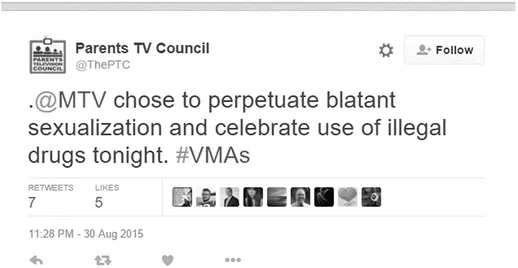
2 Commenting on Miley’s ‘wardrobe malfunction’, after an accidental glimpse of her nipple backstage that was caught on camera, the PTC condemned the pop star, and MTV, as, instead of demonstrating ‘her considerable talent as a performer [Miley chose to] rely on her own sexuality to entertain the audience’. The statement concluded: ‘MTV and Cyrus could both be forces for something positive, but tonight’s VMA partners relied on exposing millions of children to graphic, inappropriate and far-too-frequently offensive content.’ The PTC also tweeted about the ‘blatant sexualization’ and celebration of illegal drugs at the VMAs, which was ‘regrettably’ deemed appropriate ‘for a child as young as 14’
3 (Fig.
1.1).
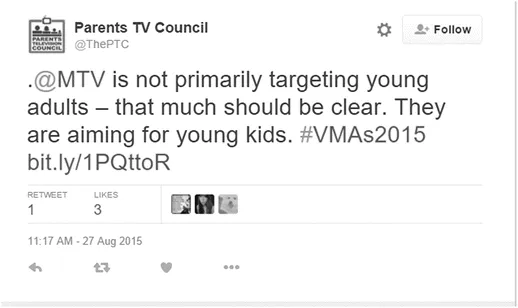
The PTC was already busy tweeting and lobbying against MTV’s choice of Miley Cyrus as a host for the 2015 awards even before the actual ceremony which took place on 31 August 2015 (Fig.
1.2).
In an exclusive interview with Gossip Cop (21 July 2015), PTC President Tim Winter said that Miley Cyrus was a ‘“Profane, Sexually Explicit” Choice For MTV VMAs Host’. 4 The organizers choice ‘pretty much tell us what kind of program MTV intends to air’—a show that ‘It’s not going to be safe for children to watch […].’
In equal measure, the influential and popular Huffington Post runs the headline ‘How Excusing Tyga And Kylie Jenner’s Relationship Validates The Sexualization of Young Girls’. 5 The reporter offers Khloe Kardashian’s view on her 17-year-old sister Kylie Jenner’s relationship with 25-year-old rapper Tyga: ‘Kylie is not a normal 17-year-old … So let’s treat this as a special case.’ The elder Kardashian explains the ‘rare circumstances’ her younger sibling experiences: ‘Kylie is taking business meetings and bought her first house, or she’s going on a private plane with Karl Lagerfeld to take a meeting. That’s not even what people do in their 30s.’ This triggers the reporter’s strict comment: ‘Right there, in that simple, seemingly innocuous statement lies everything that is wrong with how we react to underaged girls dating older men. And it needs to stop.’ She follows up this comment with another, rejecting the way members of the Kardashian family approve this overtly sexual relationship while ignoring ‘the moral and ethical implications of [it]’.
This kind of reporting is representative of the intense moralizing that has become pervasive in recent times. The moral agenda usually revolves around children’s welfare, and focuses on (a) children themselves (how to make them better, more responsible: the notion of the innocent child means, inescapably, that children need protecting and fostering, as well as restraint and improvement); (b) those adults who, by means of their actions or the decisions they take, affect children’s lives, such as parents and educators; and (c) the ways in which social institutions and processes, be it law, politics, medicine, education, the media, may work towards children’s welfare. Here, agendas have a lobbying power ‘urging those whom they see as able to affect children’s well-being to take on board their particular image of the child’ (King 1999, 12).
These moral values work on a public/private axis, for they have gradually become institutionalized in the form of policies on national, European and international levels, while being complemented by the self-disciplining mechanisms followed by individuals in order to realize the collective enterprise of constructing a secure world for children. Moral judgements about children’s welfare are perhaps nowhere more fleeting and controversial than when it comes to children’s sexuality. In fact, childhood sexuality is more often than not censored, since moralizers reject the idea that there is any form of sexual experience or knowledge that is indeed ‘good’ for children (Stainton Rogers and Stainton Rogers 1999)—an idea that, as we shall see, has deep historical roots. It is within such a contextual framework that this book project has developed and unfolds, bringing together a historical contextualization of childhood, sexuality and pornography with contemporary empirical accounts regarding the ‘presentation of the self’ and self-management.
Chapter 1 introduces the debate about the sexualization of childhood as it presently stands by following the academic, policy and media discourses around it. It offers a rough timeline of how the debate evolved through a variety of policy documents and reports from Australia, caught media attention through the launch of public campaigns regarding the protection of children, and fired up similar discussions and policy recommendations in the USA and the UK, all of which were backed up by famous child psychologists. Academic discourse stirred the debate even further across the Anglophone world, with numerous publications on the repercussions of an overtly sexualizing culture for young minds which also spiralled into a media frenzy that has not yet run its course. Against this tidal wave of discussions about sexualization, however, a counter-discourse has emerged, challenging the dominant contextualizations of sexualization, and exposing the methodological and epistemological limitations of key texts and reports. This counter-discourse theorizes the notion of children’s sexualization within the social construction of myths of childhood innocence, while also taking into account the extent of young people’s actual engagement with media and technology in co...